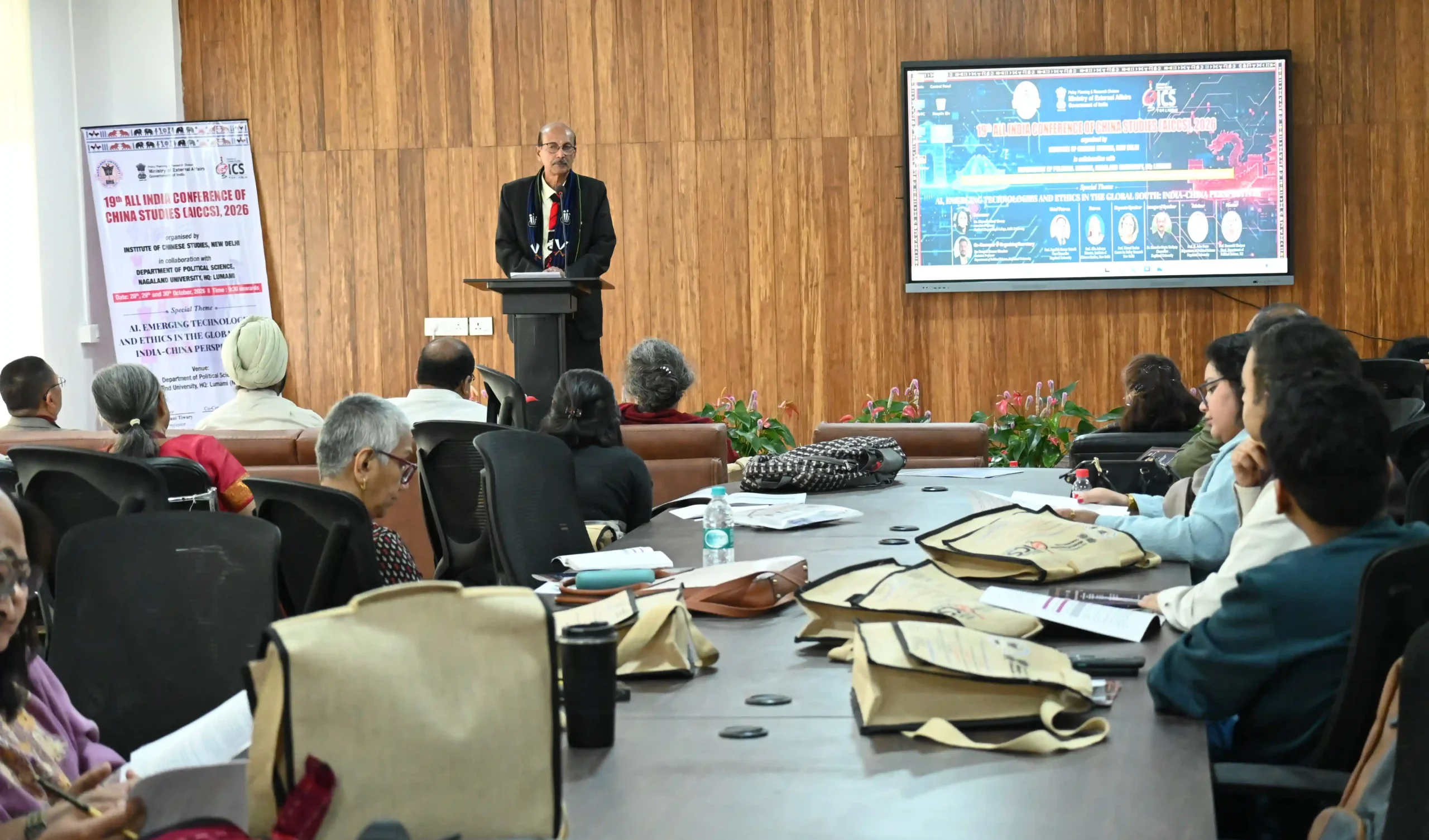
DIMAPUR, OCT 29 (NPN): The 19th All India Conference of Chinese Studies (AICCS) commenced at Nagaland University, Lumami, on October 28, bringing together scholars, researchers and practitioners to discuss contemporary China, India-China relations and the future of China Studies in India.
Jointly organised by the Institute of Chinese Studies (ICS), New Delhi and the Department of Political Science, Nagaland University, the three-day conference, scheduled from October 28 to 30, marks the conference’s farthest geographical reach in India to date. It aims to expand academic engagement with China and East Asia, particularly in the strategically significant North-East region.
The inaugural session, chaired by Prof. John Sema, featured addresses by Prof. Dasarathi Bhuiyan, Prof. Alka Acharya, Director of ICS, Lt. Col. Amardeep Singh Multani, representing the Ministry of External Affairs and Nagaland University Chancellor Dr. Samudra Gupta Kashyap. Speakers highlighted the importance of strengthening China Studies, sustaining diplomatic engagement amid strategic competition and integrating regional perspectives into academic discourse.
Delivering the keynote address, “Cartographies of the Cloud: New Maps, Old Dilemmas for the Global South,” Prof. Nimmi Kurian highlighted the material costs of artificial intelligence (AI), including resource extraction, water consumption, land use and physical labour. She connected global AI supply chains with the Naga Hills, placing North-East India within wider discussions on technology, development and environmental justice.
Special Panel I, “Current Discourses in Chinese Studies,” examined institutional, linguistic and research challenges in India. Samuel Sangtam, a research scholar at Nagaland University, called for “epistemic sovereignty” through stronger research infrastructure, Mandarin training, doctoral fellowships and theoretical frameworks grounded in India’s historical and political contexts. Nishit Kumar of Chanakya University traced the evolution of China Studies from its early focus on civilisation and language to security, economic engagement and contemporary concerns over technology and supply chains. He proposed a national consortium of universities and research bodies, dedicated faculty positions and improved archival access.
Other speakers highlighted gaps in Chinese language education, uneven implementation of the National Education Policy 2020 and the shortage of qualified faculty in North-East India.
They called for a coherent national policy, sustained funding, dedicated courses and multidisciplinary training. The panel also stressed that AI could assist research but could not replace human expertise.
Thematic Panel I, “China’s Political Economy: Environment, Energy and Regional Development,” explored energy transition, digital governance and the environmental costs of technological expansion. Prachi Aggarwal of the University of Delhi observed that China’s shift towards cleaner energy remained gradual, with coal continuing to play a significant role despite the growth of electric vehicles, batteries and solar power.
Saumya Soni of Jawaharlal Nehru University examined technology-driven governance in Zhejiang Province, highlighting the benefits of AI and big data alongside concerns over surveillance and data privacy. Mallika Bora of the University of Delhi discussed how tourism and global markets could commodify ethnic culture in Yunnan while reinforcing social inequalities.
Ana Sinha of FORE School of Management highlighted water stress and carbon-transition risks associated with semiconductor and AI infrastructure investments in India and China. She emphasised environmental sustainability, responsible water management and stronger impact assessments as essential to technological sovereignty.
Thematic Panel II, “State, Society and Governance in Contemporary China,” examined social change, youth aspirations and gender equality. Chairperson of ICS, Prof. Sreemati Chakrabarti, linked China’s contemporary development to the reforms of the 1970s and 1980s, which generated rapid growth and social transformation alongside regional disparities.
Prabir Kumar Talukdar of the University of Delhi discussed “Tang Ping,” or “lying flat,” arguing that young people’s withdrawal from intense competition reflected declining confidence in social mobility amid educational pressure, insecure employment and inequality.
Bidisha Seth of Visva-Bharati University examined the contradictions between China’s state-led feminism and restrictions on independent feminist activism. Rityusha Mani Tiwary and Saima Iqbal of Shaheed Bhagat Singh College compared women’s movements in China and India, highlighting differences in political space and institutional constraints.