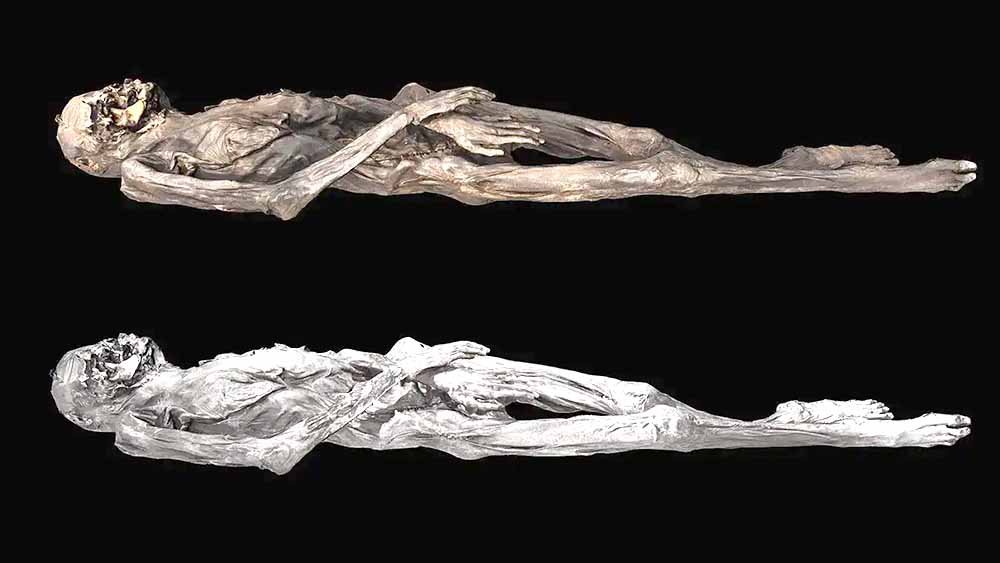
The scans revealed “intricate crisp and uniform” tattooing that could not be seen with the naked eye.
“The insights really drive home to me the point of how sophisticated these people were,” lead author Dr Gino Caspari from the Max Planck Institute of Geoanthropology and the University of Bern, told BBC News.
It is difficult to uncover detailed information about ancient social and cultural practices because most evidence is destroyed over time. It is even harder to get up close to the details of one person’s life.
The Pazyryk “ice mummies” were found inside ice tombs in the Altai mountains in Siberia in the 19th century, but it has been difficult to see the tattoos.
Now using near-infrared digital photography in the Hermitage Museum in St Petersburg, Russia experts have created high resolution scans of the decorations for the first time.
“This made me feel like we were much closer to seeing the people behind the art, how they worked and learned. The images came alive,” Dr Caspari said.
On her right forearm, the Pazyryk woman had an image of leopards around the head of a deer.
On the left arm, the mythical griffin creature with the body of a lion and the head and wings of an eagle appears to be fighting with a stag.
“Twisted hind bodies and really intense battle scenes of wild animals are typical of the culture,” Dr Caspari said.
But the woman also had a rooster on her thumb, showing “an intriguing style with a certain uniqueness,” says Dr Caspari.
The team worked with researcher Daniel Riday who reproduces ancient tattoo designs on his body using historical methods.
A ‘solid commitment’
His insights on the scans led them to conclude that the quality of the work differed between the two arms, suggesting that a different person made the tattoos or that mistakes were made.
“If I was guessing, it was probably four and half hours for the lower half of the right arm, and another five hours for the upper part,” he says.
“That’s a solid commitment from the person. Imagine sitting on the ground in the steppe where there’s wind blowing all that time,” he suggests.
“It would need to be performed by a person who knows health and safety, who knows the risks of what happens when the skin is punctured,” he adds.
By analysing the marks in the woman’s skin, the team believe that the tattoos were probably stencilled onto the skin before being tattooed.
They think a needle-like tool with small multiple points probably made from animal horn or bone was used, as well as a single point needle. The pigment was likely made from burnt plant material or soot.
Dr Caspari, who does not have tattoos himself, says the work sheds light on an ancient practice that is very important for a lot of people around the world today.
“And back in the day it was already a really professional practice where people put a lot of time and effort and practice into creating these images and they’re extremely sophisticated,” he adds.
Some of the tattoos appear to have been cut or damaged when the body was prepared for burial.
“It suggests that tattoos were really something for the living with meaning during life, but that they actually didn’t really play much of a role in the afterlife,” explains Dr Caspari. (BBC)