
The Naga Students’ Federation (NSF) commemorated the 40th NSF Martyrs’ Day at the NSF Martyrs Park Kohima on March 20.
The occasion marks the remembrance of late Kekuojalie Sachü of Kohima Village and Vikhozo Yhoshü of Kigwema Village, both from Kohima district, who lost their lives during a protest against the extension of the Disturbed Areas Act (DAA) and the introduction of the IPS cadre in Nagaland.
NSF President Mteisuding, in his speech, stated that the sacrifice of the two “fallen souls” continues to live on through the values and aspirations they instilled in future generations. He emphasized that their legacy is not limited to the past but remains a guiding force for both the present and the future.
He said that although they are no longer alive, their sacrifice has left a lasting impact, and it is now the responsibility of the present generation to carry forward the meaning and significance of what they stood for.
Highlighting the importance of the day, Mteisuding noted that it has been 40 years since the two individuals—aged only 19 and 14—laid down their lives, describing their actions as a powerful example of courage and commitment for the Naga community.
He further stated that the Naga people have not forgotten their sacrifice over the years. On the solemn occasion, the Federation extended its solidarity and support to the families of the martyrs, acknowledging their loss and honouring their resilience.
Recalling the historical background, he said the incident dates back to March 20, 1986, when the NSF had called upon the Naga people to protest against the Disturbed Areas Act at Alichen. The day remains etched in collective memory as a defining moment in the community’s history.
Describing the two as “great souls,” Mteisuding reaffirmed the Federation’s commitment to preserving their legacy and urged that their sacrifice should serve as an enduring example for younger generations, inspiring them to uphold the ideals of unity, resilience, and nationalism.
He added that their sacrifice should continue to be a source of hope, motivating the youth to carry forward the legacy they left behind. The president reiterated that the Federation will continue to remember and honor the martyrs, ensuring their contribution remains alive in the consciousness of the Naga people.
Meanwhile, Angami Students’ Union (ASU) President Diezevisie Nakhro expressed solidarity and paid tribute to the two young martyrs whose sacrifice continues to inspire the Naga community.
In his message, Nakhro recalled late Kekuojalie Sachü and Vikhozo Yhoshü, who laid down their lives in 1986. He called upon the people to honour their legacy of patriotism, unity, and justice, and to uphold the values they stood for in their struggle for Naga rights. He stated that the day marks the 40th Martyrs’ Day of the two fallen comrades and urged all to continue honouring their sacrifice while carrying forward their vision for unity and dignity among the people.
The ASU president also conveyed that the Union remains deeply indebted to the bereaved families, acknowledging their enduring loss and strength over the years. Recalling a recent initiative, Nakhro mentioned that on March 20 last year, marking the 25th NSF Martyrs’ Memorial Trophy, a trophy tour was launched across the Naga homeland to promote peace, unity, and oneness among the people. He appreciated the NSF for spearheading the initiative.
He further stated that the sacrifices of the martyrs should remind everyone to foster unity, justice, and dignity, and to strengthen the spirit of oneness among the people.
The programme also included a tribute to the martyrs, chaired by NSF Speaker Marikho-o Lerina, while the invocation was delivered by Dr. Chikhungo Puro, pastor of Chakhesang Baptist Church, Kohima, Kitsubozou.
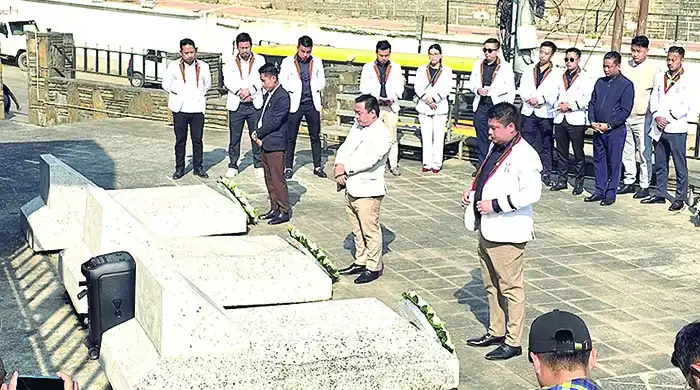
40th Naga Students’ Federation Martyrs’ Day observed
CorrespondentKOHIMA, MARCH 20 (NPN):