
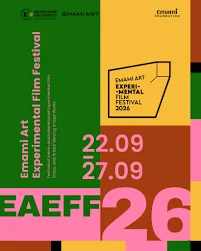
The fifth edition of the Emami Art Experimental Film Festival (EAEFF) has brought together more than 30 experimental films, videos, and moving image works by artists and filmmakers from 20 countries in the festival’s “most expansive programme to date”.
The festival, which started on Monday at Emami Art, features screenings, exhibitions, workshops, masterclasses, and conversations with filmmakers, artists, curators, and scholars.
According to the gallery, the open call received 1,657 submissions from 102 countries. The selection committee chose the Indian and international selections, with the jury selecting the award winners from the Indian section.
The official selection from India includes “A Circle as the Center of the Whole” by Utkarsh, “Saccharine Wonderland & Forces That Make Me Shiver” by Tushar Gidwani, “Koneya Bidiru (The Last Bamboo)” by Meera Krishnamurthy, “The Debris Remembers” by Prashant Chavan and Sara Athe, “Boudinet’s Curtain” by Maya.nk, and “Margherita” by Devadeep Gupta.
The international selection will feature films, including “Every Epoch Dreams the Next” by Johannes Gierlinger (Austria, Albania), “L’uomo Piu Bello Del Mondo” by Paolo Baiguera (Italy), “Possessed” by Sebastian Wiedemann and Daniel Cortés (Colombia), “The Othered Scene” by Wang-Yun Yen (Taiwan, The Netherlands), “Fissures” by Mike Rollo (Canada), and “Branches from Concrete” by Zhenyu Zhou (China, France).
The 2026 jury comprises Srikanth Srinivasan, Kamila Kuc, Mark Williams and Emmanuel Lefrant, who will select two Rs 50,000 awards from the Indian Official Selection.
Sayanth R S, lead curator and programmer of EAEFF, said that the festival this year has introduced three new programmes — Moving Image Exhibition, Students’ Experimental Cinema and Festival-to-Festival — while the official selection “similarly reflects the extraordinary formal and conceptual diversity of experimental film today”.
“The films move across diary and autobiographical cinema, thermochemical processes, flicker and structural practices, hybrid documentary, desktop cinema, experimental animation, photofilm, essay film and other forms that resist stable categorisation.
“The Students’ Experimental Cinema programme is an extension of the commitment to keeping the space open to emerging voices and new ways of thinking through images. It is important for us that the programs remain connected to pedagogical and collective spaces, where young filmmakers can encounter diverse histories of avant-garde film, video art and artists’ cinema while also questioning those histories and producing new ones,” he said in a statement.
The ‘Festival-to-Festival’ programme creates a space for dialogue between EAEFF and other institutions and communities working with experimental moving images, “allowing films to travel across contexts and generating conversations that exceed geographical and institutional boundaries”.
The festival also brings together four invited programmes, including a selection of films from the collection of Light Cone, Paris, guest-curated by director Emmanuel Lefrant; Kyoto Art Center presents works by five Japanese artists, with a reciprocal programme of Indian work travelling to Kyoto in 2027; “School’s Out Forever: No More Teachers’ Dirty Looks”, guest-curated by artist and University of Pittsburgh faculty member Tony Balko, presents work from the city’s experimental film community; and Circuit, New Zealand, presents a screening programme that examines the institutional history of the moving-image agency.The festival will come to an end on September 27. (PTI)