
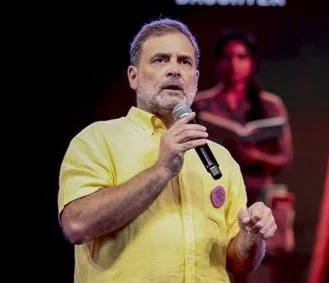
PUNE, AUG 23 (PTI): Violence is used in society to prevent women, the country’s biggest asset, from progressing and 80 per cent of them face harassment, senior Congress leader Rahul Gandhi has said.
The women should stand for themselves and believe in themselves, the Leader of Opposition in the Lok Sabha said at his party’s youth outreach programme ‘Chhatron Ki Goonj’ in Pune on Saturday.
Students interacting with Gandhi highlighted how sexual harassment, concerns over personal safety, lack of safe public transport and financial constraints continue to affect women’s access to education and economic independence.
The Congress MP listed “three forms of violence against women — physical violence, violence through denial of opportunities, economic violence”.
Nearly 4.5 lakh female foeticides take place every year, 80 per cent of women encounter harassment, 29 per cent endure physical violence and 6 per cent face rape, he said, claiming that 99 per cent of incidents of sexual violence are not reported because of fear of social stigma. About 50 per cent of women are denied opportunities for education or employment in the name of safety. Women have to spend an additional Rs 17,500 every year in the name of safe travel, Gandhi said.
Women face restrictions in several ways, he said, claiming that 60 per cent of them cannot go outside their homes alone.
“A boy is allowed to go out anytime and can come late, but you girls have to come back by 8 pm. Boys can go for any exams multiple times, but for girls, they get only one attempt. They are told it is their marriage time and no need to go for the exam,” he said.
While 45 per cent of women have to leave education or work because of marriage or household responsibilities, only 8 per cent own land, he stated.
Highlighting disparity in households, Gandhi said women in the age group of 15 to 29 work 5.5 hours at home, while in the same house, boys work only 30 minutes.
As many as 84 per cent of women need their family’s permission to take up employment, he said, adding that women earn 25 per cent less than men and do not get promotions easily.
Suchitra Pagi, an economics student from Vasai in Maharashtra’s Palghar district, recounted incidents of harassment she faced as a 13-year-old while walking home from school and later while travelling on public transport.
She said the experiences instilled a fear of men in her, but stressed that not all men are the same and urged people to intervene when they witness a woman being harassed.
Pagi also appealed to women and men to support victims instead of remaining silent spectators.
Another student, Maitri, studying psychology in Pune, said safety concerns can become a barrier to education, particularly for girls from rural areas.
She said parents in villages often hesitate to send their daughters outside for higher education because of safety concerns, and instead prefer to educate their sons.
Maitri attributed this mindset partly to social norms that assume sons will support their parents financially while daughters will marry and leave the family.
Pradnya Gavande, a second-year BSc student of cyber and digital science, highlighted the financial barriers to pursuing specialised courses such as cyber security.
She mentioned that reputed colleges charge around Rs 3 lakh for such courses, which is difficult for students from financially weaker families to afford.
Gavande, who also works part-time, sought greater availability of cyber security courses in government colleges and scholarships for students.
She also spoke about the growing misuse of artificial intelligence to create obscene images of women and extort money from them, stressing the need for stronger cyber security awareness and skills.
The students also raised concerns over women’s safety in public transport, saying they often feel unsafe both in crowded buses, where there is a fear of harassment or inappropriate touching, and in empty buses, where they fear being alone with men.
Ensuring safe mobility, affordable education and freedom from harassment was essential if women were to have equal opportunities, they noted.
Rahul’s Pune event a ‘political comedy show’: BJP
MUMBAI, AUG 23 (PTI): BJP Maharashtra vice-president Keshav Upadhye on Sunday termed Congress leader Rahul Gandhi’s student interaction in Pune a “political comedy show” and accused him of making political statements instead of addressing issues concerning students.
Upadhye, however, in a statement, claimed there was a contradiction between the Congress MP’s statements and the party’s past actions.
The BJP leader also claimed that students were brought in college buses to attend the programme and accused the Congress of turning the event into a political gathering in the name of students.
“Rahul Gandhi’s Pune event was yet another political comedy show,” he said, claiming that the Congress leader’s speech was full of “big statements and familiar allegations” but failed to address the Congress’ own record.
Upadhye questioned the Congress’ stand on women’s reservation and alleged that the party had opposed the candidature of tribal leader Droupadi Murmu for the post of President of India and the law against triple talaq.
“While searching for Manuwad, the Congress should first look in the mirror,” he said.
The Congress was unable to counter the development work of the Narendra Modi government and was therefore trying to raise issues of caste and religion, he claimed.
“Frustration over losing power, anger over electoral defeats and fear of Modi have together resulted in this so-called comedy show by Rahul Gandhi,” Upadhye charged.
While people were “laughing”, the Congress was still trying to find reasons for its electoral defeats, he added.
Sawant hit back, saying the BJP was unsettled by the strong response to Rahul Gandhi’s ‘Chhatron Ki Goonj’ event and had lost sleep over his rising appeal among the youth.
On Maharashtra Chief Minister Devendra Fadnavis’ proposed interaction with Gen Z members later on Sunday in Nagpur, Sawant alleged that the government had “trampled their hopes, aspirations, dreams and future” and wondered whether the session will have preaching about patriarchal values.
“Perhaps the chief minister will tell them about the importance of Manusmriti, that the patriarchal system is good, and that the RSS and VHP will decide what women should wear, say and how they should behave,” the Congress leader charged in a statement.
He also took a swipe at Fadnavis’ “Youth Icon” image, saying merely claiming the title does not make one a youth icon.
Sawant claimed that the BJP had been alarmed by the “unprecedented response” to Gandhi’s interaction with students in Pune.
“Despite shutting down the metro, imposing several restrictions and resorting to hooliganism, a huge number of young women turned up,” he stated.
“This has shaken the BJP and it appears that Prime Minister Narendra Modi, Union Home Minister Amit Shah and Fadnavis have lost sleep. But this fear is good,” Sawant said.