
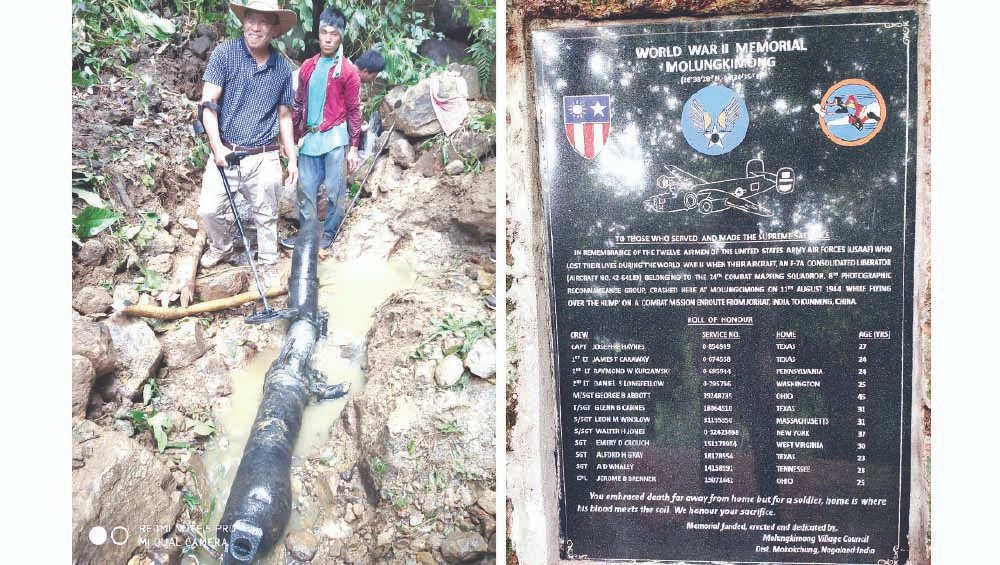
On August 11, 1944 during World War II, an American F-7A Liberator aircraft carrying 12 United States Army Air Forces (USAAF) service members exploded above Molungkimong village under Mokokchung district, killing all on board.
On Monday, August 11, 2025 Molungkimong village held a memorial service to honour the crew of the ill-fated Liberator marking the 81st Anniversary at the Molungkimong WWII Memorial Museum.
In his article, Alan Starcher, broadcast journalist in the US, who has been researching the WWII activities of the US Army Air Force in China and India for over ten years, recalled that many an American airman owed their lives to the native people of Nagaland, who worked with search and rescue squads to locate and recover lost or injured airmen. “My uncle, 1st Lt. Kenneth Starcher, a B-24 Liberator pilot serving with Gen. Claire Chennault’s 14th Air Force ‘Flying Tigers,’ was one of them–but that is another story for another day,” he stated.
Starcher’s article titled “Remembering the ‘Forgotten Theatre’ of WWII: Nagaland pays tribute to Fallen USAAF Crew”, noted that many have called the China-Burma-India Theatre the “Forgotten Theatre” of World War II, but for those who served in this part of the world, the memories would never fade.
He stated the China-Burma-India Theatre did not receive the extensive, sometimes glamorous coverage afforded the war in Europe, nor did the war fighters receive the latest and best equipment with which to battle the invading Japanese.
However, Starcher contended that the Theatre was of critical importance in the war against the Empire of Japan’s aggression. He said the purpose of basing operations in India was to support and supply the Allied effort assisting China in fending off the Imperial Japanese Army. Starcher said opening of a “second front” forced Japan’s military commanders to commit large numbers of troops, aircraft and equipment to the war in China.
Despite the Allied efforts, Starcher pointed out that the Japanese in 1942 were able to cut off the main overland supply corridor, the Burma Road, which stretched between Lashio and Kunming.
Yet, he said the Allied success in holding India gave their armed forces a base of supply and operations from which to prosecute the war against the Japanese in Asia.
Starcher pointed out that the airfields hastily constructed in northeast India restored a vital link to move men and material to bases in China. Starcher also stated that Aircraft had to regularly fly over some of the most inhospitable territory on Earth —the Himalayan Mountain range containing the tallest mountains on the planet. “It was a dangerous, but necessary, task; the loss of numerous aircraft and their crews was the high price paid to keep this vital supply line open,” Starcher noted.
He said the route became known as “the Aluminum Trail” due to the wreckage of hundreds of lost planes scattered along its path which could be seen when flying the route.
He said that since precise navigation was hampered by years-old maps, which were often outdated or even plainly wrong, the US Army Air Force was tasked with the important mission of accurately mapping the theatre.
“One such mission came to a tragic end in the skies above the village of Molungkimong on August 11, 1944, when an American F-7A Liberator photographic aircraft exploded and crashed, killing all of the twelve Americans aboard,” Starcher stated.
However, he thanked the people of the Molungkimong village and surrounding area, adding that their sacrifice — and the deaths of hundreds of Allied airmen who lost their lives in the CBI — would be remembered.
The memorial service included prayers, storytelling by one of the last remaining eyewitnesses, and a moment of silence in tribute to the twelve airmen.
The author noted that the memorial service along with the museum’s exhibits served as a poignant reminder of the courage and the ultimate sacrifice made by the twelve airmen while highlighting the enduring importance of preserving Nagaland’s WWII history for future generations.