
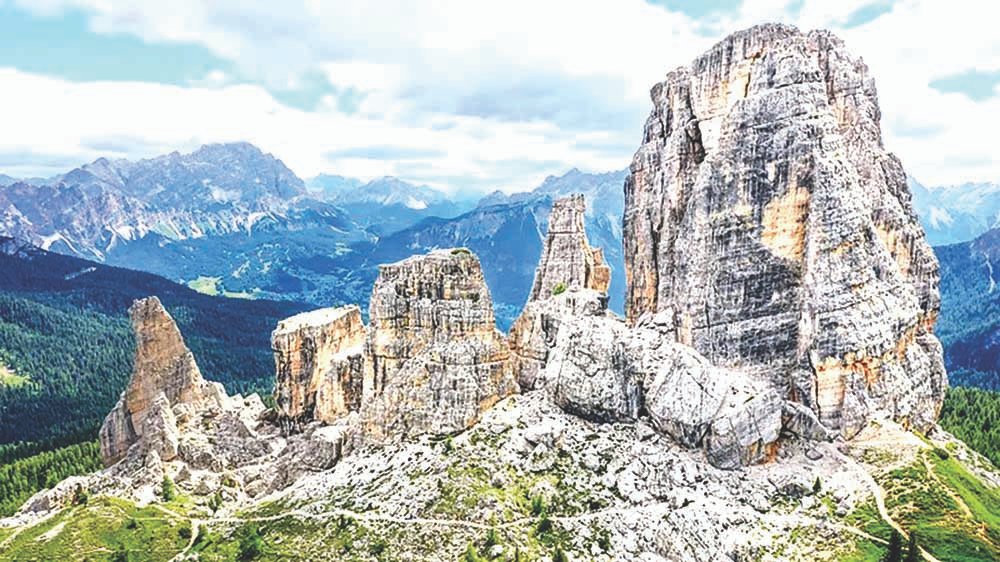
When one of Italy’s much-loved Five Towers toppled, it seemed a rare, exceptional event. In fact, throughout this stunning mountain range, peaks are crumbling.
True to its name, the Five Towers – a small, iconic mountain range in the Dolomites (Eastern Italian Alps) – resembled five stone fingers spreading up towards the sky. One night between 4 and 7 June 2004, one of them, the Trephor Tower, came down. The Rifugio Scoiattoli – a chalet so close by that patrons can easily stroll to touch the rocks even after eating too much polenta – hadn’t opened for the summer season yet, so no one heard a thing. One morning, they saw the Trephor, a monolith of more than 10,000 cubic metres – the size of the leaning Tower of Pisa without the bells and the tourists – lying down horizontally.
Today, Antonio Galgaro, an associate professor of geosciences at the University of Padua, believes he can predict which tower will be next. “It’s like a panettone divided in four slices. This one,” says Galgaro, indicating one of the peaks on an aerial picture, “will start to detach from the main block and rotate, until it comes down”. The English Tower already shows an evident diagonal crack where the rock is likely to break and slide down, like a child on a banister.
Through the summer of 2025, news of landslides interrupting the main road in the region that will host the next Winter Olympics has dropped nearly every week. On 15 June, Francesco Accardo, a local resident who lives about 20m [65ft] from the gully of Mount Antelao, saw “rocks as big as cars flying down the ravine, bouncing and rebounding”.
About two hours out of Venice, the Unesco Natural Heritage Site of the Dolomites is widely regarded as the most stunning mountain range in Italy and one of the most attractive in the world. As an Italian who spent most of my childhood holidays in the area, over the past few months I’ve found myself wondering whether the entire Dolomites are coming down. If they are, can we do anything about it? Since the Trephor fell, many significant collapses have been recorded in the Dolomites. To note some of the most spectacular ones reported by local press: the Grand Vernel (2015), Piccola Croda Rossa (2015 and 2016), Cima Lastei (2016), Carè Alto (2018), Croda Marcora (2021 and 2025), and Sassolungo and Cima Tosa (2023). Videos and photos show big chunks of mountain coming down, pinnacles toppling, and debris flows rolling down the slope like rocky rivers.
Falling is in the nature of these dramatic mountains. The Dolomites were once ancient tropical atolls in the deep ocean that rose up when the European and African tectonic plates collided hundreds of millions of years ago. Underneath the dolomia stone, there is a soft layer of clay.
“It has the consistency of Das,” Galgaro says, referring to an artificial playdough popular in Italy in the 1980s, similar to a malleable grey terracotta.
Let’s take the Five Towers as a case study.
The rock monoliths both tilt and rotate under the force of gravity as they settle on the soft clay below. The result is visible from above. “It looks like a flower, each tower slightly inclined outwards,” says Galgaro.
Once one side of a tower sinks a bit deeper than the other side, it creates a diagonal crack, along which the rock eventually breaks, slides down and falls.
That’s how the steep Dolomites landscape took its shape – big pieces of rock fell, leaving spires looking like a villain’s castle in a Disney movie. The debris created gravelly slopes. (BBC)
In Belluno alone, the largest of the five Dolomites provinces, 6,133 significant landslides interrupting traffic and affecting villages have been recorded since the Middle Ages. Of course, many more events might have been forgotten, not recorded, or otherwise fallen through the cracks of history. Because of this incomplete record, it is not easy for scientists to be sure whether or not large rockfalls are increasing rapidly in recent times.
Still, even though erosion is natural, primeval and inevitable, there is now a general feeling of acceleration among locals and experts, and only partly because of the media attention drawn to the area ahead of the 2026 Winter Olympics. “Every mountain guide will tell you that, in fact, you feel like you are walking on something much more fragile than before,” says Crosta.