
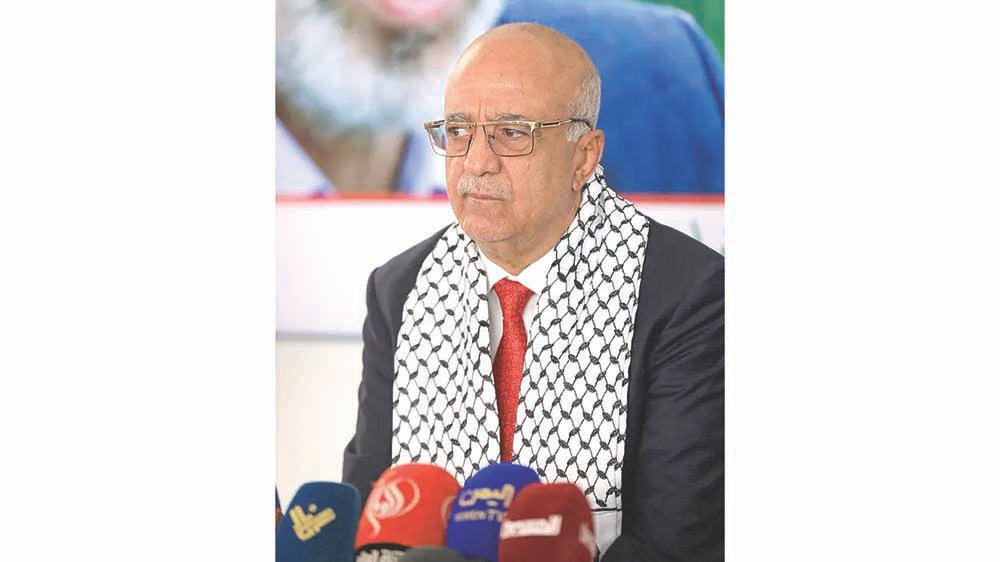
An Israeli airstrike has killed the prime minister of the Houthi rebel-led government in Sana’a, the capital city of Yemen, reports quoting the Houthis have said, noting that the latter has vowed vengeance.
He was the most senior Houthi official killed in the Israeli-US campaign against the Iranian-backed rebels.
Ahmed al-Rahawi was killed in Thursday’s strike in Sanaa along with a number of ministers, the rebels said in a statement on Saturday. Other ministers and officials were wounded, the statement added without providing details. The premier was targeted along with other members of his Houthi-controlled government during a “routine workshop held by the government to evaluate its activities and performance over the past year,” the Houthi statement said. Thursday’s strike took place as the rebel-owned television station was broadcasting a speech by Abdul Malik al-Houthi, the secretive leader of the rebel group, in which he was sharing updates on the latest Gaza developments and vowing retaliation against Israel. Senior Houthi officials used to gather to watch al-Houthi’s prerecorded speeches.
Al-Rahawi wasn’t part of the inner circle around al-Houthi that runs the military and strategic affairs of the group. His government, like the previous ones, was tasked with running the day-to-day civilian affairs in Sanaa and other Houthi-held areas.
The strike that killed the prime minister targeted a meeting for Houthi leaders in a villa in Beit Baws, an ancient village in southern Sanaa, three tribal leaders told The Associated Press. They spoke on condition of anonymity because they feared repercussions. Late on Saturday, the military in a statement confirmed killing al-Rahawi “along with additional senior officials.”
Hamas confirms death of Gaza chief: Months after Israel’s claim, the Palestinian militant group Hamas has formally confirmed the death of its Gaza military commander, Mohammad Sinwar. The confirmation follows Israel’s announcement in May that Sinwar had been killed during a targeted strike.
Hamas, while refraining from providing specific details on the circumstances of his death, released images of Sinwar alongside other slain leaders, referring to him as a “martyr”.
In the wake of his death, leadership of Hamas’ armed wing is expected to shift to Izz al-Din Haddad, who currently oversees operations in northern Gaza.
Mohammad Sinwar was the younger brother of Yahya Sinwar, the former Hamas chief in Gaza and one of the principal architects of the October 7 attacks on southern Israel.
Along with his role as Gaza’s military commander, he had been serving as the seventh leader of the Izz al-Din al-Qassam Brigades since July 2024.
Yahya Sinwar himself was killed in 2024 during an Israeli military operation in Gaza, after which his stature within Hamas ranks had grown significantly.
Mohammad Sinwar, meanwhile, was long known as a key figure in Hamas’ militant operations, playing a crucial role in the 2006 abduction of Israeli soldier Gilad Shalit.
Shalit was held captive until 2011, when he was freed in a prisoner exchange deal that included the release of Yahya Sinwar.
Throughout his militant career, Mohammad Sinwar survived multiple assassination attempts, most of them carried out by Israel. He was first targeted in 2000 during the Second Intifada, followed by attempts in 2006 and 2008.
During the 2014 Gaza conflict, Hamas even staged his death to conceal his whereabouts. For years afterwards, Israeli intelligence agencies operated under the belief that he had been killed, until they later uncovered evidence proving otherwise.
Earlier in May this year, the Israel Defense Forces (IDF) and Shin Bet launched a precision strike in southern Gaza, specifically targeting Sinwar.
Reports indicated that bunker-busting munitions were deployed to destroy underground exits beneath the European hospital, where Sinwar was believed to be hiding.
Weeks after the strike, Israeli Prime Minister Benjamin Netanyahu publicly declared that Sinwar had indeed been eliminated.
Announcing the development, Netanyahu stated, “We eliminated tens of thousands of terrorists, Mohammad Deif, Hassan Nasrallah, Yahya Sinwar.”