
In a major step toward preserving and promoting indigenous linguistic heritage, Nagaland University (NU), in collaboration with the Directorate of School Education, Government of Nagaland, has launched a pioneering initiative to develop written grammar for all 18 state-recognised Naga languages. The project aims to incorporate structured pedagogical grammars into school textbooks for Classes 5 to 12, in alignment with the National Education Policy (NEP) 2020.
A press release issued by NU highlighted that while Naga languages have been taught in schools for decades, none have had dedicated written grammars to support the teaching-learning process. The initiative seeks to fill this gap by systematically documenting grammatical components such as parts of speech, tense and aspect, phrase and clause structures, tone, and orthography. It also aims to enrich vocabulary and standardize usage across educational materials.
Vice Chancellor of NU, Prof. Jagadish K. Patnaik, described the initiative as a cultural mission rather than a purely academic exercise. “This endeavour seeks to preserve, strengthen, and promote the linguistic heritage of our people,” he stated, adding that the project reflects the university’s commitment to community development and the vision of NEP 2020, which emphasizes education in the mother tongue and the preservation of India’s linguistic diversity.
The initiative is being led by associate professor and Head of the Department of Tenyidie at NU Dr. Mimi Kevichüsa Ezung. She emphasized the importance of grammar in language development, noting that vocabulary and grammar are the two foundational components of any language. “A written grammar is a formal representation of the abstract properties of a language,” she said, adding that the effort is crucial for standardization and fostering pride in one’s mother tongue.
Dr. Ezung further stated that the initiative goes beyond textbook development, it is about preserving identity, culture, and indigenous knowledge. With many Naga languages undergoing standardization, the creation of pedagogical grammars will ensure consistency in both written and spoken forms.
The grammar resources developed under this initiative will be integrated into school textbooks alongside prose, poetry, and translation materials. The State Council of Educational Research and Training (SCERT) and the Nagaland Board of School Education (NBSE) will oversee curriculum integration, while teacher training programmes including refresher courses hosted by NU are planned to support classroom implementation.
The project is collaborative in nature, involving multiple stakeholders. Language Literature Boards will assist in selecting standardized language varieties, coining new terms, and overseeing textbooks for Classes 9 to 12. The State Centre of Naga Languages (SCNL), under the Directorate of School Education, will develop textbooks for Classes 1 to 8 and coordinate translation, proofreading, and final approvals with the Literature Boards. SCERT and NBSE will ensure the grammar content is embedded within the official curriculum.
Technical workshops hosted by NU’s Department of Tenyidie are already underway, equipping language officers under SCNL with tools to translate and document grammatical categories in their respective languages.
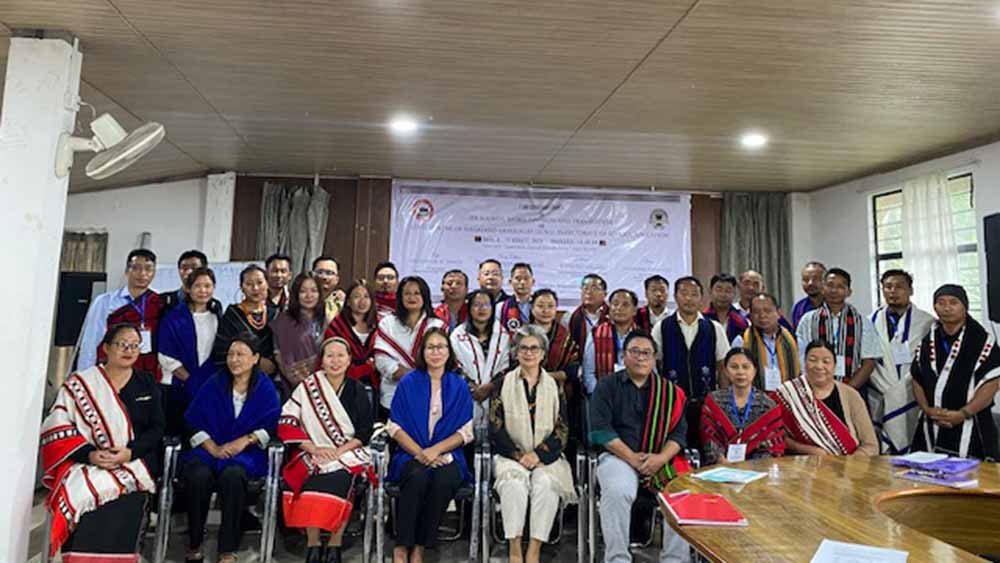
NU leads to develop grammar for 18 Naga languages
DIMAPUR