
State Council of Educational Research and Training (SCERT), Nagaland, in collaboration with PARAKH, organised a one-day dissemination workshop on the Post PARAKH Rashtriya Sarvekshan (PRS) 2024 at SIEMAT Hall, SCERT, Kohima on Friday.
According to a DIPR report, additional director SCERT, T. Lima Longkumer, in his address, described education as the foundation of progress and said the survey offers critical insights into learning levels, teaching practices, school environments and the challenges shaping the future of children. He informed that the survey assessed students of Grades 3, 6 and 9 in language, mathematics, science and social sciences, while also examining teacher preparedness, infrastructure and community participation.
Longkumer noted that the results reflect both strengths and areas requiring greater attention. Students in Nagaland showed encouraging performance in language and certain social science competencies, but learning gaps persist in mathematics and science, particularly at the middle stage. He emphasized the need for stronger skill education, enhanced teacher development, greater integration of technology, inclusive practices and a safe, supportive school environment.
“These findings are not mere statistics but a call to action,” Longkumer said, urging all stakeholders to ensure that every child in Nagaland receives quality education that nurtures potential, builds confidence and prepares them for the future. He acknowledged the dedication of teachers, master trainers, school leaders, officials and community stakeholders who contributed to the successful completion of the survey.
Calling for collective effort, Longkumer appealed for the insights to be translated into concrete actions. “Together, we can bridge learning gaps, strengthen our education system and make schools places where every learner thrives,” he said. He further called upon all stakeholders to work in unity towards realizing the vision of the National Education Policy (NEP) 2020—an inclusive, equitable and competency-based education system for the children of Nagaland.
Delivering the keynote address, Head and CEO of PARAKH, NCERT, Prof. Indrani Bhaduri described PRS as a robust national survey designed to generate evidence on students’ learning competencies aligned with NEP 2020. She said PRS goes beyond national and state averages by offering granular district-level data, enabling states to prepare targeted District Action Plans embedded within the Competency-Based Assessment Framework and implemented through the Holistic Progress Card.
Prof. Bhaduri highlighted that the survey, conducted in Grades 3, 6 and 9, is complemented by contextual data from student, teacher and school questionnaires, resulting in a comprehensive dashboard of indicators. These include district-level performance in key competencies, intra-district variations and links between learning outcomes and contextual drivers such as teacher preparedness, instructional practices, resources and student engagement.
She said the findings reveal learning gaps and disparities across districts and subgroups by gender, social category, school type and location, helping states identify districts that require greater support. Prof. Bhaduri emphasized that PRS establishes a baseline for monitoring progress in future cycles and urged states to use the insights for equitable resource allocation, focused remediation and district-specific interventions.
Describing PRS as a transformative shift in how learning is assessed and improved at both classroom and system levels, she said the integration holds promise for achieving equitable and high-quality learning outcomes across India’s diverse educational landscape. Prof. Bhaduri concluded by extending her best wishes to states in implementing post-PRS educational plans with commitment and vision.
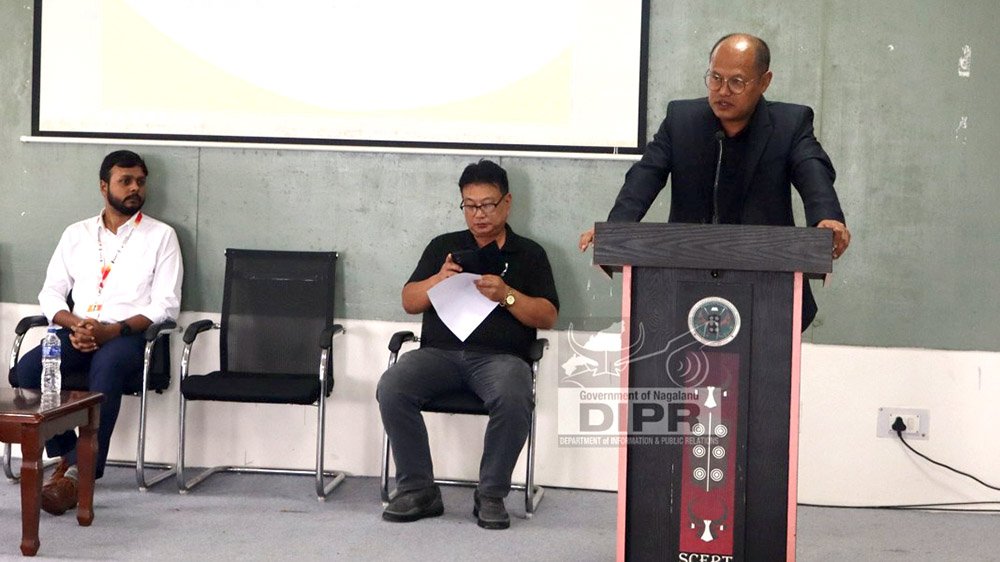
Workshop on Post-PARAKH survey findings
DIMAPUR