
Assam-based People’s Party founder Daniel Langthasa, who is set to be part of a newly announced pan-Northeast political entity, has said that issues concerning the region have long been ignored and that the voices of its people remain insignificant in Parliament due to limited representation, despite past alliances between regional and national parties.
Langthasa recently joined hands with Meghalaya chief minister and National People’s Party (NPP) president Conrad Sangma, TIPRA Motha chief Pradyot Manikya, and former BJP spokesperson Mmhonlumo Kikon to unveil the new regional political platform, a move that has stirred political reactions across the Northeast.
A musician-turned-activist and now politician from Assam’s Dima Hasao district, Langthasa has been vocal on matters of illegal mining, illegal immigration, and land rights of tribal communities in the Sixth Schedule area governed by the North Cachar Hills Autonomous Council.
Speaking to PTI, he said that for decades issues of the Northeast had been overlooked. “Alliances have been made, like the North-East Democratic Alliance (NEDA) under the BJP and during the Congress too,” he said, but added that regional voices continue to be unheard because each state sends only a few MPs to Parliament.
Pointing to a political trend in the region, he said parties in the Northeast often align with whichever party is in power at the Centre. “Before the BJP came to power in 2014, there was no footprint at all of the BJP in the Northeast. Suddenly, within a couple of years, all states were either ruled by the BJP or their allies,” he said. This, he stated, underlined the need for a new, unified political entity rather than another alliance.
On land rights in Dima Hasao, Langthasa said tribals have been wrongly portrayed as being anti-development. Referring to recent attempts to allocate land to a cement company “against the wishes of locals”, he said tribal resistance was rooted in protecting land, not opposing progress. While acknowledging that mining and minerals were essential, he said state and central governments often ignored norms laid out under the Sixth Schedule.
He said Dima Hasao’s population was around two lakh, of which 1.2–1.3 lakh were tribals, and traditional systems of land ownership—where land is communally held and shifting cultivation is practiced—were being undermined. He alleged that common village land was being reclassified as “council khas land”, enabling the Autonomous Council to sell it to private companies without the consent of the people.
Citing a Gauhati High Court observation earlier this year expressing shock over the Assam government’s allotment of nearly 3,000 bighas of land to a private cement firm in Dima Hasao, he said villagers were fighting the case, and alleged that locals resisting the move had been threatened by council members and armed groups. He also criticised the allocation of around 9,000 bighas for limestone mining in Umrangso, calling it an ecologically fragile area and an important winter roosting site for the endangered Amur falcon.
Asked about possible political impact ahead of next year’s assembly polls, Langthasa said dissatisfaction was rising on issues of land, illegal migration from neighbouring countries such as Bangladesh, Myanmar and Nepal, and rising migration from other Indian states. “We are not against anyone, but for our own survival. Our numbers are less, and we will be eradicated in a few years,” he warned. “If the government does not take it seriously, there will be serious repercussions.”
On the detention of climate activist Sonam Wangchuk under the National Security Act (NSA), he called for Wangchuk’s immediate release, saying the demand for Sixth Schedule status for Ladakh was “genuine”. Describing the allegations against Wangchuk as “very unfortunate”, he said Ladakh, being a border region, would be strengthened by Sixth Schedule protections. “At the end of the day, you cannot fight bigger battles without having the locals on your side,” he said, adding that the Northeast’s own history demonstrated this.
Langthasa said he had earlier told Wangchuk that the Sixth Schedule, though important, “is not the gold standard of protection” as often assumed.
Wangchuk was detained on September 26 under the NSA, two days after violent protests in Ladakh left four dead and 90 injured. The law allows detention for up to 12 months to prevent actions deemed “prejudicial to the defence of India”.
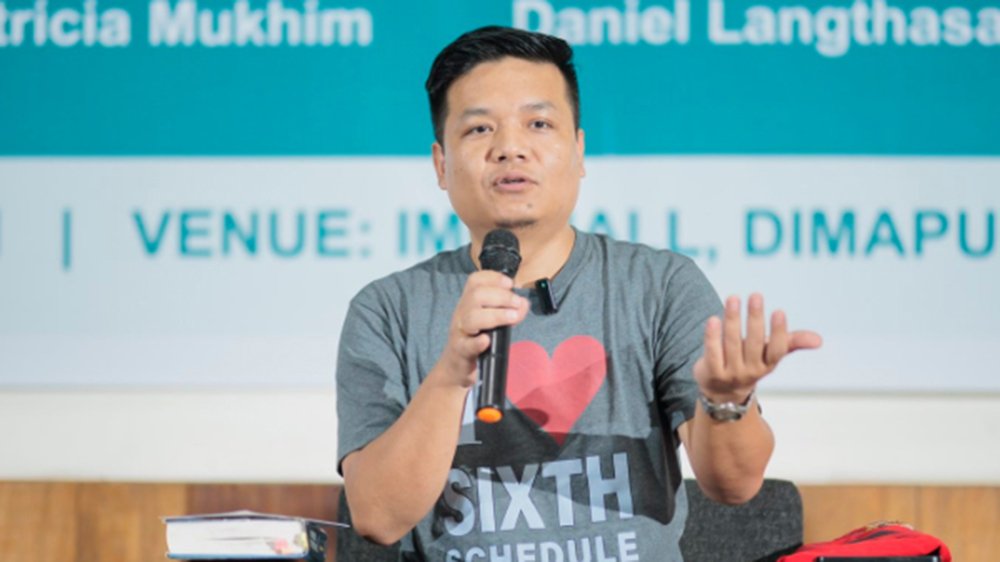
NE ignored despite ties with national parties, says Daniel Langthasa
NEW DELHI, NOV 9 (PTI)