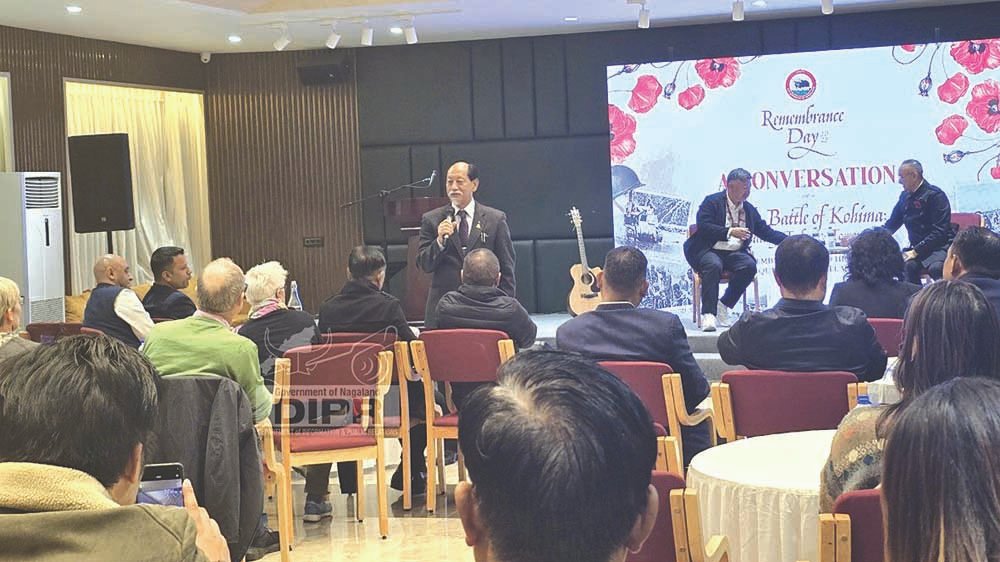
Marking Remembrance Day, the State government, in collaboration with the Commonwealth War Graves Commission (CWGC), organised a commemorative event titled “A Conversation on the Battle of Kohima: Yesterday, Today and Tomorrow” at Hotel Vivor, Kohima.
According to DIPR, State chief minister Dr. Neiphiu Rio graced the programme and felicitated the evening’s guests– Bhaarat Dave, Deputy Chief of Mission, British Deputy High Commission; Sophie Rogan, Second Secretary, Embassy of Ireland; Amit Sengupta, Head of Press and Media, British High Commission; and Arnab Banerjee, Culture Attaché, Irish Embassy.
Sharing a personal anecdote, Rio recalled his mother’s recollection of British soldiers staying in their village during the war and giving chocolates to young boys and girls who fetched water. He also mentioned that his father had served in the Assam Regiment under the British and had received the King George medal after independence. “Our elders always remembered the British as generous and kind,” he said.
The main highlight of the evening was a conversation between advisor to chief minister and chairman of IDAN, Abu Metha, and politician, scholar and author, Mmhonlumo Kikon, whose book “His Majesty’s Headhunters: The Siege of Kohima That Shaped World History” revisits the battle in depth. The discussion reflected on the history of the Battle of Kohima and its relevance for present and future generations.
Mmhonlumo observed that while the Nagas come from a rich oral tradition, few written records exist about the Battle of Kohima. “This is the beginning of telling our stories, of how and why the battle happened, and what our people went through,” he said. He acknowledged Charles Pawsey, then Deputy Commissioner of Naga Hills, and highlighted the humanitarian role played by the Nagas during the war. “The Nagas’ support was not political but human. The Japanese lost the goodwill of the people when they began taking food by force,” he added.
A participant from England, grandchild of a British army engineer who helped build the Naga Hospital during the war, also shared memories that bridged past and present generations.
Reflecting on reconciliation, Kikon noted how former enemies had become friends, pointing to earlier peace exchanges between the British High Commission and the Japanese Embassy in Kohima. He said Japanese teams still visit the Naga Hills to search for the remains of their fallen soldiers. “The story of Kohima has evolved into one of reconciliation and peace,” he remarked.
The event was attended by officials from the British Deputy High Commission, Embassy of Ireland, British High Commission, Irish Embassy, scholars, researchers, and government representatives. (DIPR)