
A one-day workshop on “Building a Child-Friendly Media” was conducted on Saturday at Hotel Saramati, Dimapur, jointly organised by the Nagaland State Commission for Protection of Child Rights (NSCPCR) and the Dimapur Press Club (DPC). The programme aimed to strengthen ethical and legal understanding among journalists regarding responsible reporting on child-related issues.
Delivering the main address on the theme “Building a Child-Friendly Media vis-à-vis Roles and Responsibilities of Media in Relation to Child Rights,” Special Public Prosecutor of the Fast-Track Special Court (FTSC) Dimapur, Imlimongla, called upon media professionals to recognise the profound responsibility they carry when reporting on children. She said the duty to build a child-friendly media “rests upon the very light carried by the press,” adding that the sensitivity and accuracy with which stories involving minors are reported reflect the maturity of society itself.
She reminded journalists that “words heal and words wound,” stressing that a single headline, photograph or social media post has the power to either uphold a child’s dignity or damage it irreversibly. This responsibility, she said, is rooted in the robust legal and constitutional framework that protects children in India. She underscored that India, home to the world’s largest child population, reaffirmed its commitment to protecting children when it ratified the United Nations Convention on the Rights of the Child (UNCRC).
Imlimongla further highlighted how the Constitution safeguards child rights through Article 14 (right to equality), Article 15(3) (special provisions for children), Article 21 (right to life, dignity and privacy) and Article 39(f) (protection of childhood from exploitation). These principles, she said, guide not just the justice system but also the media.
She cautioned that the modern media climate, dominated by speed, sensationalism and digital competition, often pushes journalists to rush stories without verifying facts. Such haste, she said, can cause irreparable harm when children are involved. “Even a single careless disclosure can scar a child for life,” she warned, urging media houses to prioritise ethical judgement over the pressure of breaking news.
Imlimongla outlined the legal obligations governing media reporting on minors, emphasising that the POCSO Act mandates reporting of child sexual offences and restricts any disclosure that could identify a child. She noted that the Juvenile Justice Act similarly prohibits revealing the identities of children in conflict with the law and requires the use of non-stigmatizing terminology. Guidelines from NCPCR and NHRC were highlighted for urging the media to avoid sensationalism and prioritise child welfare, while constitutional free speech protections remain subject to restrictions meant to safeguard minors.
Addressing digital-era challenges, she cautioned that viral content can cause lasting harm and stressed that online platforms must preserve evidence and report child sexual abuse material. Provisions under the Bharatiya Nyaya Sanhita were cited as relevant when irresponsible reporting damages children or families.
NSCPCR chairman Alun Hangsing underscored the media’s influence on public understanding, pointing to rising POCSO cases and the need for stronger community awareness. Dr. Moalemba Jamir stressed that confidentiality remains central to reporting on children. The programme was chaired by DPC general secretary Kanili Kiho, with the vote of thanks delivered by NSCPCR member Akumla Longchari.
During the open discussion, participants sought clarity on complaint procedures for media violations, and officials affirmed that any citizen may file a report with police. The NSCPCR encouraged newsrooms to craft internal editorial protocols in the absence of a national policy. Challenges linked to minors’ social-media use were also raised, with officials noting the need for parental vigilance and media restraint. Suggestions for mandatory training for journalists gained support, and the Commission said it is exploring partnerships with media bodies to strengthen capacity-building efforts. The NSCPCR reiterated its readiness to guide reporters before publication of sensitive material, stressing collective responsibility in protecting children’s rights.
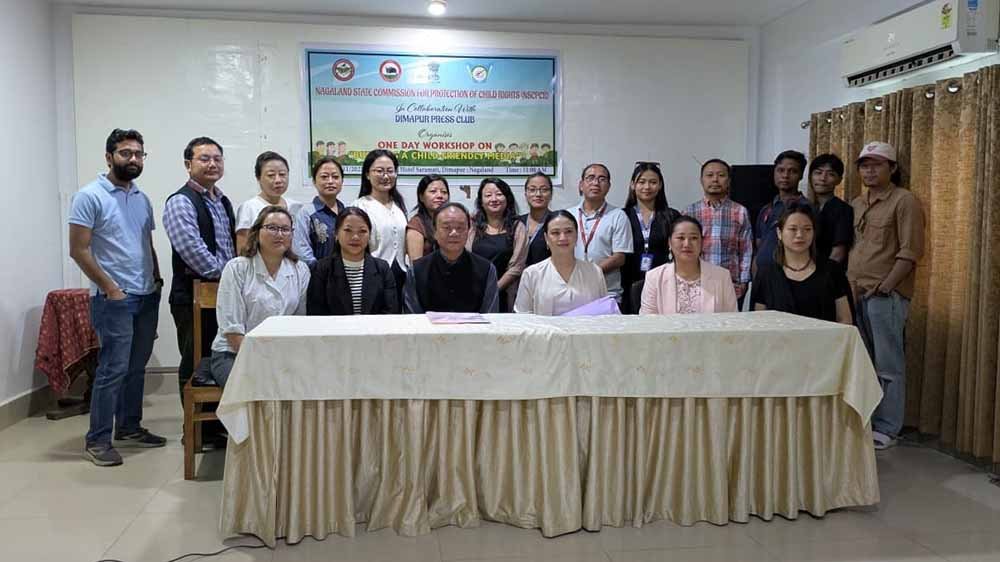
Nagaland Workshop on ‘Building a Child-Friendly Media’
Staff ReporterDIMAPUR, NOV 15 (NPN)