
Press clubs across Nagaland—Kohima Press Club (KPC), Dimapur Press Club (DPC), and Mokokchung Press Club (MPC)— observed National Press Day on November 16 under the theme “Safeguarding Press Credibility Amidst Rising Misinformation.”
At Kohima, the event held at Hotel Japfü was graced by Akum Longchari, publisher of The Morung Express, as the resource speaker. Reflecting on the evolution of Nagaland’s media, Longchari described it as a “home-grown” institution built by elders and strengthened by generations of journalists committed to truth and ethics. He emphasized that media credibility depends on independence—free from fear, bias, or vested interests.
Drawing from over two decades of experience, Longchari spoke on the complexities of truth in today’s media landscape. He warned that misinformation, though not new, has intensified with digital proliferation, creating a polarised ecosystem. Quoting Manish Maheshwari, former head of Twitter India, he said, “If the 20th century was about who controlled oil, the 21st will be about who controls truth,” urging the Naga media to engage critically with the idea of “truth sovereignty.”
He cautioned that when truth is commodified and weaponised, it becomes a tool of division. Citing Ugandan scholar Mahmood Mamdani, he stressed the need to distinguish between truths that illuminate and those that obscure. In the Naga context, he noted that history, geography, and politics often distort truth, allowing subjective feelings to override facts. He challenged journalists to bridge the gap between emotion and evidence and to uphold journalism as a revolutionary act rooted in context, meaning, and trust.
Longchari also highlighted internal contradictions in Nagaland—systemic corruption, cultural commodification, identity fragmentation, and economic disparity—and urged the media to question who defines narratives and whether they reflect the people’s interests. Calling for a reimagining of the Naga media, he encouraged journalists to rise above official narratives, investigate root causes, and tell stories that inspire new imaginations. “Journalism is a praxis,” he said, “and must evolve with the times through action and reflection.”
During the event, the KPC Impact Journalism Award—the only professional journalism recognition in Nagaland—was conferred upon Reyivolu Rhakho for excellence in reporting. The KPC-NBOCWWB Media Fellowship 2025 was awarded to Chizokho Vero, Shongmo, and Yarden Jamir. The programme was chaired by Associated Press Asia Pacific Deputy News Director and KPC member Yirmiyan Arthur Yhome.
In Dimapur, DPC observed the day at Ethnic Table, Notun Bosti, with Dr. Moalemba Jamir, associate editor of The Morung Express, as the theme speaker. Dr. Moalemba described credibility as journalism’s most vital asset—not printing presses or digital reach, but the trustworthiness of its practitioners. He noted that the current media environment blurs the lines between news, entertainment, political messaging, and promotional content, making the need for credibility more urgent than ever.
He warned that a lapse in credibility affects not just media houses but institutions and communities. Urging journalists to look inward, he stressed the importance of newsroom transparency and identity. He pointed out that many digital platforms lack editorial policies or institutional clarity, leading to visibility without accountability.
Earlier, DPC president Henlly Phom acknowledged the dedication of journalists committed to truth and urged continued promotion of fact-based reporting. The programme was chaired by Kekhriésenuo Lily Kiewhuo, with a Q&A session moderated by DPC leadership. Niboli H. Yeptho delivered the vote of thanks.
In Mokokchung, MPC observed the day at its chamber with support from the Department of Information & Public Relations (DIPR). Editor of Mokokchung Times, Limalenden Longkumer, delivered the keynote address, stressing that credibility, once lost, leaves no foundation for trust. He identified misinformation—including fake, half, and paid news—as a major challenge in the digital age.
Longkumer urged journalists to prioritise verification over virality and cautioned against rushing to publish without fact-checking. “Journalists are not influencers or content creators,” he said. He called for transparency, ethics, and editorial independence, warning that alignment with special interests risks eroding credibility. He also advocated for media literacy to help the public discern truth from falsehood.
In his presidential address, MPC president Sashimeren described the observance as timely, given the surge of misinformation on social media. He questioned whether journalists should cater to leadership expectations or focus on grassroots realities, and reaffirmed the press as the fourth pillar of society.
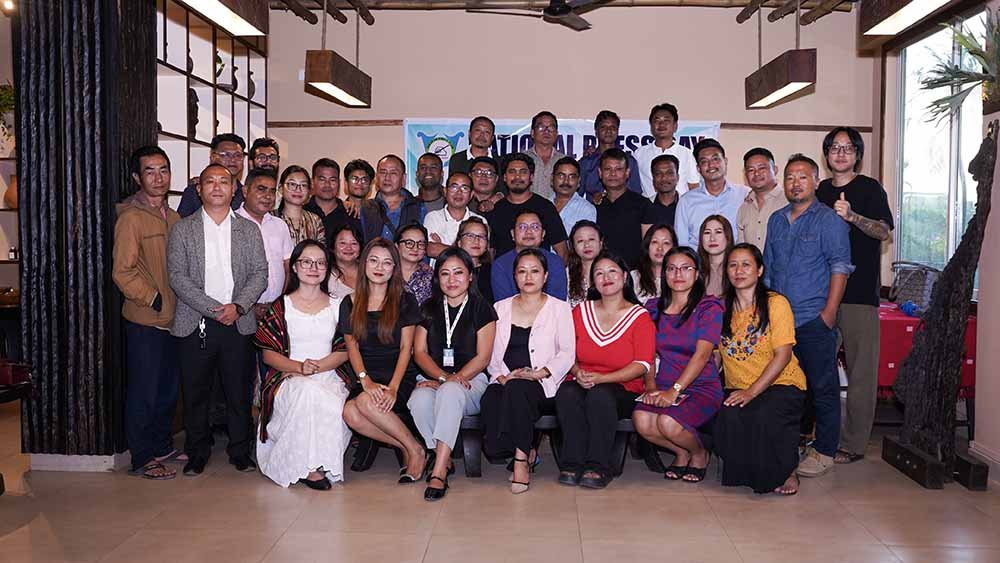
Nagaland Press Clubs observe National Press Day
CorrespondentDIMAPUR/KOHIMA, NOV 16 (NPN)