
Garo community celebrated the Wangala Mini Hornbill Festival with great enthusiasm at Eralibil village, Dimapur, on Friday. The event was organised by the Nagaland Garo Tribal Council (NGTC).
Addressing the gathering as special guest, Deputy Commissioner of Dimapur, Dr. Tinojongshi Chang, said the participation of different tribes in the festival was a testament to Nagaland’s commitment to cultural diversity, peace, unity and mutual understanding. He observed that such platforms not only highlight the rich cultural heritage of Nagas but also help communities understand each other’s issues and aspirations.
Describing Dimapur as a “mini Nagaland” where all tribes live together harmoniously and share each other’s concerns, Chang reminded that cultural heritage forms the core of one’s identity. Noting that Naga traditions lack written documentation, he said they continue to survive through oral transmission from generation to generation. He urged the younger generation to preserve cultural practices, expressing concern that many youth today feel hesitant to speak their mother tongue or wear traditional attire.
“We should overcome this mindset. We have to know our culture because our culture is our identity,” he said.
He also stressed the need for proper documentation of Naga culture to prevent the loss of traditional knowledge over time. The DC further called upon the gathering to shed the perception of being a minority, emphasising that all tribes, irrespective of population size, are equal stakeholders in building a stronger Nagaland.
Dwelling on the proposed census and implementation of RIIN, he appealed to the people to understand the objectives clearly, assuring that the initiative was not meant to discriminate but to safeguard the future of indigenous communities. He clarified that RIIN would be implemented for all Naga tribes in phases, not just for four communities.
Amidst the presence of many tribal leaders, Chang encouraged collective efforts for the welfare of all and assured the administration’s support in addressing community concerns.
Meanwhile, guest of honour and president of the Association of Indigenous Minority Tribes of Nagaland (AIMTN), S.K. Khemprai, in his address described Wangala as a traditional post-harvest festival and noted that most tribal festivals share strong agricultural roots. While acknowledging that many residents of Dimapur were gradually moving away from agriculture, he expressed happiness that cultural festivals continued to be celebrated with zeal.
Khemprai also highlighted challenges currently faced by the four tribes—Garo, Kachari, Kuki and Mikhir—and urged the community to pray for better days. He expressed appreciation to the state government and department of Tourism for integrating tribal festivals into the Mini Hornbill framework, calling it an encouraging step towards cultural revival. “Because of Hornbill and Mini Hornbill festivals, we have revived our traditional dances and games,” he remarked.
Reiterating that culture is the foundation of identity, Khemprai cautioned that losing cultural heritage would ultimately mean losing one’s sense of identity.
Earlier, the programme was chaired by NGTC general secretary Jasper R. Marak, invocation was offered by associate pastor of Garo Baptist Church Kohima, Sengme Sangma, and welcome address was delivered by NGTC president Karampal G. Momin. The significance of Wangala was shared by NGTC Kohima Unit president, Solomon D. Sangma.
Highlights of the programme included cultural performances by Garo Students Union Samaguri Unit, Garo Cultural Troupe Dimapur, Garo Cultural Troupe Eralibill, Zhothomi ce Kroko, Khe nam tii maa tai Ahom Cultural Troupe Dhansari (Golaghat, Assam), Mech Kachari Cultural Troupe, and Wangala Dance by Samaguri village.
Vote of thanks was delivered by NGTC joint secretary Cliff Sangma, while benediction was pronounced by youth pastor of MBC Dimapur, David Marak.
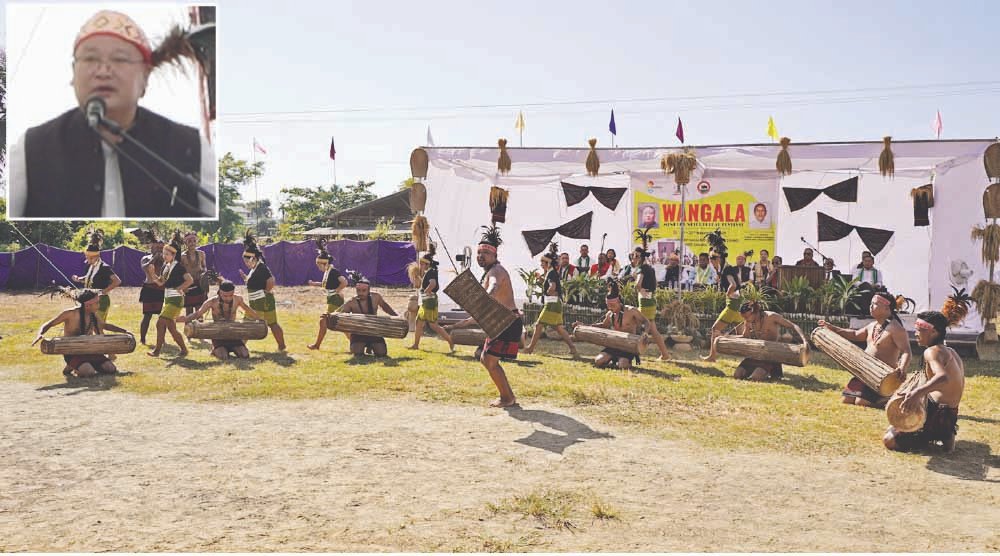
Nagaland Wangala Mini Hornbill Festival celebrated with fervour
Staff ReporterDIMAPUR, NOV 21 (NPN)