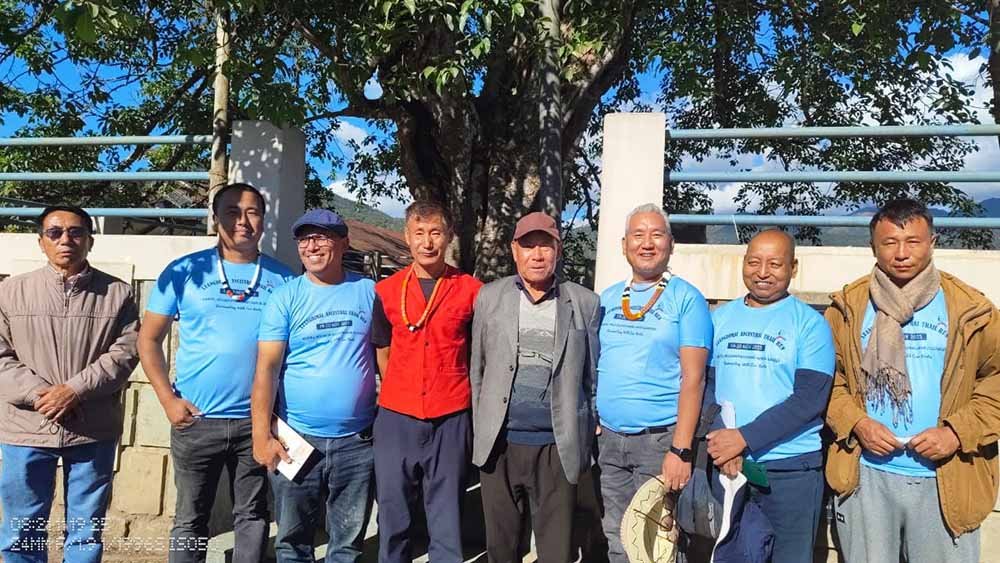
The Makuiluangdi Festival 2025, held under the theme “Malanwangbo – Return of the Native,” concluded on Saturday at Makhel, Manipur, with leaders and community representatives calling for unity, cultural preservation, and collective responsibility among the Naga people. The event is organised by the Luangdimai Citizens Forum in collaboration with the Indian Council for Cultural Relations (ICCR) and sponsored by the North Eastern Council (NEC). The festival is scheduled from November 18 to 22.
Speaking at the inaugural function, Convenor of the Central Organising Committee, K. Elu Ndang, delivered the keynote address in which he underscored Makhel as the spiritual and ancestral centre of Naga origin. He stated that the gathering at Makhel was not merely ceremonial but represented “a homecoming to the source,” describing the theme ‘Return of the Native’ as a profound call to heal divisions, reclaim identity and strengthen unity among Naga communities. He emphasised that in a period of political, social and cultural challenges—particularly for Naga communities in Manipur—the call to return to Makhel had become more urgent and sacred. According to him, being a native today involved navigating complexities brought about by modern pressures, political transitions and internal societal strains. He expressed concern that these factors were making people feel estranged even within their own homeland.
Ndang outlined what he termed a “triple return”: a return to the roots of unity, a return to culture as a protective fortress, and a return to responsibility as stewards of ancestral legacy. He noted that Makhel symbolised the shared origin of all Nagas, reminding the community that unity was historically their strongest foundation. He urged the people to revive a sense of collective belonging and heal present divisions by reaffirming their bond as descendants of a common ancestor.
Highlighting culture as the second pillar, Ndang described Naga languages, traditional governance, ethos of respect for elders, warrior heritage, ritual practices, and attire as the cultural bulwarks that had preserved Naga identity for centuries. He called for conscious efforts to fortify cultural practice, including the transmission of mother tongues to younger generations and deeper engagement with traditional rituals and attire.
On the third point, he stated that a returning native was not a passive witness but one who carried a responsibility to protect and redeem the community. He urged elders to continue guiding society with justice, courage and wisdom, while calling on the youth to blend ancestral knowledge with modern skills and opportunities, and to articulate the Naga story with clarity and pride.
He described the gathering at Makhel as a pledge to protect the sanctity of the land, uphold unity and ensure that the story rooted at Makhel continued to strengthen. He encouraged attendees to leave the festival with a renewed sense of purpose and to carry the spirit of oneness back to their villages and towns.
Earlier in the programme, Chairman of Makhel Village, A. Kazhiso, delivered the welcome address, followed by a special address from Makhel Village Chief Salew Pfokreni. A short speech was also delivered by Joseph in his capacity as President of the Mao Council. The opening prayer was offered by Ch. John, catechist of Our Lady of Victory Church, Makhel, and the vote of thanks was proposed by Mr. Aaron Pamei, Member LCF Elder Board, before the programme concluded with a closing prayer by K. Jonathan, Pastor of Makhel Shajouba CRC.
As part of the inaugural day events, the Ancestral Trail Run was flagged off following a prayer by L. Kokho, Pastor of MBC Makhel, and a blessing pronounced by Salew Pfokreni, Chief of Makhel. The flag-off was jointly led by Salew Pfokreni (Chief of Makhel), N. Athikho Joseph (President, Mao Council), A. Kazhiso (Chairman, Makhel Village) and K. Elu Ndang, (Convenor, Central Organising Committee).
(Correspondent)