
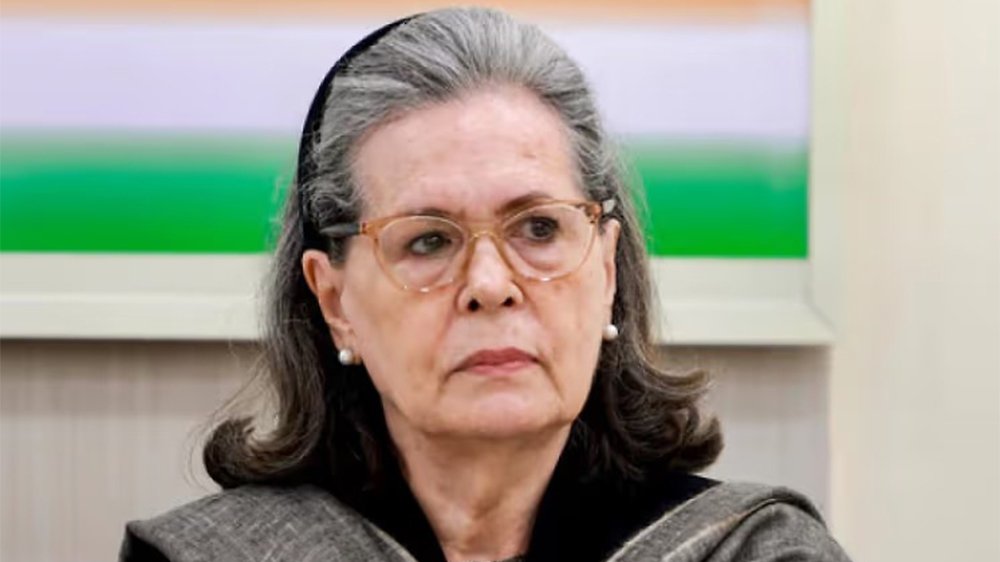
Congress Parliamentary Party chairperson Sonia Gandhi on Monday said the “demolition” of the historic Mahatma Gandhi National Rural Employment Guarantee Act (MGNREGA) will have catastrophic consequences for crores of people across rural India and called upon all to unite and safeguard the rights that protect everyone.
In an editorial in ‘The Hindu’ titled “The bulldozed demolition of MGNREGA”, the former Congress chief said the “death” of MGNREGA is a collective failure.
This comes a day after President Droupadi Murmu gave her assent to the Viksit Bharat Guarantee for Rozgar and Ajeevika Mission (Gramin) (VB-G RAM G) Bill, which replaces the MGNREGA and has a provision for 125 days of wage employment for rural workers.
“MGNREGA realised the Mahatma’s vision of Sarvodaya (welfare of all) and enacted the constitutional right to work,” Gandhi said.
“It is imperative, now more than ever, to unite and safeguard the rights that protect us all,” she added.
Gandhi said the employment guarantee scheme to deal with rural distress has now been “bulldozed and demolished”.
MGNREGA was a rights-based legislation inspired by Article 41 of the Constitution of India, which calls upon the government to secure citizens’ right to work, she said.
“Over the past few days, the Narendra Modi government worked to bulldoze MGNREGA’s abolition without any discussion, consultation, or respect for parliamentary processes or Centre-State relations. The removal of the Mahatma’s name was only the tip of the iceberg. The very structure of MGNREGA, so integral to its impact, has been annihilated,” she said.
She described VB-G RAM G as “nothing but a set of bureaucratic provisions”.
The Modi government’s new Bill has restricted the ambit of the scheme to rural areas as notified by the Union at its discretion, Gandhi said.
Against uncapped central allocation, there is now a pre-determined budgetary allocation that caps the number of days of employment provided in each state. The number of workdays provided are, therefore, left to the Centre’s priorities rather than the people’s needs, she said, adding that the all-year guarantee of employment has been finished off.
Gandhi said one of the greatest impacts of MGNREGA was increased bargaining power of the landless poor in rural India, which elevated agricultural wages.
“This bargaining power will definitely be eroded under the new law. The Modi government is attempting to suppress wage growth and that too at a time when the proportion of employment in agriculture has risen for the first time since Independence, contrary to what should have been the case,” she noted.
She also said by transferring a significant portion of the expense onto the states, the Modi government is discouraging them from providing work under the scheme. The finances of states, already under severe stress and strain, will be further devastated, the Congress leader said.
Under the VB-G RAM G Bill, the cost-sharing pattern is 60:40 between the Centre and states, 90:10 for northeastern and Himalayan states, and 100 per cent central funding for Union territories without legislatures.
Gandhi further said that aside from demolishing the demand-based nature of the programme, the Modi government has ended the decentralised nature of the scheme.
“The Modi government is resorting to fraudulent claims that it has enhanced the employment guarantee from 100 days (under MGNREGA) to 125 days. For all the reasons outlined above, that will certainly not be the case. Indeed, the real nature of the Modi government’s intentions can be understood from its decade-long track record of throttling MGNREGA.
“It began with the Prime Minister’s (in)famous mocking of the scheme on the floor of the House and proceeded apace through a ‘death by a thousand cuts’ strategy through, for instance, stagnant budgets, the use of disenfranchising technology and delayed payments to workers,” she said in the article.
Gandhi said the demolition of the right to work must not be seen in isolation but as part of the long assault by the ruling establishment on the Constitution and its right-based vision for the country.
“The most fundamental right to vote is under unprecedented assault. The Right to Information has been desecrated with legislative changes that weaken the autonomy of Information Commissioners, and by wholesale exemptions from the Act for ill-defined ‘personal information data,” she said.
The Right to Education has been undermined and The Forest Rights Act, 2006, was markedly weakened by the Forest (Conservation) Rules (2022), which removed the gram sabha from any role in permitting the diversion of forest land, the Congress leader said, adding that The Right to Fair Compensation and Transparency in Land Acquisition, Rehabilitation and Resettlement Act, 2013 has been significantly diluted.
“Through the three black farm laws, the government attempted to deny farmers the right to a minimum support price. The National Food Security Act, 2013, may very well be next on the chopping block,” Gandhi said.
BJP rebuts Sonia Gandhi’s allegations
The BJP on Monday termed Congress leader Sonia Gandhi’s claims about the VB-G RAM G Act a “flight of political fancy” and alleged that her arguments against the law rest on “mischaracterisations, selective memory and outright falsehoods”.
The Viksit Bharat Guarantee for Rozgar and Ajeevika Mission (Gramin) (VB-G RAM G) Bill, which replaces the MGNREGA, became an Act with President Droupadi Murmu’s assent on Sunday.
Criticising the law, Gandhi said the “demolition” of the historic Mahatma Gandhi National Rural Employment Guarantee Act (MGNREGA) will have catastrophic consequences for crores of people across rural India and called upon all to unite and safeguard the rights that protect everyone.
In an editorial in ‘The Hindu’ titled “The bulldozed demolition of MGNREGA”, the Congress parliamentary party chairperson also said the “death” of MGNREGA is a collective failure.
Hitting back, BJP IT department head Amit Malviya said on X, “Sonia Gandhi’s recent article on MGNREGA reads less like a serious engagement with law or data and more like a flight of political fancy” he charged.
In a point-by-point rebuttal, the BJP leader alleged that Gandhi in her article “romanticised” the origins of MGNREGA, claiming that it emerged from widespread consultation, but it’s “far from the truth”.
“MGNREGA was conceived and driven by the National Advisory Council — an unelected executive body that functioned, in effect, as a super-cabinet. So dominant was its role that (then) Prime Minister Manmohan Singh was frequently derided as a ‘super cabinet secretary’ under Sonia Gandhi’s NAC,” he alleged.
It’s “historical revisionism” with Gandhi presenting this process now as participatory democracy, he charged.
Dismissing Gandhi’s claims that demand-based employment is being dismantled, thereby destroying the employment guarantee itself, Malviya asserted that the legal right to employment remains untouched under the VB G RAM G Act.
“What has changed is the budgeting framework — from an open-ended, reactive model to a norm-based system, which is how virtually all government schemes function,” he said.
“Far from weakening the guarantee, employment has been strengthened from 100 days to 125 days. In FY 2024-25, planned allocations closely tracked actual demand, demonstrating that disciplined planning works,” he said.
The BJP leader said Gandhi’s argument that MGNREGA remains the central pillar of rural survival and that the new law will suppress rural wage growth ignores how rural India has changed.
While MGNREGA did play a role in alleviating distress, it has not kept pace with today’s rural realities, he claimed.
“NABARD and MPCE data show that 80 per cent of rural households report higher consumption, 42.2 per cent report higher incomes and 58.3 per cent now rely exclusively on formal credit,” Malviya said.
“MGNREGA today functions as a fallback safety net, not as the defining feature of rural livelihoods,” he said, and termed as “equally misleading” Gandhi’s claim that the poorest will be abandoned if the old framework changes.
“Rural poverty has fallen sharply from 25.7 per cent to 4.86 per cent. MSME credit has tripled since 2014, enabling self-employment and non-farm livelihoods.
“Public policy cannot be frozen in the conditions of 2005 when India has demonstrably moved forward,” he added.
The BJP leader also dismissed as “false” the allegation that the Centre is shifting the financial burden to states, moving from a supposed 90:10 model to 60:40 under the VB-G RAM G Act.
“MGNREGA was never funded at 90 per cent by the Centre in practice. States already bore 25 per cent of material costs, major administrative expenses, and 100 per cent of unemployment allowance, often without predictability or transparency,” he said.
The new model simply formalises and rationalises funding, making states “equal partners” rather than “passive implementers of top-down mandates”, the BJP leader said.
Noting that Gandhi objected to the 60-day work restriction portraying it as an assault on year-round employment, Malviya said that, in reality, this period is “aggregated, flexible, and state-notified — not a blanket ban”.
It protects agricultural operations during sowing and harvest, prevents labour shortages, allows workers to earn higher seasonal farm wages, and still expands the overall employment guarantee to 125 days under the VG-G RAM G Act, he said.
Malviya said Gandhi’s concern that Panchayats and Gram Sabhas are being weakened is “similarly misplaced”.
Under the VB-G RAM G Act, all works originate from Viksit Gram Panchayat Plans approved by Gram Sabhas, he said, adding, “What is being dismantled is fragmentation and opacity, not decentralisation.”
“The bottom line is clear. This is not demolition, it is overdue repair. The real choice is not between compassion and reform, but between paper guarantees that under-deliver and a modern framework that actually works,” he said.
Malviya accused Gandhi of ignoring systemic failures that plagued MGNREGA for years.
“Rs 193.67 crore misappropriated in 2024-25 alone, with recovery of barely 5.32 per cent; fake works existing only on paper; machinery replacing labour; and digital attendance systems bypassed across 23 states.” These were not “minor lapses” but “deep structural flaws”, he said.
Despite these challenges, Malviya said, the reforms under the Modi government have delivered “measurable gains”.
“Between FY 2013-14 and FY 2025-26, women’s participation rose from 48 per cent to 56.74 per cent; Aadhaar-seeded active workers increased from 76 lakh to 12.11 crore; workers on APBS (Aadhaar Payment Bridge System) grew from zero to 11.93 crore; geo-tagged assets expanded from none to over 6.44 crore; and e-payments surged from 37 per cent to 99.99 per cent,” he added.