Freed from the threat of invasive predators, Galapagos birds are performing astonishing feats of return and innovation – 200 years after Charles Darwin visited the archipelago.
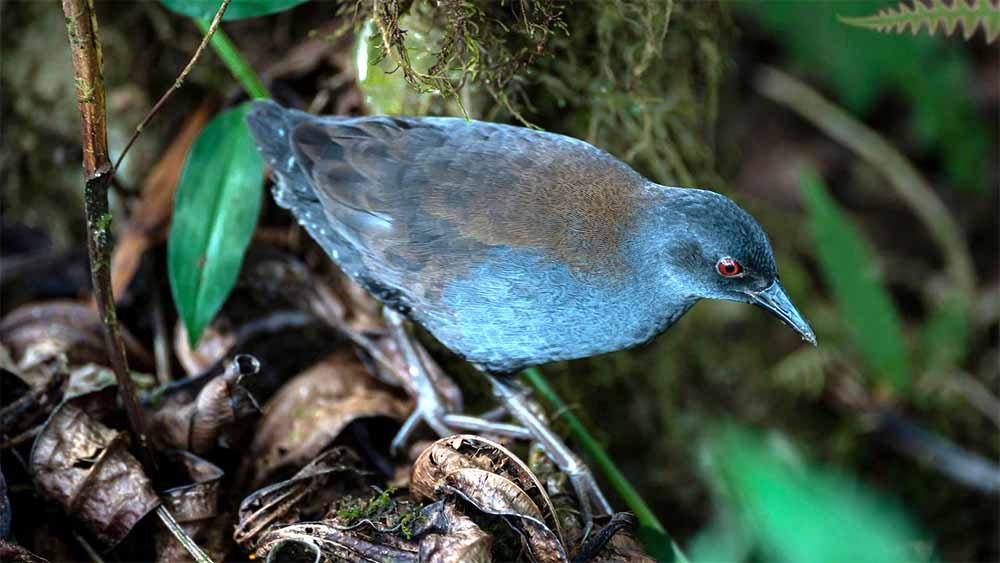
For almost 200 years, the Galapagos rail had been missing from Floreana. Thought to be extinct on this small, inhabited island in the Galapagos archipelago, the shy, near-flightless bird is still found on some of the other islands. But Charles Darwin was the last person to record a sighting of one on Floreana, when he famously visited the island in 1835.
This year, after the removal of rats and feral cats from Floreana, the bird stunned conservationists by making a surprise re-appearance on the island. How the lost bird returned is a mystery. Other threatened birds have also recovered, and some are even singing new tunes never heard on the island before, which you can listen to below. The change reveals new insights into how a safer, almost predator-free environment can allow animals to experiment and innovate, scientists say.
“The Galapagos rail was one that I was not expecting at all,” agrees Paula Castaño, a wildlife veterinarian who works for Island Conservation, one of the organisations restoring Floreana. “It just showed up” on Floreana, she says, adding that perhaps it had clung on as a small, hidden, unnoticed population all this time.
“[The rails] reappeared and now it’s very common to find these birds just walking around the island. You can hear it, you can see it, it’s unbelievable,” says Paola Sangolquí, a marine biologist at the Jocotoco Conservation Foundation, which is also part of the restoration project.
The rail’s reappearance is part of what scientists are describing as an extraordinary return of life to Floreana, after the removal of the invasive predators that had wreaked havoc on native species.
“It’s an instant explosion of these species that were considered very, very rare until last year,” says Sonia Kleindorfer, a behavioural biologist at the University of Vienna who, with her team, has been studying different finch species on Floreana and other islands for 20 years. “It’s a remarkable, instant comeback,” she adds.
In late 2023, after a decade of preparatory work, the rats and feral cats were eradicated as part of a project to restore Floreana’s native ecosystem. In 2025, bird counts revealed that several species that were previously rare such as Galápagos doves, lava lizards, geckos and the dark-billed cuckoo were all seen more frequently, according to Birgit Fessl, principal investigator of landbird conservation at the Charles Darwin Foundation, which is part of the project to restore Floreana.
“But the most exciting finding was the re-discovery of the Galápagos Rail,” Fessl says. “This bird had not been recorded on Floreana for centuries – the only historical proof of its presence [was] a specimen collected by Darwin himself.” (BBC)