
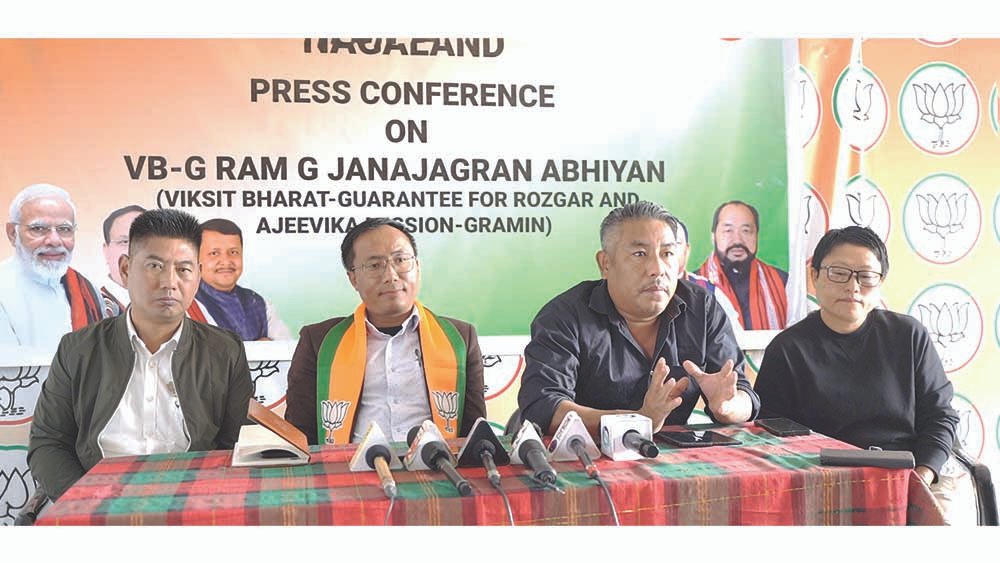
As part of the party’s nationwide public awareness campaign titled ‘VB–G RAM G Janjagaran Abhiyan’, the Bharatiya Janata Party (BJP) Nagaland state unit on Wednesday explained the provisions of the newly enacted Viksit Bharat—Guarantee for Rozgar and Ajeevika Mission (Gramin) [VB–G RAM G] Act, 2025.
The directive for the outreach drive was issued by BJP national general secretary Arun Singh through an official letter dated January 4, 2026.
Addressing a press conference at the BJP office here, BJP state unit general secretary Manai Konyak urged eligible rural beneficiaries to actively avail the scheme, which has replaced the Mahatma Gandhi National Rural Employment Guarantee Act (MGNREGA).
Konyak said the VB–G RAM G Act, 2025 marked a significant overhaul of rural employment and livelihood programmes in the country.
He explained that the scheme’s title reflected its focus on guaranteeing employment and sustainable livelihoods in rural India, in line with the national vision of Viksit Bharat 2047.
Highlighting key features of the Act, he said that one of the major changes under VB–G RAM G was the increase in number of guaranteed employment days from 100 to 125 per rural household per financial year.
He said the scheme also introduced a revised funding framework, under which the state government would bear expenses exceeding normal allocations, thereby strengthening accountability at the state level.
Further, Konyak informed that works under the scheme would be paused during peak agricultural seasons, ensuring that farming activities were not disrupted. State BJP general secretary said that planning would follow a well-defined framework, with implementation and monitoring carried out through national-level and state-level steering committees.
Meanwhile, providing further insight behind the new legislation, state BJP general secretary Sunep C Jamir said the VB–G RAM G Bill was introduced after carefully assessing the evolving socio-economic realities of rural India.
He pointed that MGNREGA, which was enacted in 2005, was two decades since its implementation, adding that rural conditions have undergone substantial change since then.
Jamir also cited official data showing significant reduction in poverty levels, from 27.1% in 2012–13 to 5.7% in 2022–23, as well as marked improvements in digital connectivity, road infrastructure, banking penetration, and livelihood support mechanisms in the rural sectors.
He opined that such transformations necessitated a new scheme that reflected the present day rural realities. Jamir said that VB–G RAM G aimed not merely to provide wage employment, but also to promote self-reliance (Atmanirbhar Bharat) by transforming employment generation into long-term wealth and asset creation in rural areas.
Explaining the structural shift in the new scheme, Jamir said that unlike the earlier demand-driven model under MGNREGA, VB–G RAM G follows a normative, budget-based approach, allowing for focused and goal-oriented implementation.
He said that works under the scheme would be undertaken based on four thematic pillars—water security, rural infrastructure, livelihood infrastructure, and climate resilience.
Meanwhile, when asked whether the state or the central government would be accountable in case funds were delayed, Jamir replied that the state government would be held responsible.
He explained that accountability has been embedded into the bill through the “normative” funding mechanism, under which delays and cost overruns would no longer be passed on without responsibility.
Jamir said that the state government would also be held accountable for pending or unpaid wages from earlier periods.
Asked whether state being a part of the funding agency would hamper other developmental aspects in the state as it wholly depended on the central government for developmental funds, he clarified that while the scheme remained centrally sponsored, funding patterns vary, with a 60:40 Centre–State ratio for most states, and 90:10 for North Eastern states, including Nagaland.
He added that the central government would continue to bear 100% administrative costs and material procurement expenses, while the state’s financial participation ensures improved oversight and accountability.
Highlighting on the shortcomings observed under the MGNREGA, Jamir said that in FY 2024–25, only 7.6% of rural households were able to avail the full 100 days of guaranteed employment, leaving a majority unable to fully benefit from the scheme.
He said that reported cases of misappropriation under MGNREGA during the same period amounted to over Rs. 193 crore, raising concerns about leakages and inefficiencies.
To address such issues, Jamir said the new scheme incorporated advanced technological safeguards, including AI-based monitoring systems, geospatial tracking of works, biometric verification of beneficiaries, and multi-level scrutiny from village to state levels. “These measures are designed to eliminate loopholes, curb misuse of funds, and ensure that benefits reach genuine beneficiaries”, he stated.
He also maintained that VB–G RAM G placed strong emphasis on decentralised planning, with project proposals originating at the village and panchayat levels, moving up through block, district, and state levels before finalisation. Jamir said the scheme at the same time would be integrated into a national rural infrastructure framework, allowing for coordination and benchmarking across states.
Meanwhile, Konyak appealed all eligible rural residents to actively approach village councils, concerned officers, and committees to ensure they receive the benefits of the scheme.
He also urged communities to ensure that underprivileged and eligible individuals were not left out. He informed that the scheme was open to all adults willing to undertake gainful employment for up to 125 days in a financial year.
Nagaland: BJP highlights provisions of VB–G RAM G
Staff ReporterDIMAPUR, JAN 7 (NPN)