
The Naga Club on Saturday observed ‘Magna Carta Day’ at Nyütsümvü Yhor Badze in Tsiesema Bawe village, commemorating the historic 1929 memorandum submitted by the Naga Club to the Simon Commission, a defining assertion of Naga political identity and self-determination.
Addressing the gathering, noted peace activist Niketu Iralu stressed the enduring relevance of the Naga Club at a time when many, particularly the younger generation, were questioning and seeking clarity on Naga history. Standing before the memorial stone, he said reading the inscription carried a “magical power,” reflecting the depth of thought, conviction and moral clarity of the pioneers who articulated the Naga position nearly a century ago.
Explaining the significance of the site, Iralu said the name Nyütsümvü meant “refusing to surrender,” and pointed to the inscription that spoke of a “reward” already declared, leaving it to the people to decide how they would live with it. He said the legacy of Nyütsümvü and Lhouvitsü gave meaning to the day’s observance and urged that their footprints remain a lasting inspiration for future generations.
Iralu said the idea of “footprints” symbolised the vision of early Naga leaders who clearly understood Naga values, dignity, integrity and history.
He recalled that 18 years after the 1929 memorandum, extensive consultations culminated in the declaration of Naga independence on the eve of August 14, 1947, which the pioneers believed had to be taken at that precise historical moment.
He said it was now well documented that India’s first prime minister had sent emissaries who acknowledged that the Nagas had declared they were not part of India, even though official maps portrayed otherwise. While acknowledging India’s difficulty in accepting the Naga position, Iralu maintained that this was not a Naga problem.
He asserted that stating “we are not you, and you are not us” did not amount to being anti-India, adding that Nagas desired India to be a great nation, but not one shaped by partisan or authoritarian interests. According to him, Nagas continued, without guilt, to challenge India’s moral and political conscience, a process he described as slow, demanding and deeply testing.
Iralu stressed that accountability before God lay in how individuals contributed to repairing the damage inflicted on Naga society. He warned that society was entering a period of serious self-examination and cautioned against pursuing paths shaped purely by human ambition rather than moral and spiritual principles.
He further warned that even if Nagas were to become a republic without ethical grounding, leadership could degenerate into materialism and authoritarian ideologies that would ultimately lose their way. Despite being small in number, he said Naga principles were comparable to historic movements elsewhere in the world, and that the Naga Club carried a historic mandate to continue such critical conversations.
On Indo-Naga relations, Iralu said India was unlikely to openly discuss Naga sovereignty due to internal political constraints, noting that no political party in Delhi could risk addressing the issue without electoral repercussions.
He said India preferred to divert discussions to other issues, while Nagas maintained that the final decision rested with them.
Using an analogy, he described India as a “big elephant,” stating that while Nagas were as old as any civilisation, their exposure had been limited. He emphasised the need for clarity of purpose and argued that funds provided by India should be viewed as “rent” and utilised responsibly for development, warning that repeated adverse CAG reports pointed towards self-destruction if misuse continued.
Iralu also cited remarks by senior journalist Nirja Choudhury, who had described Naga history as “very beautiful” and recalled how Nagas had stood up to British rule. He said while military victory over India was unrealistic, strengthening Naga society socially and economically would itself pose a moral challenge to the Indian state. He further described extortion as evidence of political and moral bankruptcy within Naga society.
Naga Club president K Seyie, in his address, recalled the visit of former Nagaland governor R N Ravi in 2018, when expectations were high for a possible solution. He said representatives of Western Angami public organisations had clearly conveyed that historical facts could not be distorted. Quoting Ravi, Seyie said democratic struggles would continue, but armed confrontation could not defeat the Indian Army.
Seyie echoed that the statement “you are not us and we are not you” was self-explanatory. He cautioned against romanticising armed struggle and stressed the need for economic and social development, warning that even if independence were achieved, integration would remain a serious challenge. He said extortion was “killing our people” and warned that society was heading towards a precipice of self-destruction.
Adding to the discussion, Dr Viketoulie Pienyü said the Naga movement, nearing a century, had suffered damage and deviations but had neither been abandoned nor would it die. He said the movement must now be strengthened on economic, cultural and social fronts, emphasising Naga uniqueness that made assimilation impossible. He identified disunity and mistrust among Naga tribes as the biggest obstacles and called for serious dialogue on unity.
Earlier, Er Khrielievio Yhor shared personal recollections of his father, Nyütsümvü Yhor, describing him as a simple man deeply committed to the Naga cause. He recounted his father’s limited formal education, his service as a voluntary teacher, and the pressures he faced from both the Indian Army and the NNC. Despite declining formal politics, he said his father inspired many villages to support the movement and firmly believed that the “reward” had already been declared.
The programme was moderated by senior research fellow Dr Khriezo Yhome, while invocation was pronounced by Dr Thorsie Katiry. Short speeches were also delivered by senior members Hoshito Assumi and Gwasinlo Thong.
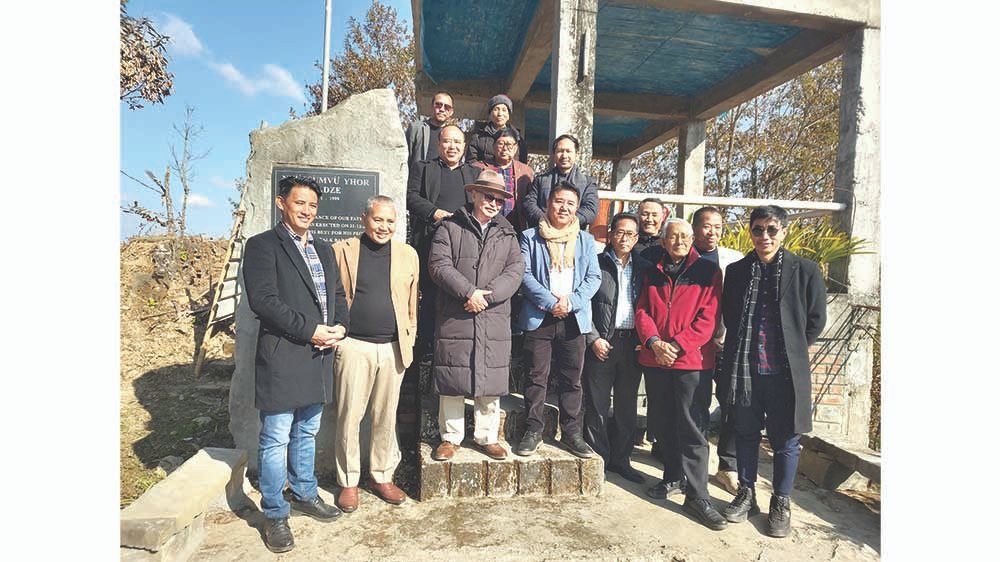
Nagaland: Naga Club observes Magna Carta Day, reaffirms Naga political legacy
CorrespondentKOHIMA, JAN 10 (NPN)