
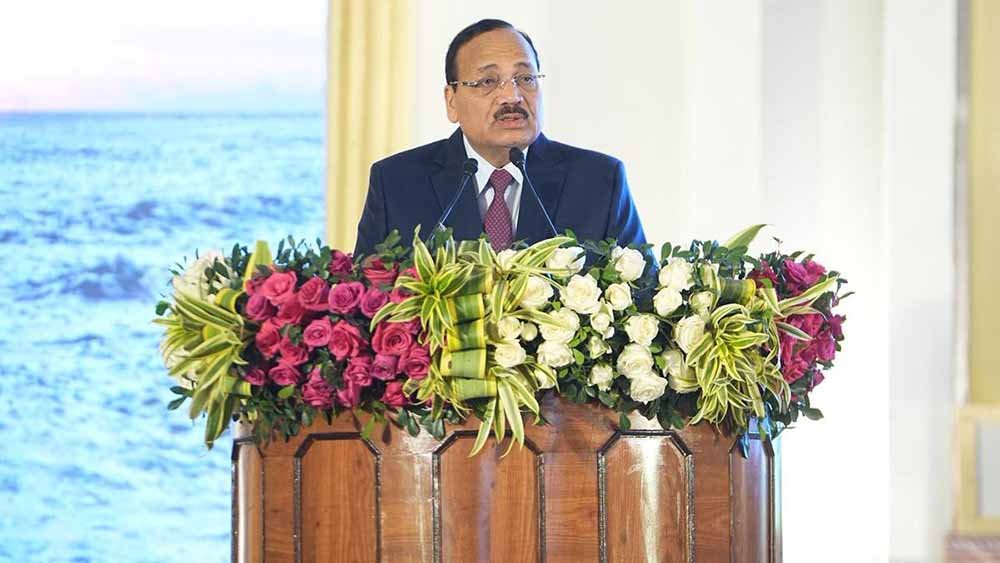
Chief Justice of India Surya Kant expressed surprise at the opposition by members of the Gauhati High Court Bar Association (GHCBA) to the new Integrated Judicial Court Complex in Assam’s Kamrup district, the foundation stone for which he laid on Sunday.
He maintained that “personal vested interest should not be valid grounds” for resisting the development of new infrastructure.
“The Integrated Judicial Court Complex is envisaged to match aspirations of the future. It is being built not for the moment but for decades ahead,” the CJI said after laying the foundation stone for the facility at Rangmahal in North Guwahati.
The GHCBA has been opposing the relocation of the high court complex to the northern bank of the Brahmaputra river from the heart of Guwahati city, and staged a four-hour hunger strike and abstained for attending the foundation laying ceremony on Sunday.
As the head of the country’s judiciary, Justice Kant stressed that he is bound to cater to the needs of those coming into the profession.
The chief justice of India said that he was surprised when he learnt that the GHCBA is opposing the new integrated court complex, which will also house the Gauhati High Court.
The Gauhati High Court serves as the high court for the states of Assam, Arunachal Pradesh, Nagaland and Mizoram.
“Those opposing the new court complex are either ill-informed or not realising the needs of new members of the bar. Personal vested interests should not be valid grounds for opposing development of infrastructure for the future,” the CJI added.
CJI Kant said the site for the new complex is ‘strategically positioned’ and will provide all facilities under one roof.
Mentioning that a large number of pending cases before courts in the country, he maintained that efficiency of infrastructure alone will not solve this problem.
He pitched for mediation and structural dialogue, not as a compromise but as an effective way for dispute resolution rather than going for confrontational litigation.
The CJI also stressed that dispute resolution is not confined to pronouncing of judgment only, but also includes the entire process for delivery of justice right from approaching the courts to the final judgement for all stakeholders.
When all functions are in tandem, it becomes a cohesive experience for all, and integration of infrastructure is an important aspect, the CJI added.
“I have seen how exhausting it is for litigants to move around courts, tribunals. I am personally delighted that this complex will change this by bringing it all in a single, accessible location,” he said.
CJI Kant appreciated that the new integrated complex will have a primary health centre, a separate bar room for women lawyers and a dedicated approach road for the high court building.
He said the new complex will meet the requirements of not only the litigants, lawyers and judges, but also of the staff working for the courts.
Envisioned as a modern judicial city, the new complex will be developed over 148 bighas (around 49 acres) with a phase-I cost of around Rs 479 crore, officials said.
The new complex will house the principal seat of the Gauhati High Court, district court buildings, and high court office and bar buildings. It will also have parking facilities for 900 cars and 400 two-wheelers.
Gauhati HC Bar Association sits on hunger strike, to boycott CJI’s function for new complex
The Gauhati High Court Bar Association on Sunday began a four-hour strike to boycott the foundation stone laying of the new high court complex, to be done by the Chief Justice of India.
A new complex of the Gauhati High Court has been proposed as part of a judicial township at Rangmahal in North Guwahati and CJI, Justice Surya Kant, is scheduled to lay the foundation stone of it later in the day.
The members of the Gauhati High Court Bar Association (GHCBA) took part in a four-hour hunger strike on Thursday and Friday in front of the old building of the Gauhati High Court.
“We are completely against shifting the high court from the present location, which is the heart of the city. We have begun our hunger strike from 10 am to 2 pm. None of our members will attend the function,” GHCBA vice president SantanuBorthakur told PTI. The GHCBA has been opposing the move to shift the court complex from the beginning, but the government has unilaterally decided and is now going ahead to construct a new judicial infrastructure, he alleged.
“As it appears, the foundation stone will be laid today. After this, we are thinking of challenging this in court. Our executive committee will meet within the next few days and decide the future course of action,” Borthakur said.
The GHCBA has been vehemently opposing the relocation of the high court complex to the northern bank of Brahmaputra from the existing place at the heart of Guwahati city.
Assam Advocate General DevajitSaikia on Saturday criticised the GHCBA, claiming that there was a “nexus with political parties” behind the protest.
The government is planning to construct the new judicial township at Rangmahal, spread across 148 bighas (nearly 49 acres) of land.
In November last year, the state cabinet had approved Rs 479 crore in the first phase to construct a judicial township in North Guwahati.
Earlier, GHCBA had demanded an immediate halt to the project in the interest of all stakeholders and the public at large.
The Gauhati High Court is presently located in the Uzan Bazar area of central Guwahati on the southern bank of Brahmaputra. It has a historical building, while a state-of-the-art multi-crore modern multi-storey structure was constructed and inaugurated a few years ago.
Both the buildings are located face-to-face on two sides of Mahatma Gandhi Road and are connected through an underground tunnel, having escalator facilities.
The Assam government is seeking to develop the riverfront of Brahmaputra, for which it requires the high court land. A new convention centre is also being built next to the old high court complex on the riverbank.