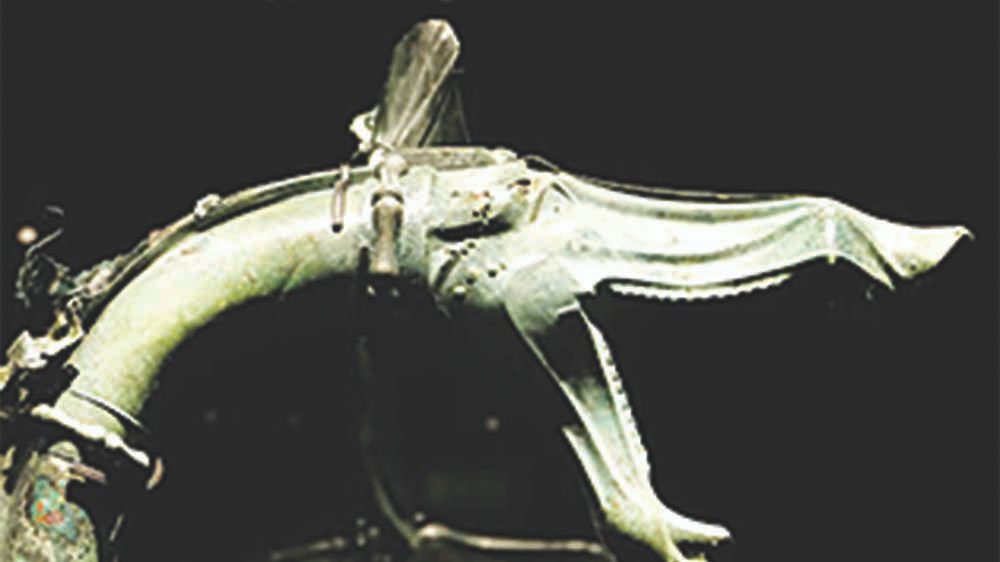
The strength of the boar was symbolic enough for Celtic warriors 2,000 years ago to craft it onto battle trumpets and military standards. Archaeologists in Norfolk, England, found examples of both together ahead of work on a residential construction project.
The 2,000-year-old trumpet, known as a carnyx, was commonly used by Celtic tribes across Europe to inspire warriors during battle. The instrument’s distinct use also fascinated the Romans, who often captured the trumpets and displayed them as war trophies. The artifact found in Norfolk is just the third discovered in Britain, and is one of the most complete ever recovered in Europe, according to a statement from Historic England.
The dating of the West Norfolk hoard to the first century C.E. puts it in the same timeframe as a battle in which the Celtic Iceni tribe was lead by Queen Boudica to fight against the Romans, according to the BBC. However, Boudica failed in her attempt, meaning the Romans may have captured a carnyx as a trophy.
A team from Pre-Construct Archaeology discovered more than just the animal-headed trumpet—alongside it were pieces of what could be a second carnyx, five shield bosses (the ornamental pieces located at the centers of shields), an unknown iron object, and a sheet of bronze featuring the image of a boar’s head that was once a piece of a military standard (the first of its kind ever found in Britain). “Finds of this kind are exceptionally rare in Britain and across Europe,” Pre-Construct Archaeology wrote, adding that this was an “internationally significant Iron Age hoard.”
Gary Trimble, senior project officer, told the BBC that locating a carnyx is “extraordinarily rare […] a boar standard, that’s even rarer. We have our fair share of hoards in Norfolk, but this is so, so different. It is really, really special.”
Once spotted, excavation teams lifted an intact block of soil surrounding the hoard to preserve the archaeological context. Using non-invasive X-ray and CT scanning, the team members peered into the soil block to understand what they were working with before starting the conservation process, which was done in conjunction with Historic England, Norfolk Museums Service, and National Museums Scotland.
(Yahoo News)