
The Nagaland government has initiated a major shift towards complete digitisation of birth and death registration, with the manual system set to be phased out in the coming months under the Nagaland Registration of Births and Deaths (Amendment) Rules, 2024. The move aims to ensure universal, accurate and timely civil registration, strengthen governance, and improve delivery of public services.
This was announced at a press conference held on January 21 at the Directorate of Economics and Statistics (DES) conference hall here, where senior officials briefed the media on the amended rules and the state’s roadmap towards a fully digital civil registration system.
Advisor for Information Technology & Communication, Economics & Statistics and Evaluation, H. Sethrongkyu Sangtam, said the registration of births and deaths in Nagaland would soon be entirely digital, with no further issuance of manual certificates. He informed that while a dual system of manual and online registration was currently in place, this would be discontinued once all registration units across the state are onboarded onto the online platform.
Urging the public to adopt digital registration, Sangtam said civil registration was not merely a procedural requirement but a critical public responsibility.
“Every birth and death marks an important milestone, not only for families but also for the State. Proper and timely registration ensures legal identity and enables the government to plan effectively for education, healthcare, infrastructure and social welfare programmes,” he said.
To ensure accessibility in remote and rural areas, Sangtam said government teachers posted in villages have been entrusted with the responsibility of registrars. Registration units have been established in every recognised village, while PHCs and CHCs have registration facilities managed by nursing in-charges.
In urban areas, registration units operate from the DES directorate, district offices and all government district hospitals.
Explaining the legal framework, Sangtam said civil registration is a continuous, permanent and compulsory recording of vital events such as births, deaths, stillbirths, marriages and divorces, which together form vital statistics.
At the national level, the Office of the Registrar General of India (ORGI) under the Ministry of Home Affairs is the nodal agency for implementation of the Registration of Births and Deaths Act, 1969. In Nagaland, the Department of Economics and Statistics has been the nodal department since 1974.
He said the Act was amended by Parliament in 2023 and came into force across the country on October 1, 2023. Subsequently, the Nagaland Legislative Assembly passed the Nagaland Registration of Births and Deaths (Amendment) Rules, 2024, which were notified in the Nagaland Gazette on February 28, 2025.
Highlighting the far-reaching implications of the amendment, Sangtam said a birth certificate has now become the sole document required for school admissions, government job appointments, Aadhaar enrolment, voter ID registration, issuance of driving licences and marriage registration. The amendment, he said, would help create a comprehensive and reliable national and state-level database, ensuring transparency, efficiency and targeted delivery of public services and social benefits.
He further explained that for persons born on or after October 1, 2023, the birth certificate will be the only valid proof of date and place of birth. One significant reform under the amended rules is the removal of the earlier requirement of an affidavit before a Notary Public for delayed registration beyond 30 days and up to one year. Instead, a self-attested document along with approval from the competent authority will now suffice, simplifying the process for citizens.
On the digital platform, Sangtam said ORGI developed a uniform online Civil Registration System (CRS) in 2014 to enable real-time registration and maintain a centralised database. Certificates generated through the portal carry a unique registration number and QR code, making them easily verifiable and tamper-proof.
In Nagaland, online registration of births and deaths was launched on April 19, 2022. Out of the total 1,474 registration units in the state, 889 have already been onboarded onto the ORGI portal, and efforts are underway to activate the remaining units. He said training on online registration has been completed for all registrars across the state.
Sangtam also informed that the CRS portal was upgraded and revamped on May 13, 2024, making it more user-friendly. Citizens can now apply for birth and death certificates directly from home, and the certificates are delivered electronically to the registered email ID and mobile number of the applicant.
Another major initiative, he said, is the digitisation of old manual birth and death certificates. The state government has already issued a notification to expedite this process. He urged the media to play an active role in spreading awareness so that people come forward to digitise their old certificates, which would help build a complete and reliable digital database.
For delayed registrations beyond one year, Sangtam said the authority has been decentralised to expedite cases. Instead of a Magistrate of the First Class, approvals will now be given by the District Magistrate, Sub-Divisional Magistrate or an Executive Magistrate authorised by the District Magistrate.
Chief Registrar of Births and Deaths and secretary, Akunu S. Meyase, elaborated on the procedures and timelines for registration. She said births, deaths and stillbirths must be registered with the registrar of the area where the event occurred, in accordance with Sections 8 and 9 of the Act.
She informed that registration within 21 days is free of cost. Registrations between 21 and 30 days attract a late fee of Rs.20. Delayed registrations beyond 30 days and up to one year require written permission from the District Registrar, a late fee of Rs.50 and submission of a self-attested document in Form 14. Registrations after one year require an order from the District Magistrate, Sub-Divisional Magistrate or authorised Executive Magistrate, along with a late fee of Rs.100.
Meyase added that a birth can be registered even without the child’s name, which can later be entered within 12 months free of cost, or up to 15 years on payment of Rs.5. She cautioned that non-reporting, furnishing false information or refusal to sign registration forms are punishable offences under the Act. Registration may also be carried out based on information from informants or suo motu by the registrar.
Director of Economics and Statistics, Neidilhou Keditsu, said registration of births and deaths establishes legal identity and serves as a critical source of population data for planning, public health monitoring and evaluation of social sector programmes. He reiterated that Nagaland currently has 1,474 registration centres, with 1,447 in rural areas and 27 in urban areas.
Keditsu said the amended Act, notified on August 11, 2023, allows birth certificates to serve as the sole document for education, employment, voter registration, Aadhaar, marriage registration and driving licences. He added that the QR-enabled CRS software ensures uniformity and authenticity of registration across the country.
He informed that online registration has been implemented across all district headquarters, with digitisation being carried out in phases. As of October 31, 2025, 889 units have been activated. While acknowledging some operational challenges, he said dedicated personnel have been appointed to address technical and logistical issues.
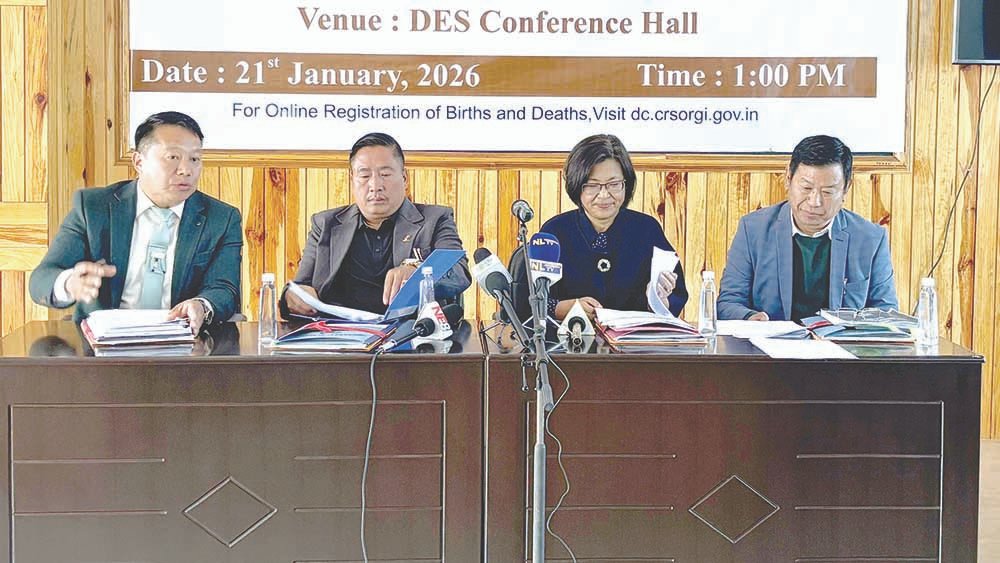
Nagaland to fully digitize birth and death registration
CorrespondentKOHIMA, JAN 21 (NPN)