
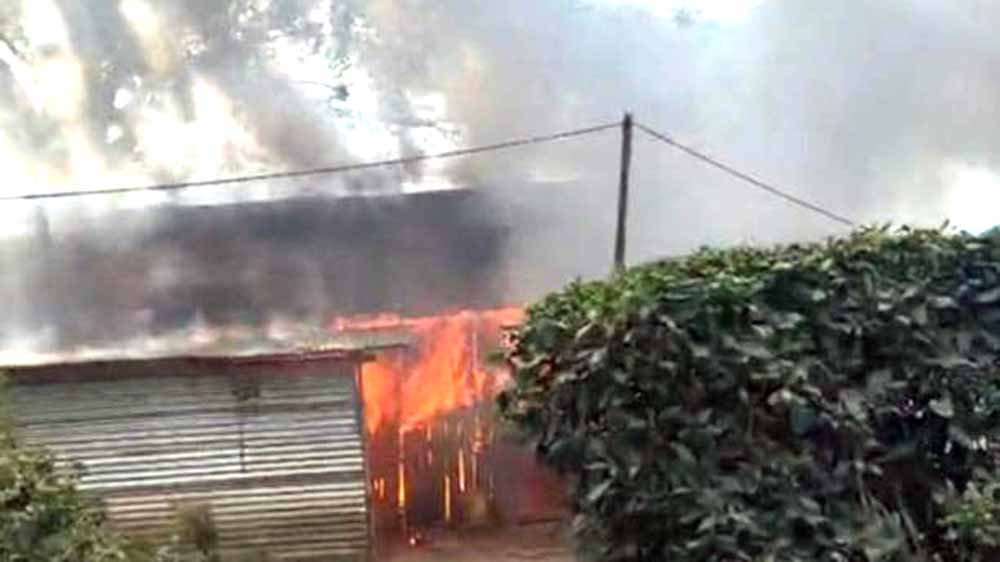
KIM, UNC JOINTLY CONDEMN ARSON AT KUKI VILLAGE, APPEAL FOR PEACE
At a time when apex bodies of Kuki and Naga tribes are working to ease tensions arising out of recent torching of some structures, the Foothills Naga Co-ordination Committee (FNCC) has set record straight on the existence of the village that has been claimed to be torched.
The FNCC, on Tuesday, while denying arson at K Songlung part II, a Kuki village, claimed that the incident involved torching of illegal farmhouses.
The committee also described K Songlung village as “an illegal self-style village” and that there was no reference to K Songlung (II) in the Manipur Gazette.
The site in question consisted only of temporary and rudimentary structures erected for poppy cultivation on ancestral Naga land, FNCC claimed in a statement issued by its information and publicity wing.
Regarding the claim by various Kuki based CSOs of arson of a village on Monday (January 26), the FNCC stated that the incident involved the dismantling and razing of at least three farmhouses near the Waphong Inthan area, an action reportedly claimed by the Zeliangrong United Front (ZUF) as part of its ongoing campaign against illicit poppy cultivation and related activities.
The GNCC alleged that the structures were being used by individuals engaged in large-scale poppy cultivation with the help of hired labourers.
Dismissing the allegations, the Kuki Organisation for Human Rights Trust (KOHUR), the Sadar Hills Chiefs’ Association and the Committee on Tribal Unity (CoTU) that a village named “K. Songlung” or “K. Songlung (II)” had been set on fire. The FNCC, however, asserted that no such village existed, either on the ground or in official records. Referring to the Manipur (Hill Areas Village Authority) Act, 1956, the committee pointed out that a village must comprise a minimum of 20 households to be legally recognized.
It further pointed out that there is no reference to K Songlung (II) in the Manipur Gazette, reiterating that the site in question consisted only of temporary and rudimentary structures erected for poppy cultivation on ancestral Naga land.
The FNCC claimed that the land historically belonged to an Inpui village known as Tamphoimon.
The original Inpui inhabitants abandoned the area during the Kuki rebellion of 1918, after which the land remained under the care and jurisdiction of Waphong Inthan Inpui village.
The Kukis illegally occupying the farmhouses arrived only in early 2017, constructed two temporary farmhouses and began poppy cultivation on the surrounding hill slopes, leading to forest destruction and unlawful claims over the land.
The FNCC further stated that despite repeated warnings and appeals from the state government and other organizations to stop poppy cultivation and illegal settlement, such activities continued unabated.
It maintained that the recent action was directed solely against illegal farmhouses linked to poppy plantations and not against any recognized village or civilian settlement.
While stating that it does not condone or encourage the destruction of villages, the FNCC reiterated its firm opposition to illicit poppy cultivation, terming it a grave social, moral and security threat to the region.
The committee expressed regret over the loss of property but maintained that the affected site was ancestral Inpui land and not a Kuki village called K Songlung. Lasting peace and co-existence can only be achieved when the Kukis abandoned their “adventurously selfish policies of territorial domination/aggression, demographic manipulation/illegal population plantations, illicit poppy cultivation and playing victim card in Naga areas, the FNCC suggested.
It added that the 24-hour ultimatum issued by SAHILCA was construed as a provocative challenge that invite conflict which SAHILCA would do well to avoid, the committee finally cautioned.
“The FNCC remains steadfast in its commitment to safeguarding land and social harmony in Naga areas,” the statement finally reiterated. The FNCC’s statement came even as the Kuki Inpi Manipur (KIM) and the United Naga Council (UNC), in a joint meeting convened today, unequivocally condemned the burning down of several households at K Songlung (Part-II) village in broad daylight on January 26, 2026, allegedly by the Zeliangrong United Front (ZUF)–Kamsom group.
The two apex tribal bodies, in a joint statement, said the incident resulted in significant loss of property and created panic among the affected families.
Expressing grave concern over the act of violence, KIM and UNC appealed to the general public and all concerned to maintain peace and exercise restraint, urging communities to avoid any form of violence.
The joint meeting further cautioned fellow tribals against writing or posting unwarranted rumours and false propaganda that could fuel animosity and tension among communities.
Expressing solidarity with the victims, KIM and UNC conveyed their concern for the affected families and underscored the need for immediate relief measures and justice for those impacted by the incident.