
Meghalaya is among the greenest states in the country, with the majority of forest areas under community management, including sacred forests and community-protected fish sanctuaries that support biodiversity and livelihoods, Chief Secretary Shakil P. Ahammed said on Friday.
Speaking at a two-day international conference titled “Scaling nature-based solutions for Himalayan resilience” here, Ahammed underscored the importance of nature-based and community-led conservation efforts in the State, noting that environmental stewardship in the state is deeply rooted in traditional practices and local governance systems.
The Chief Secretary drew attention to traditional innovations such as the living root bridges and bioengineered structures created by weaving tree roots across streams describing them as powerful symbols of intergenerational ecological responsibility. He emphasised that conservation efforts must focus on securing resources for future generations.
Despite high rainfall, he said that the state faces seasonal water stress due to terrain and runoff patterns, with significant water outflow downstream.
He also referred to climate vulnerability assessments indicating rising temperatures, erratic rainfall, and district-level risks.
Moreover, the government has introduced integrated policies and programmes covering water resource management, electric mobility, organic farming, and forest protection.
He also highlighted key achievements including large-scale mapping of streams and springs, revival of critical springsheds, expansion of ecosystem and forest protection measures, strengthening of community cooperatives, and livelihood support through community-based natural resource management programmes supported by national and international partners.
The conference brings together policymakers, practitioners, researchers, development partners, private sector representatives, youth, and community leaders from across the Indian Himalayan Region (IHR) and the wider Hindu Kush Himalaya region. The event aims to advance Nature-based Solutions (NbS) as a central strategy for strengthening climate resilience and promoting sustainable development across mountain ecosystems.
The Indian Himalayan Region is among the most climate-vulnerable areas globally, facing increasing risks from erratic rainfall, extreme weather events, ecosystem degradation, biodiversity loss, floods, and landslides.
These challenges threaten water security, food systems, livelihoods, and human settlements, underscoring the need for integrated, landscape-level responses that enhance both ecological integrity and community well-being. Nature-based Solutions are increasingly recognised worldwide as an effective framework for addressing climate change, biodiversity conservation, and sustainable development through ecological approaches. Across the Himalayan region, NbS interventions such as springshed management, watershed restoration, agroforestry, and community-led conservation are already demonstrating measurable impacts. However, many efforts remain fragmented and project-driven, with limited policy integration and financing support.
The conference is designed to address these gaps by focusing on NbS design principles and enabling conditions including governance, finance, institutions, technology, and partnerships. The conference programme includes high-level policy dialogues, technical sessions, community knowledge exchanges, youth engagements, and focused discussions on NbS financing and technology.
It is structured around a three-tier outcome framework: developing actionable NbS pathways for Meghalaya, generating policy and finance recommendations for scaling NbS across the Indian Himalayan Region, and strengthening regional collaboration on mountain-focused NbS strategies.
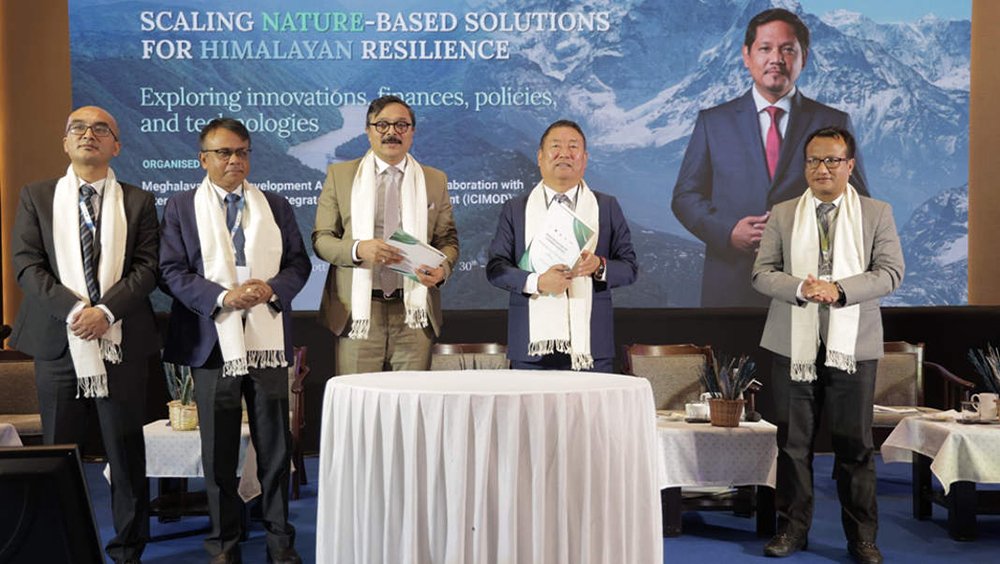
Meghalaya among greenest states in country, says Ahammed
CorrespondentShillong, Jan 30