
Minister for PHED and Cooperation, Jacob Zhimomi, on Friday stated that the Union Budget for 2026-27 reflected the long-term vision of Prime Minister Narendra Modi-led government.
Addressing a press conference at the BJP office here, Zhimomi said the budget was aimed at building an economically self-reliant, inclusive, and developed India by 2047, aligning with the “Viksit Bharat” vision.
He described the budget—presented by Finance Minister Nirmala Sitharaman on February 1, 2026—as a culmination of BJP’s manifesto commitments over the past 13 years under Prime Minister Modi.
Zhimomi emphasized that it introduced major transitional reforms in the interest of citizens’ welfare without altering the fundamental structure of the Constitution.
The minister highlighted that the budget was guided by three core principles of the Modi government: action over ambivalence, reform over rhetoric, and people over populism with “Atmanirbhar Bharat” (self-reliant India) remaining its central theme.
He noted that while India achieved political freedom in 1947, economic freedom remained incomplete due to ongoing dependence on foreign goods, services, and developed economies. Zhimomi said this reliance has negatively impacted local traders, industries, and commerce, especially in developing regions.
“Without economic self-reliance, freedom is incomplete,” he said, adding that the “Vocal for Local” campaign revived the spirit of the Swadeshi movement to bolster domestic production.
He maintained that the “Atmanirbhar Bharat” initiative shaped not only internal economic policies but also the country’s socio-political landscape and foreign relations. Since 2014, he said the Modi government has consistently reduced dependencies and built domestic capacities across sectors.
On the “Viksit Bharat” @2047 vision, Zhimomi said the budget supported the ambition of transforming India into a fully developed nation by the centenary of Independence, with all states playing an integral role.
The minister pointed out major booster support for MSMEs, small and medium industries, local economies, khadi and village industries, urban local bodies, and Panchayati Raj institutions (including village councils in Nagaland). He said women-led participation was prioritized as a key driver of economic growth and governance.
Further, the minister said that government’s focus on structural reforms aims to strengthen families, villages, and towns through micro-level planning. “Development must begin at the grassroots and reach the last person in the last village,” he stated.
Highlighting the government’s mantra “Sahakar Se Samriddhi” (prosperity through cooperation), Zhimomi said it promoted shared prosperity over individual wealth. He said cooperative societies nationwide would now be recognized as startups, enabling access to institutional support. “In states like Nagaland, land is our biggest asset and capital. Our villages and fields can become startups,” he added, noting this approach unlocks local economic potential.
On fiscal prudence, he likened national budgeting to household finances: expenditure must align with income to avoid deficits. “You cannot earn Rs 100 and plan to spend Rs 200. That is not an economy. That is not the model Prime Minister Modi is advocating,” he said. Zhimomi stressed on savings, security provisions, and planned expenditure.
He said the budget adhered to responsible spending, with fiscal discipline evident in targets like a reduced fiscal deficit.
Zhimomi also termed the budget “youth-centric,” viewing India’s vast youth population as its greatest capital. He said the focus was on strategic, productivity-driven employment through skilling and upskilling, rather than temporary jobs, to prepare youth for future challenges.
The minister also said that significant allocations support agriculture, allied sectors, employment generation, and income-enhancing activities, ensuring every citizen accesses resources and opportunities.
He assured that no state would be left behind, with progress monitored via sustainable development goals, environmental protection, climate sensitivity, and adherence to global norms including carbon credit mechanisms.
Key highlights included the expansion of Ayushman Bharat and exemptions on life-saving medicines (such as cancer drugs) to make healthcare affordable. Innovation, research, technological advancement, and national security receive major attention, including investments in space technology and defence.
Zhimomi also highlighted government’s focus on the Northeast, promoting organic farming, tourism, and biodiversity conservation. He said tourism infrastructure would be strengthened to revive traditional practices and position India as a global destination.
Expressing confidence, the minister said the Union Budget would propel India from the world’s fifth-largest economy toward becoming one of the top economies by 2047, with Nagaland contributing meaningfully to national development.
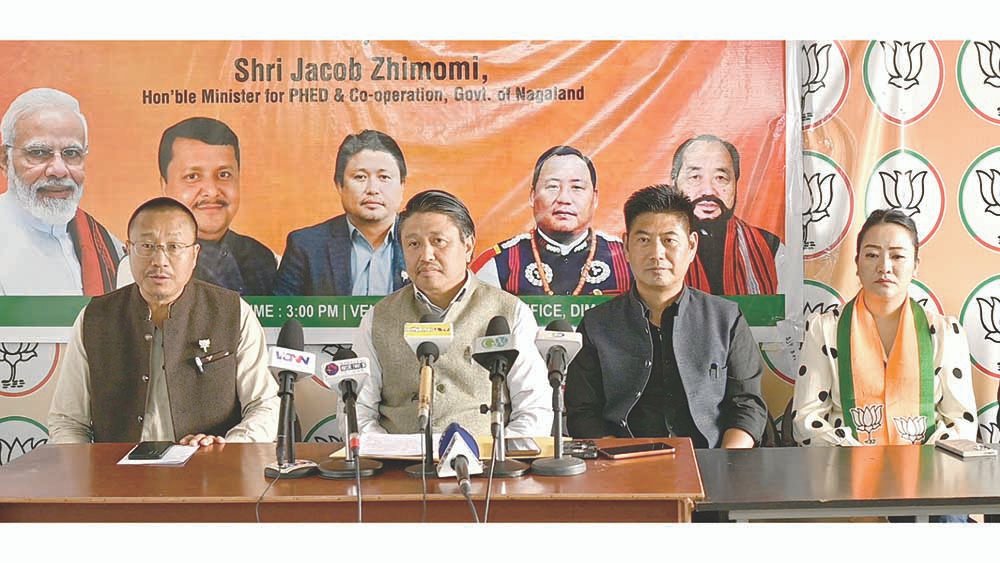
Union budget reflects long-term vision of Modi govt: Jacob
Staff ReporterDIMAPUR, FEB 6 (NPN)