
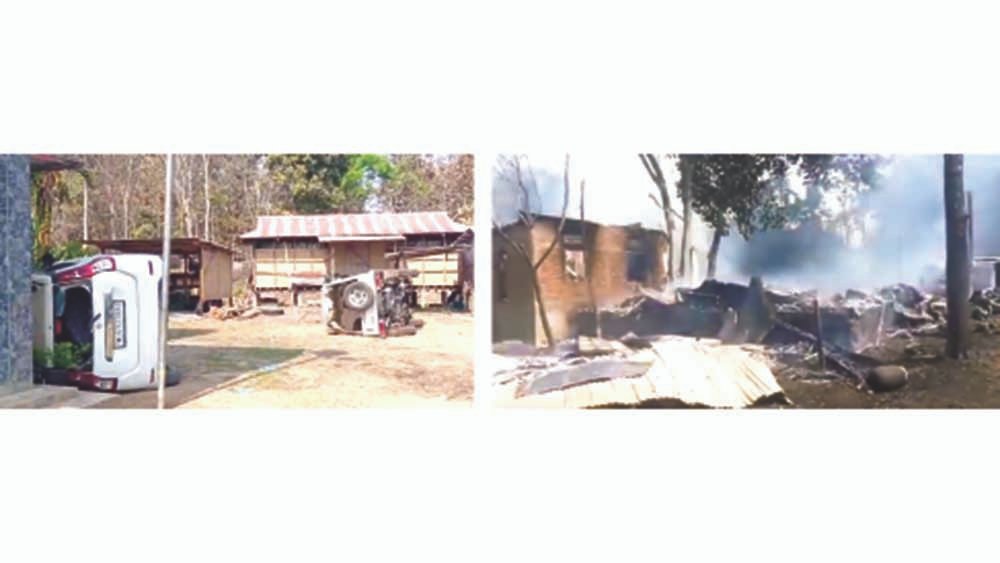
A long-standing land dispute in Maova village under Medziphema sub-division escalated into violent clashes on Friday, leaving several injured, including Extra Assistant Commissioner (EAC) Medziphema and police personnel. Multiple vehicles and structures were also damaged in the unrest.
Information about the sequences of events was sourced from a press release by DCP Crime and PRO Dimapur police. According to PRO, information was received around 9:30 a.m. regarding a meeting between members of the Chakhroma Youth Organization and Maova villagers. Anticipating law and order concerns, EAC Medziphema, the officer-in-charge of Medziphema Police Station, DBs, and security forces rushed to the site to maintain peace.
Upon arrival, officials found both groups engaged in heated arguments. By 10:30 a.m., the situation spiraled into physical scuffles, with sticks, chairs, and stones used in the confrontation. Despite efforts by security personnel to disperse the crowd, PRO said the violence intensified as nearly 2,000 people gathered.
During the clashes, EAC Medziphema and two security personnel sustained injuries. One NAP (IR) jawan suffered a serious head injury from stone-pelting and was hospitalized. Meanwhile, a mob vandalized nine houses and three shops, torched eight shops, a community hall, a youth office, and a council guest house under construction. More than 30 LPG cylinders exploded in the fire, though no fatalities were reported. Twenty-one vehicles were damaged, three of them completely burned.
Timely reinforcements led by DCP Chümoukedima, along with fire tenders, brought the situation under control by 11:30 a.m. Security measures have since been strengthened, and normal traffic resumed in the area.
Commissioner of Police, Dimapur, condemned the violence, arson, and destruction of property, urging citizens to maintain peace, exercise restraint, and avoid spreading rumours. Civil society groups, community leaders, and youth organizations have been called upon to cooperate with authorities to prevent recurrence.
Authorities have urged the public to maintain peace and exercise restraint. Citizens have been advised against spreading rumours or unverified information through social media and cautioned not to assemble unlawfully or take the law into their own hands.
Community leaders, civil society organisations, and youth bodies have been requested to extend full cooperation to the administration and police in preserving harmony and preventing a recurrence of such incidents.
Dimapur Police reiterated its commitment to safeguarding lives and property, stressing the importance of collective responsibility in upholding communal peace.
We did not go there to create violence: CPO
The Chakhroma Public Organization (CPO) has strongly condemned the violent confrontation at Maova village under Medziphema sub-division, while reiterating its commitment to dialogue and peaceful resolution of land-related disputes.
Briefing the media at CPO Hall, CPO president Zhato Kimho said the Chakhroma community was not accustomed to violent confrontations and had historically coexisted peacefully with Kuki communities in the region. He alleged that relations had soured in recent years due to restrictions imposed on landowners despite land being sold. According to him, in six or seven Kuki villages under CPO jurisdiction, land purchased by Naga individuals was later restricted from development activities such as farming, fisheries, fencing, or construction.
“Materials are seized, youths are sent to chase people away, and everything is done in the name of the GB’s order,” Kimho claimed, adding that complaints had been reaching the CPO for the past three to four years.
He explained that after receiving reports of construction being carried out by the village GB on land allegedly purchased by others, the CPO conducted a physical verification and issued a formal notice on December 2, giving time until December 25 for removal of the structure. The notice, he said, was ignored despite reminders.
“With no response even after the deadline passed, we decided to go and meet the GB and the chairman to understand their motive,” he stated.
Kimho alleged that upon arrival, the delegation was blocked on the highway by 70–80 villagers, including women, who formed a human barricade. “I was pushed, and they refused to let us pass even after I introduced myself as the CPO president,” he said, stressing that the team had gone unarmed for dialogue.
He further claimed that stone-pelting began in a “pre-planned” manner, leading to injuries to an IRB constable and the EAC. He added that after reinforcements were called, CPO youths chased villagers towards the GB’s residence, where the house was later set ablaze. Loud explosions were heard during the fire, which he attributed to gas cylinders.
Kimho reported that around 24 CPO members were injured and three vehicles damaged. He denied any pending court case over the disputed plot, insisting the matter was rooted in traditional and customary arrangements. He maintained that Kukis were allowed to settle in the area with permission from Naga forefathers.
CPO vice president Sebastian Zumvu said the leadership had gone for dialogue but alleged villagers were armed with stones, lathis, and daos. He noted that the injured constable was standing next to the president and that he himself was struck on the leg.
CPO finance secretary Zasivikho Zakiesato emphasized that the GB and chairman must take responsibility, clarifying that the incident was not a clash between two communities but involved individuals attempting to create division. He highlighted that inter-community relationships, including intermarriages, had existed for decades, and recalled that CPO had extended humanitarian assistance to all communities during the Manipur conflict.
Kimho concluded that the organization would consult Angami elders before deciding on the future course of action. He stressed that CPO did not intend to escalate tensions but termed the response they faced as “shocking and unacceptable.” He called for greater awareness among the Naga public regarding land-related developments in the area.
It could have been resolved through dialogue: Maova VC
Meanwhile, Maova Village Council chairman Sutminlal Vaiphei has alleged that a large mob stormed the village during Friday’s clashes, vandalising properties, torching structures, and injuring several villagers.
Vaiphei said the dispute stemmed from two small plots near Chathe Bridge close to the Chathe Prayer Centre, which had been contested since last year. He confirmed that a notice was received and claimed a reply was submitted, but no further communication followed. “We thought they were coming for talks. At that time, the EAC, Dobashi, GB and I were discussing how to stop the issue peacefully. While we were talking, clashes broke out on the road between youths and the situation went out of control,” he stated.
Denying any premeditated confrontation, Vaiphei described the incident as unfortunate and said villagers, including women, sustained injuries. He estimated that around 10 structures, including shops, were damaged or burned, along with vehicles and nearby property. He appealed for state government intervention to resolve the dispute and restore normalcy, adding that earlier replies to the Deputy Commissioner had gone unanswered.
Village GB Seiboi corroborated the account, saying he had alerted authorities after learning of a large convoy heading towards the village. He alleged that CPO youths destroyed a newly built house and forced entry into his residence, damaging vehicles and household property. “While trying to stop them, the EAC was also injured,” he said.
Seiboi estimated that around 1,000 people were involved, overwhelming the police presence. He reported that a community hall, an incomplete guest house, a youth office, and several shops were burned, while five two-wheelers, five four-wheelers, and one JCB were damaged. Windows of his house were also smashed during stone-pelting.
Expressing concern for safety, he said women and children were traumatised and appealed to the state government and police to provide adequate security to prevent further escalation.