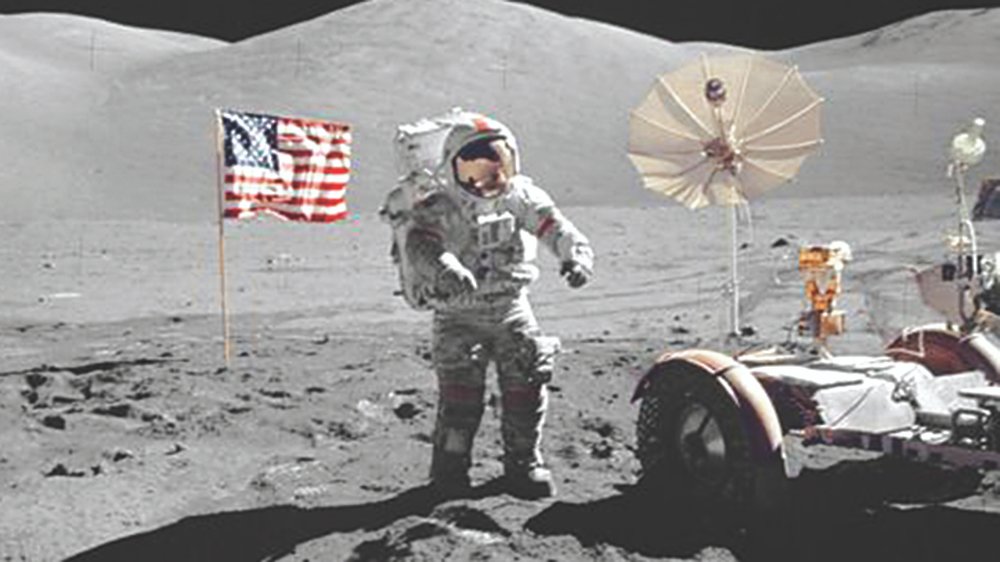
As he took his final steps before leaving the moon, Apollo 17 commander Gene Cernan had some poignant closing words: “We leave as we came, and, God willing, as we shall return, with peace and hope for all mankind.”
It was December 14, 1972, and Cernan knew his footprints would be the last to impress the lunar soil for a while, because the planned Apollo missions that were supposed to follow — 18, 19 and 20 — had long since been canceled. But he probably wouldn’t have guessed that, over 50 years later, his speech would stand as the last words spoken by a human on the moon.
Artemis II, which NASA is preparing to launch as soon as March after recent testing delays, will perform a lunar fly-by rather than a landing. Still, the mission will mark humanity’s first journey to the vicinity of the moon since Apollo 17. “The short answer to that question is political will,” said Teasel Muir-Harmony, a historian of science and technology and the curator of the Apollo Collection at the Smithsonian National Air and Space Museum in Washington, DC. “It takes a whole lot of political will to send humans to the moon. These are extremely complex, really costly, major national investments. It has to be a priority over a sustained period of time.”
In the years since the Apollo program ended due to budget cuts, there have been a number of other federal initiatives to send humans to the moon again, Muir-Harmony added. “But what’s happened is that as presidential administrations changed, space priorities for these large-scale programs also changed. And so we just haven’t seen the sustained political will to follow through with a program that will take many years, significant funding and lots of resources in general.”
Les Johnson, a former NASA chief technologist who worked at the agency for over three decades, agreed that rapidly changing political objectives have been a key factor: “Every four to eight years, NASA has its human spaceflight goals and objectives completely, totally, radically altered,” he said.
“When I joined NASA in 1990, we were directed to go back to the moon by then President George H.W. Bush. But when President Clinton took office in 1993, he canceled that. He said, we’re going to make the space station happen — don’t do anything associated with going back to the moon,” Johnson said. “We did that for eight years, and then in 2001 we got George W. Bush, and he said, cancel all this other stuff and let’s focus on going back to the moon. So we did, and a project called Constellation was born, which survived the two terms of the second Bush presidency.”
The cycle continued with Barack Obama moving NASA’s priorities more toward sampling asteroids, and President Donald Trump coming in and shifting back to lunar goals. Then, after 2020, Joe Biden broke up the pattern.
“He was the first president in my career at NASA who did not change everything,” Johnson said of Biden. “He said, I really didn’t like a lot of what Trump did, but I think going back to the moon is a good idea. Let’s just keep going.” Now, in Trump’s second term, his administration has recently doubled down on returning astronauts to the lunar surface — intent on outpacing China in the new space race. (RNZ)