
The 16th Scientific Advisory Committee (SAC) meeting under the Indian Council of Agricultural Research (ICAR) Krishi Vigyan Kendra (KVK) was held at the conference hall of Nagaland University, Lumami, Zunheboto, on February 16. The meeting was chaired by Prof. J.K. Patnaik, Vice-Chancellor of Nagaland University.
Representatives from the Department of Livestock and Animal Husbandry highlighted the critically low population of the Sumi Ne (Sumi goat), a rare long-haired breed found in Satakha and Keltomi. Its fibre, traditionally used for jewellery by the Sumi community, has commercial potential but requires urgent conservation.
Prof. J.K. Patnaik described the decline of the Sumi goat as serious, stressing the need for conservation alongside adoption of modern technologies. He remarked, “First, let us protect our culture, and then we can think about scaling up.” He assured that Nagaland University and SAC would continue to collaborate and provide training and resources for farmers.
A fruit scientist recalled Nagaland’s declaration as a horticulture state in 2014, urging greater focus on minor fruits and vegetables, and stressing proper processing for coffee to enhance market value.
Dr. Rakesh Kumar Chaurasia, principal scientist and head, KVK Zunheboto, presented the Annual Progress Report for 2025, while Dr. Visakho Shunyu, CTO (GPB and Agronomy), outlined the Annual Action Plan for 2026. The agenda included review of the Action Taken Report from the 15th SAC meeting, discussion on the Annual Report 2025, and suggestions for the Annual Action Plan 2026, with emphasis on technologies suited to Zunheboto’s agro-climatic conditions.
Farmers also shared feedback. L. Holuto Ayemi, chairman of the Farmer Producers Organisation (FPO), Zunheboto, acknowledged KVK’s outreach to remote villages nearly 90 km away and called for follow-up visits, more focus on animal husbandry, and training on integrated farming systems. Kakuto Assumi of Litami village highlighted irrigation challenges, coffee plantation issues, and crop destruction caused by elephants. H. Ghukhali Sema of Naghuto village shared her success story of earning around Rs. 40,000 annually through value addition training by KVK. Itohei of Khrimito village noted KVK’s support in piggery, poultry and food processing.
SAS officials emphasized integrated farming systems and linked elephant incursions into fields to floods in Assam and deforestation in Nagaland. Members recommended focusing on indigenous crops, noting rabi soybean’s poor performance in the state.
In his concluding remarks, Prof. J.K. Patnaik commended KVK for its outreach and satisfactory work, noting that Naga farmers are enlightened and proactive. He said efforts would be made to secure funding from agencies such as NABARD to conserve the endangered Sumi goat in cooler hill zones.
The meeting concluded with a vote of thanks delivered by Dr. Kundan Kumar, SMS (Agricultural Extension).
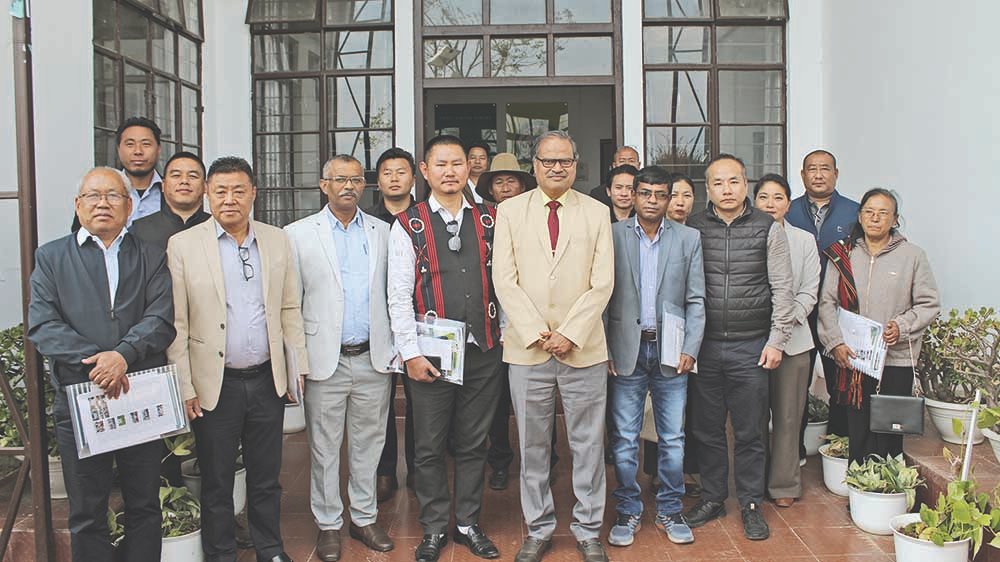
Nagaland: SAC stresses conservation of endangered Sumi goat
DIMAPUR