
The two-day, first-ever Soybean Festival in Nagaland is underway at Angh Hall, Agri Expo, Chümoukedima under the theme “From Field to Feast: Celebrating our Soybean Legacy”. Organised by ICAR–AICRP on Soybean under TSP and NEH component, School of Agricultural Sciences (SAS), Nagaland University, Medziphema Campus, the festival aims to popularise soybean cultivation and highlight its nutritional, agricultural and economic importance.
Speaking at the inaugural session as special guest, director, Department of Agriculture, Sanuzo Nienu, said crop-based festivals were celebrated across the country to promote cultivation, and the soybean festival was a significant step for Nagaland. He expressed happiness at the large turnout of farmers and described soybean as the “miracle bean” and “golden bean” due to its rich protein and oil content. He noted that soybean is vital for human consumption, animal feed, soil fertility through nitrogen fixation, and even industrial uses such as glue production. Cultivated in over 50 million hectares worldwide, soybean has become one of the most important crops globally.
Nienu also cautioned that excessive consumption may cause digestive discomfort, and advised individuals with allergies or iodine deficiency, as well as pregnant and breastfeeding women, to exercise care. He encouraged farmers to adopt the knowledge and practices shared during the festival for better productivity and income.
Delivering the keynote address, Professor SAS-NU, L. Tongpang Longkumer, described soybean as a “wonder crop” and “meat of the poor” since its protein is comparable to meat while its oil is cholesterol-free. He highlighted that soybean accounts for nearly half of India’s oilseed production, with Nagaland cultivating 13,105 hectares and producing 17,422 metric tonnes annually. He observed that productivity remains low due to limited use of manure and modern inputs, though Mon district currently leads in production.
Longkumer shared that the national average yield stands at 11.79 quintals per hectare, with Telangana recording the highest at 18.8 quintals. Nagaland’s average yield is 12.6 quintals, with potential to increase to 15–16 quintals. He added that Mon district currently leads as the highest producing district in the state.
He underscored the need for sustainable practices, advocating bio-pesticides over chemical pesticides. While India uses about 7,489 metric tonnes of bio-pesticides annually, Nagaland’s usage stands at only 38 metric tonnes, reflecting scope for improvement.
Earlier, the programme was chaired by Prof. Akali Sema, professor in-charge, Research Cell, SAS-NU. Prof. A.K. Singh, Department of Agronomy, SAS-NU, delivered the welcome address, while Dr. G. Zion, YP-I, AICRP on Soybean, SAS-NU, proposed the vote of thanks.
The inaugural session also featured presentations by Dr. Bendangsenla Imsong, SMS/CTO (Plant Breeding & Genetics), KVK Jharnapani, on “Variety selection for rainfed conditions”, and Dr. Pezangulie Chakruno, Junior Scientist (Plant Pathology), AICRP on Soybean, SAS-NU, on “Soybean Scenario of Nagaland”.
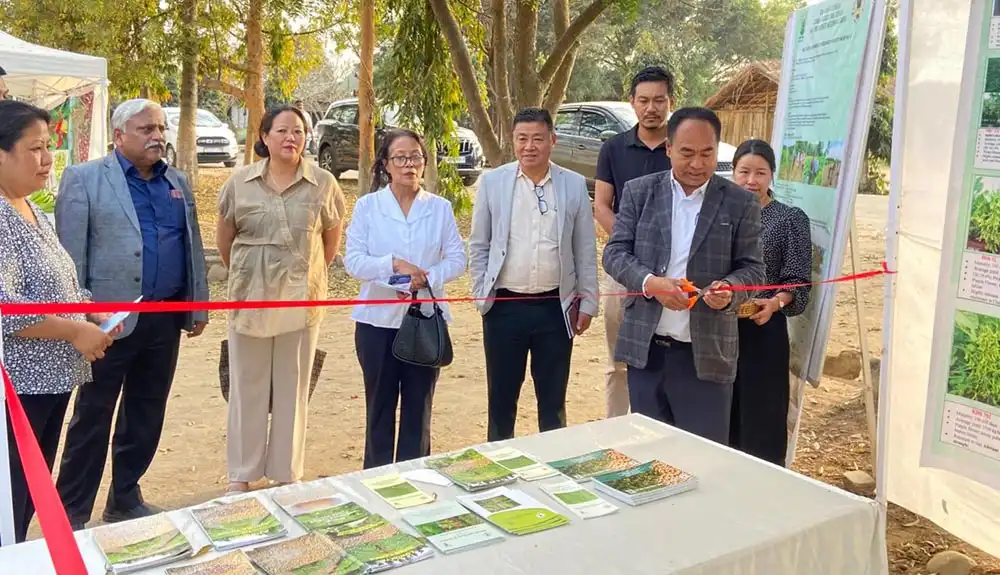
Nagaland hosts first soybean festival
Staff ReporterDimapur, Feb 20 (NPN):