
Enable India, in collaboration with the office of the state Commissioner for Person with Disabilities, Nagaland State Disability Forum and Pordigals’ Home, launched ‘Our Vaani’ on February 25 at Don Bosco Institute for development and Leadership (DBIDL), Dimapur, Nagaland.
Our Vaani is an accessible social networking platform that enables persons with disabilities and communities, especially in rural and semi-urban areas to access information on education, skilling, employment, and government schemes through a simple phone call, without the need for internet connectivity.
Nandini Kavita of Enable India, launched, ‘Our Vaani,’ by introducing it as a social networking platform for persons with disabilities developed by Enable India. The platform allows users to share and access solutions, information, and updates from their homes using any phone, making it accessible even in remote areas.
Initially launched in Kannada language, it expanded to Bangla, Tamil, Hindi, English, enabling knowledge-sharing across states and communities. The platform is moderated to ensure accurate information.
Nandini Kavita said the platform also allows the government to provide information, including schemes for persons with disabilities, while emphasizing that ‘Our Vaani’ empowers people with disabilities to share their voices, replicate solutions, and connect directly with each other. She also emphasized that people with disabilities should empower themselves and feel proud when their voices are heard in the community.
She explained that ‘our Vaani’ allows sharing a wide range of information useful to persons with disabilities, including assistive aids, awareness, livelihood, education and training, legal information, government documents and schemes, experience sharing, extracurricular activities, employment news, and medical information. The platform is organized into five channels: main, for urgent announcements; employment, for job-related news; skilling, for education and training; assistive aid solutions, for challenges and their remedies; and miscellaneous, for general knowledge and community sharing.
Users can also share practical guidance, such as rights, and medical treatment experiences, which can be used across states. She also encouraged users to actively participate without fear of mistakes, making it a unique and accessible tool for the disability community.
Nagaland State Disability Forum, president, V. Fatima Kera, who emphasized that disability inclusion must go beyond words and be reflected in practical action. Simply talking about accessibility is not enough if basic facilities, such as wheelchair ramps, are not provided. True inclusion means understanding the specific needs and challenges of persons with disabilities.
She also highlighted the importance of inclusive communication, such as giving verbal self-descriptions for visually impaired participants and providing sign language interpreters for those who are hearing impaired. She stressed that inclusion is about creating an environment—both physically and attitudinally—that genuinely accommodates and respects their needs.
Representing the district administration as well as the District Level Committee on Disability, Extra Assistant Commissioner (EAC), Imtijungla Lemtur, described the platform’s launch as more than just the introduction of a new initiative, calling it a step toward strengthening the voices of persons with disabilities. She said it reinforces commitments to accessibility, inclusiveness, and dignity, stressing that disability is not about charity but about increasing access.
From a policy perspective, she noted that disability rights require proactive and practical implementation, not just protection. Highlighting connectivity challenges across the region, she said the platform could help close information gaps. She encouraged the PWD community to actively use the platform and provide feedback, emphasizing that it is a two-way process, with feedback coming from both sides so that we can move forward and do what is best for the PWD community as a whole.
Representing the office of the state Commissioner for Person with Disability, Kohima, Nagaland, Ashe H. Kiba outlined the functions of the Office of the State Commissioner for Persons with Disability (SCPD) in Nagaland, established under Section 79 of the RPWD Act 2016. The office identifies laws or policies inconsistent with the Act, investigates rights violations, reviews safeguards, promotes awareness, undertakes research, monitors implementation of schemes, and can function as a court in cases related PWDs.
She stressed that while the office works to protect the rights of persons with disabilities, many individuals hesitate to come forward or disclose their identity to assert their rights. She urged persons with disabilities to empower themselves, recognize their abilities, and actively advocate for their rights rather than relying solely on sympathy or charity.
Enable India’s Dil Bahadur Sunar also demonstrated how to use the platform, showing participants how easy it is for persons with disabilities to access information and share solutions using any phone.
Anyone who wants to access ‘Our Vaani’ can simply dial 7669074637 from their phone to listen to, share, and receive important information for persons with disabilities.
Earlier, the programme was chaired by Yangerjungla, sign interpreter, Ruth Longkumer, welcome speech by Pordigals’ Home, director, K. Ela, a song by Eshen and friends, vote of thanks by Nagaland State Disability Forum, Ngaugonbe and benediction by ACID, assistant director, Sr. Graceful.
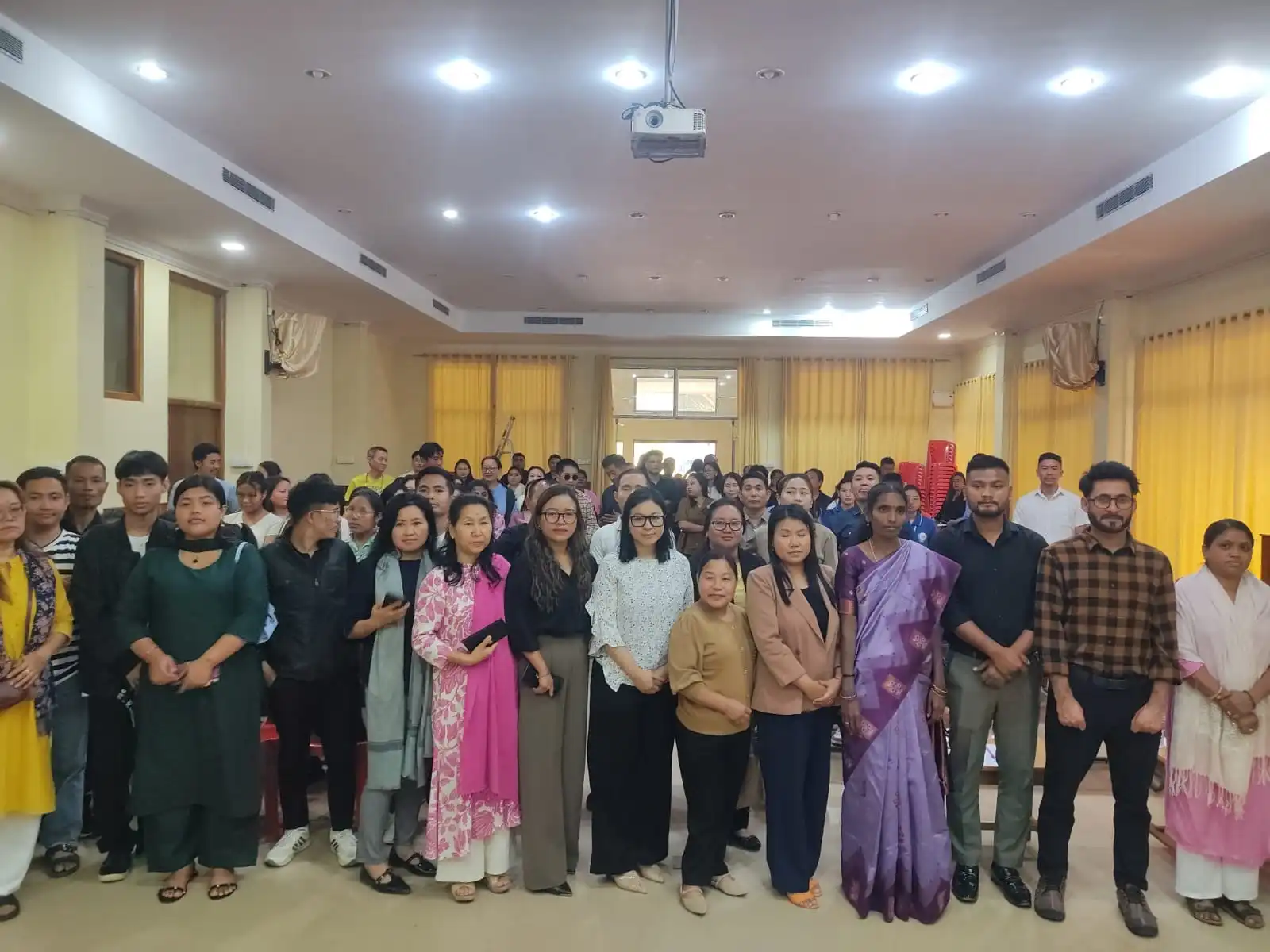
‘Our Vaani’ launched in Nagaland for PwDs
Staff ReporterDIMAPUR, FEB 25 (NPN):