
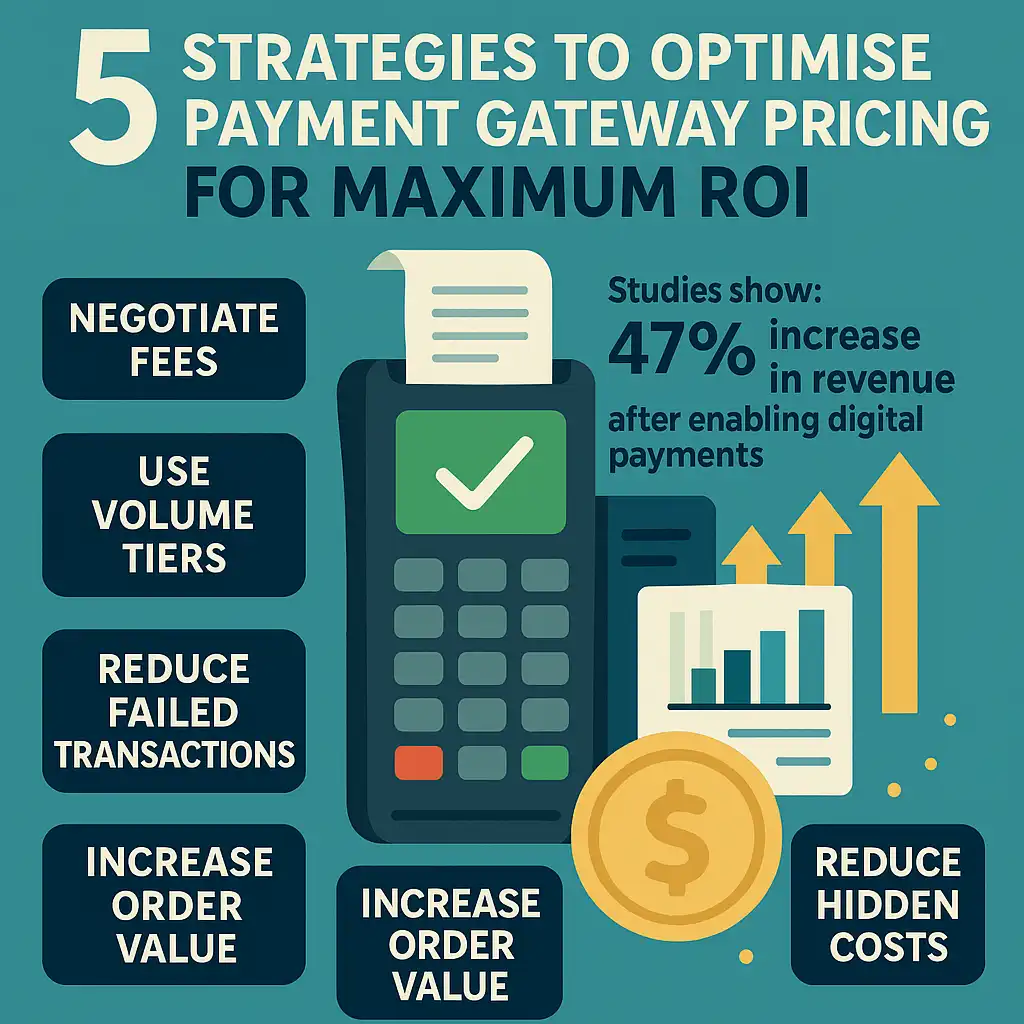
Studies show that businesses report a nearly 47% increase in annual revenue after enabling digital payments, underscoring the integral role of payment systems in sales performance and operational efficiency.
Yet the true cost of processing transactions is often overlooked. Gateway fees, settlement delays, failed payments, refunds and disputes can quietly reduce margins when pricing structures aren’t assessed regularly.
Strategic pricing decisions directly influence cash flow, protect margins and support long-term growth. This makes optimising payment gateway pricing essential for achieving a stronger ROI from every transaction. Let’s explore five strategies that optimise the payment gateway.
Effective ways to enhance payment gateway pricing for stronger ROI
A well-structured pricing approach helps businesses reduce payment processing costs without compromising performance. These effective strategies ensure your payment gateway delivers stronger ROI while maintaining a smooth, reliable checkout experience.
- Analyse your transaction volume to negotiate better pricing
Payment gateway pricing often depends on monthly transaction volumes. Higher volumes usually qualify businesses for discounted pricing tiers. Before negotiating, businesses should analyse:
- Average monthly transaction count
- Peak-season spikes
- Payment method distribution
- Refund and dispute ratios
Understanding this data helps businesses negotiate structured pricing instead of accepting flat rates.
A scalable payment gateway that offers competitive pricing for higher volumes ensures that as your transactions grow, your cost per payment reduces, improving overall ROI. Businesses processing large volumes should always request volume-based price breaks or custom pricing models aligned with their growth trajectory.
- Use multi-mode payments to reduce failed transactions
Failed transactions increase operational costs and directly impact profit margins. A payment gateway offering multi-mode payments, Unified Payments Interface (UPI), cards, net banking, loyalty points and split-payment options, helps reduce failures caused by:
- Insufficient balance
- Expired cards
- Issuer declines
- Network timeouts
Multi-mode support improves conversion rates and reduces the need for repeated payment attempts, which indirectly optimises your cost per transaction.
By enabling payments through multiple methods, including the ability to split payments in a single checkout, businesses avoid revenue leakage and maximise the value of each processed transaction.
- Adopt affordable payment options to increase order value
Affordability plays a major role in driving sales for mid-to-high-value categories. Payment gateways with built-in affordability tools, such as EMIs, Pay Later options and loyalty point redemption, help increase:
- Average Order Value (AOV)
- Repeat purchases
- Customer satisfaction
By offering customers more freedom to complete their purchase in flexible ways, businesses see a rise in conversions and revenue. A payment gateway with an extensive affordability suite reduces price sensitivity, spreads customer outflow over time and improves sales volume.
- Use real-time insights to reduce hidden costs
A data-driven payment gateway provides dashboards that allow businesses to track:
- Success rates by bank, issuer and payment mode
- Refund and dispute patterns
- Settlement timelines
- Transaction health and peak activity
- Checkout drop-off trends
These insights help identify revenue leaks, bank-specific issues or underperforming payment modes.
For example, if a payment method consistently shows low success rates, you can route customers toward more reliable options to protect revenue. Additionally, real-time insights help prevent unnecessary dispute fees, reduce customer support costs and optimise settlement cycles.
Data-driven decisions reduce operational inefficiencies and strengthen performance, proving that intelligence is a key component of pricing optimisation.
- Improve security and compliance to avoid financial penalties
Security breaches can be financially damaging, causing losses through chargebacks, fraud, customer churn and regulatory penalties. A high-security payment gateway helps businesses stay compliant with standards and ensures:
- Tokenised transactions
- Encrypted data
- Reduced fraud exposure
- Safer authentication flows
- Compliance with local regulatory requirements
Better security reduces disputes and chargebacks, protecting margins while maintaining customer trust. It also prevents incidents that could lead to regulatory fines or legal costs.
When security is integrated into the gateway, businesses avoid heavy investments in external tools and infrastructure, making secure operations more cost-effective.
Strengthen profitability with the right payment gateway
A well-optimised payment gateway is one of the most effective tools for improving ROI across digital transactions. By reducing friction, supporting multiple payment modes, strengthening security and offering smarter pricing configurations, businesses can convert more customers without inflating operational costs.
As digital payments continue to accelerate across sectors, choosing a gateway built for reliability, scalability and affordability becomes essential for long-term success. Trusted providers like Pine Labs Online offer payment gateway solutions with flexible pricing and data-driven optimisation at scale.
With the right payment gateway strategy, businesses can reduce costs, protect margins and unlock sustainable growth across every online revenue channel.