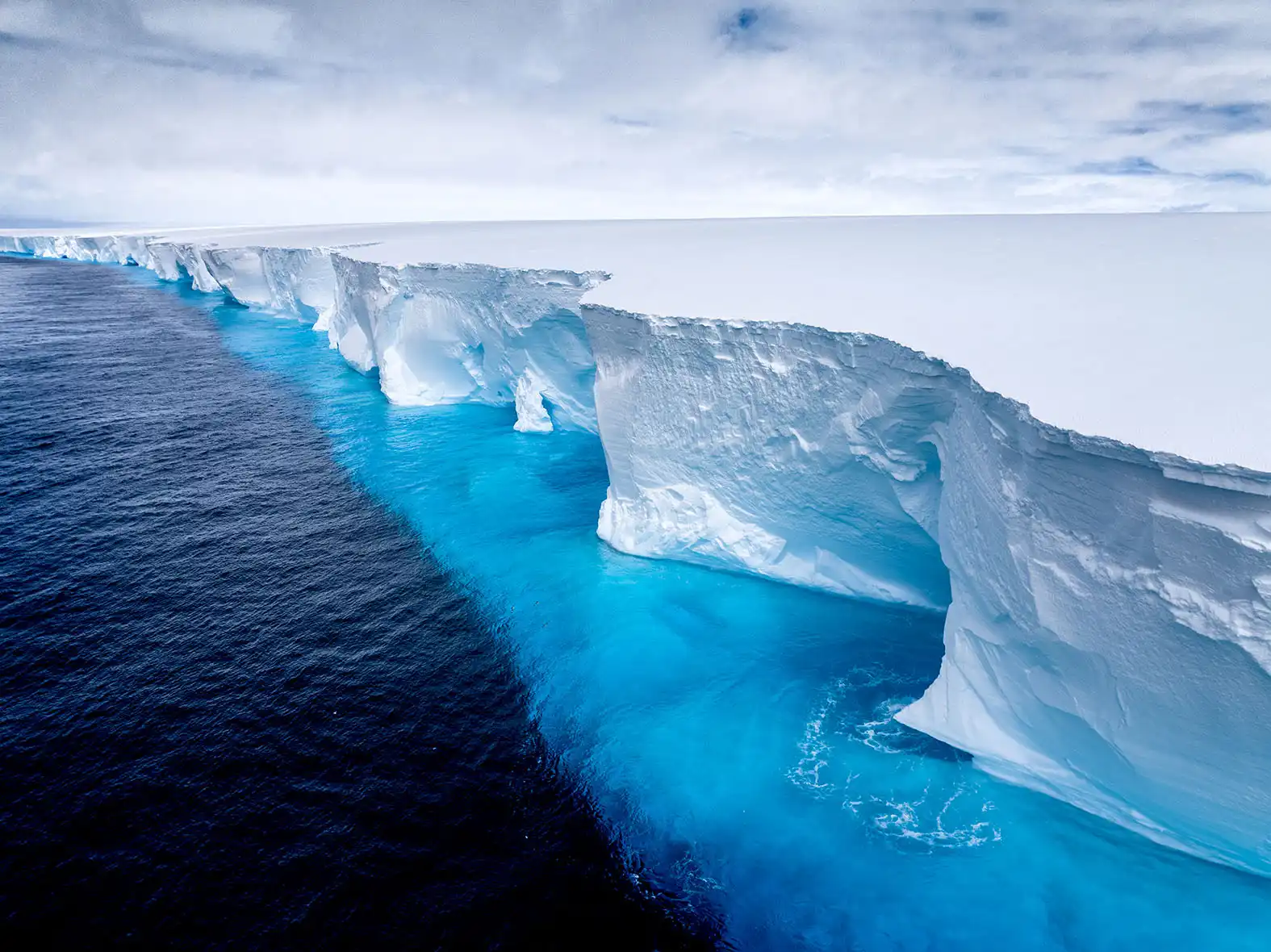
The story of one of the world’s oldest icebergs is nearly at an end, after a breathtaking 40-year journey that has captivated scientists.
The iceberg, known as A23a, was once the largest on Earth, covering an area more than twice the size of Greater London.
But after a path full of twists and turns, A23a has melted, fractured and spectacularly disintegrated over the past year.
Now, far from the icy seas of Antarctica, what’s left of A23a is being eaten away by warmer waters. It’s in its death throes, not expected to last more than a matter of weeks.
All icebergs melt eventually, but scientists have been looking at how it’s disintegrated for clues about how other parts of Antarctica might respond as the climate changes.
“It’s been an extraordinary journey,” says Prof Mike Meredith of the British Antarctic Survey in Cambridge. “But it is on its last legs now.”
This is the story of A23a’s final months.
But first we have to go back to 1986. That year, a nuclear reactor exploded at the Chernobyl power plant in what is now northern Ukraine, Gary Lineker won the golden boot at the Fifa World Cup in Mexico, and Whitney Houston received her first Grammy award.
Away from the world’s gaze, the Filchner Ice Shelf – a massive floating tongue of ice extending from the Antarctic continent and into the Weddell Sea – was changing dramatically. One of the icebergs to break off – or calve – was A23a, then about 4,000 sq km (roughly 1,540 sq miles). It soon became anchored in the muds of the Weddell Sea, where it remained stuck for more than 30 years. It wasn’t until 2020 that scientists noticed signs that A23a was on the move again.
While it’s likely icebergs have lived longer in the Earth’s distant past, A23a is thought to be the oldest iceberg in the world today, at least among those picked up by satellites and tracked by scientists.
“Its journey is really pretty impressive, just for sheer longevity,” says Dr Christopher Shuman, a retired scientist formerly with the University of Maryland, Baltimore County, in the US. He likens tracking its path to watching a TV drama “where you don’t know what you’re going to see next”.
As A23a moves across the vast South Atlantic Ocean, it can be hard to grasp its scale – but if you could drop it into the English Channel its size would be much more striking.
At the start of 2025 – even after 39 years – A23a was still a collosus. It would have almost stretched between the Isle of Wight and Normandy in France. Now, it wouldn’t even reach halfway from Dover to Calais.
“To watch it be so stable for so long, and then just disintegrate over one year, has been fascinating,” says Dr Catherine Walker of the Woods Hole Oceanographic Institution in the US, who was born the same year as A23a.
Through the first half of 2025, A23a shrank by about a quarter, as chunks of ice broke off and ocean waters ate away at its sides and base. By midway through the year, A23a had lost its title as the world’s biggest iceberg, but it was still going strong. (BBC)
Then in August and September, A23a found itself in an area of the South Atlantic Ocean above the North-west Georgia Rise. It’s a mound on the seabed roughly a couple of kilometres high, about 1,500km (930 miles) east of the Falklands.
Above the rise, A23a appeared to be spinning on a rotating column of ocean water for a few weeks. Scientists believe those mechanical forces on an iceberg already weakened by warm waters could have helped to effectively pull the berg apart.
Several large icebergs broke off A23a in quick succession – bergs big enough to be given their own names, A23g, A23h and A23i, showing they calved from the original.