
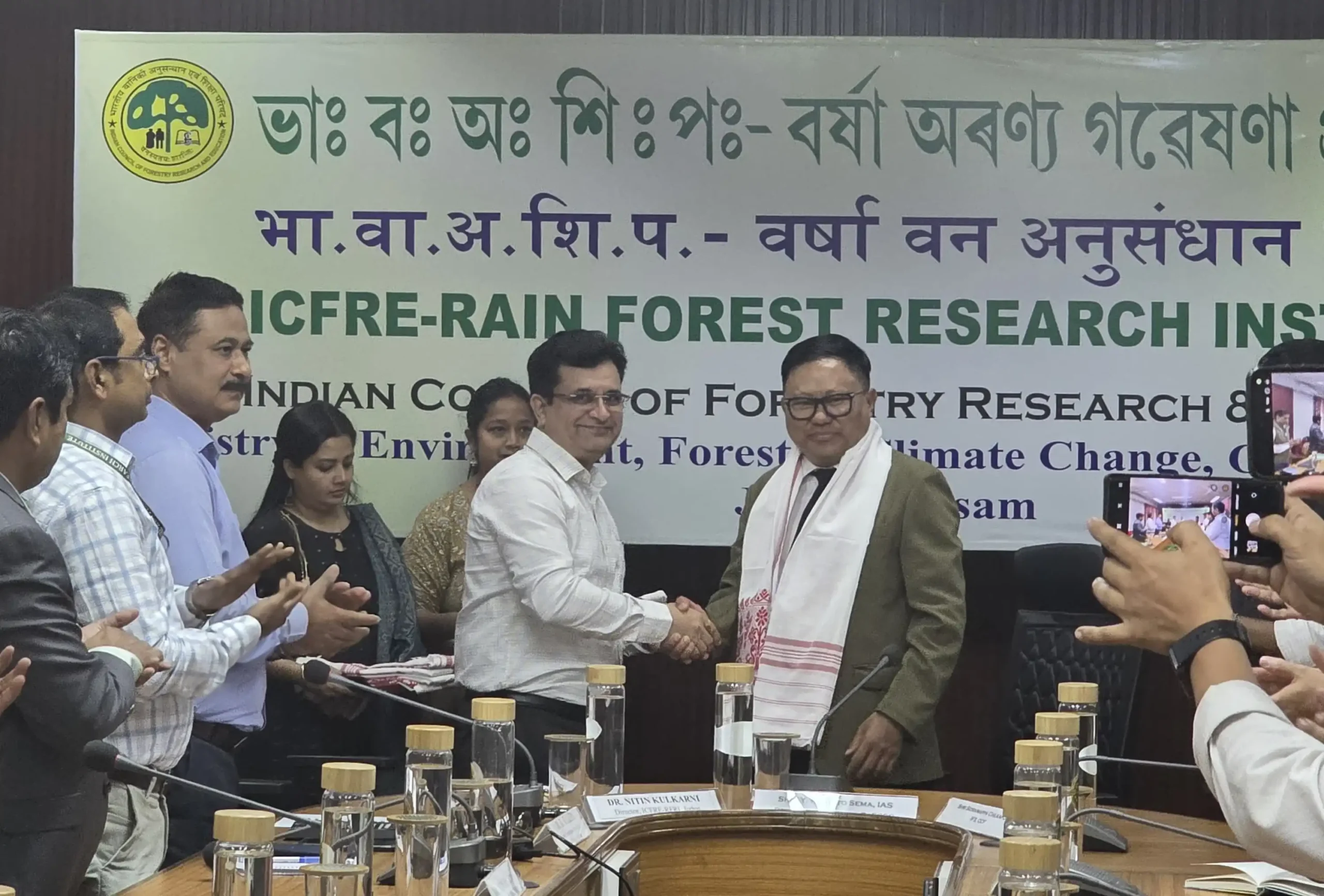
A delegation of eight officers from the Department of Environment, Forests and Climate Change (DEFCC), Government of Nagaland, led by principal secretary Y. Kikheto Sema, visited the Rain Forest Research Institute (RFRI), Jorhat, Assam on March 6 to explore scientific collaboration in sustainable forest management and improved cultivation techniques for economically important species such as agarwood and teak.
The delegation was received by RFRI director Nitin Kulkarni and scientists of the institute. The visit included discussions and presentations along with field visits to research facilities including the bambusetum and museum. RFRI functions under the Indian Council of Forestry Research and Education (ICFRE) and undertakes forestry research and extension activities across the North East.
During the interaction, Kikheto highlighted the potential of agroforestry in Nagaland, noting that traditional jhum cultivation was becoming economically unviable and ecologically unsustainable. Citing the India State of Forest Report, he said around 800 sq km of forests had been lost in Nagaland between 2013 and 2023.
He said agarwood cultivation could provide a sustainable and economically viable alternative for farmers, as nearly every part of the tree had commercial value.
The state government, he said, was working towards formulating a comprehensive policy for conservation and promotion of agarwood through scientific cultivation and trade.
Observing that around 70% of the state’s population depended on agriculture, Sema said promotion of agarwood cultivation could enhance farmers’ incomes, strengthen the rural economy and generate employment for rural youth.
He expressed concern that Nagaland’s export quota for agarwood chips or powder and oil had been fixed at only 3,400 kg and 180 kg per year respectively—about 2.25% and 2.55% of the national quota—despite the state having substantial agarwood resources with good natural infection. The delegation was informed that the allocation was based on a Non-Detrimental Finding study conducted by the Botanical Survey of India (BSI).
Sema said such a survey should have been conducted in consultation with the state government and across the state rather than through a limited sample study, adding that the government would take up the matter with BSI and the Centre.
He estimated that Nagaland could have at least 25 lakh agarwood trees but said farmers often failed to get fair prices due to lack of awareness and policy support, leading to dependence on buyers from Assam.
Referring to plantation diversification, Sema said coffee cultivation was being promoted in the state and suggested that RFRI explore integrated plantation models combining agarwood and coffee. He also referred to the Union Budget 2026 proposal to support agarwood cultivation and trade in the North East, stating that it offered an opportunity to develop a structured agarwood sector with scientific guidance.
Sema emphasised the need for technical inputs such as quality planting materials, appropriate spacing, artificial inoculation techniques and improved processing and marketing mechanisms. He noted that agarwood from Nagaland with natural infection was in high demand in West Asia and Southeast Asia.
Welcoming the development of an indigenous inoculum called “Sashi” by RFRI that could achieve nearly 100% infection within two years, he suggested that the institute assist farmers in adopting artificial inoculation techniques.
Referring to regulations under the Convention on International Trade in Endangered Species of Wild Fauna and Flora (CITES), he said agarwood from Nagaland fetched premium prices in international markets, but absence of a policy framework had led to informal trade outside the state.
The delegation was also informed that the Ministry of Development of North Eastern Region, through the North Eastern Regional Agricultural Marketing Corporation Ltd (NERAMAC), was facilitating establishment of agarwood processing and trade hubs at Kadamtala in Tripura and Golaghat in Assam. While noting that the Golaghat centre could benefit growers in Nagaland, Sema urged RFRI to explore the feasibility of establishing a similar hub in the state.
He also sought RFRI’s assistance in identifying improved teak clones developed by the Institute of Forest Genetics and Tree Breeding (IFGTB), Coimbatore that could reduce the harvesting cycle from 35–40 years to about 12–15 years. Scientists also clarified that Jatropha, once promoted as a biodiesel crop, had later been found economically unviable in the region.
Sema further urged RFRI to examine the potential for bamboo cultivation in foothill areas of Nagaland adjoining Assam to supply raw material to Assam Bioethanol Private Limited, Numaligarh, which produces bioethanol from bamboo biomass.
Following the discussions, it was agreed that RFRI would collaborate with the Government of Nagaland in areas including resource mapping of agarwood, expansion of cultivation, promotion of artificial inoculation techniques, supply of quality planting materials and capacity building of forest officials and farmers. Both sides also agreed to work towards signing a memorandum of understanding to formalise the collaboration.