
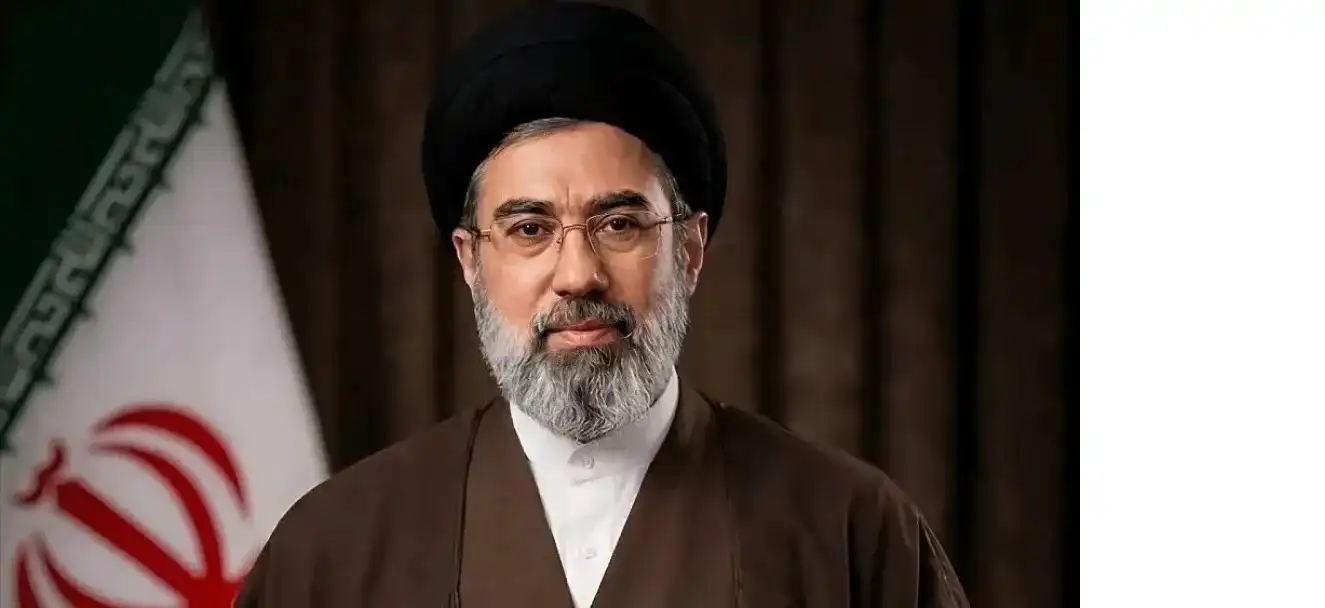
Iran’s Supreme Leader Ayatollah Mojtaba Khamenei says that the leverage of closing the Strait of Hormuz should be used and that Iran’s attacks on Gulf Arab neighbours will continue.
His first statement since his appointment was read on state television Thursday by a news anchor.
Iranian state television offered no explanation of why Khamenei, 56, did not appear on camera.
Israeli intelligence assessments suggest he was wounded in the war, likely in the February 28 Israeli strike that killed his father, the 86-year-old late Supreme Leader Ayatollah Ali Khamenei.
The price of Brent crude oil, the international standard, spiked back over USD 100 as Iranian strikes have hit ships and the American-Israeli war with Iran showed no signs of slowing.
US President Donald Trump has meanwhile promised to “finish the job,” even though he claimed Iran is “virtually destroyed.”
Thursday’s major developments include Iran’s attacks against commercial ships around the Strait of Hormuz and Iraq’s port of Basra, escalating its defense strategy of pressuring the US by squeezing the oil-rich Gulf region to threaten global economic stability. The first week of the war cost the United States USD 11.3 billion, according to the Pentagon.
The Israeli military also is striking Iran and attacking Iran’s militant ally Hezbollah in Lebanon, where more than 800,000 people have been displaced by the fighting.
The UN refugee agency says up to 3.2 million people in Iran have been displaced by the ongoing war.
Khamenei said he, like the Iranian public, only learned about being selected as supreme leader from Iranian state television.
He did not mention his location in the statement as well as he’s likely in a secure, secret location to avoid a threatened Israeli operation to kill him. Minutes after the speech ended, the sound of airstrikes again boomed across Iran’s capital.
Khamenei acknowledged in his speech the death of his father, signalling he was there in the aftermath and saw his father’s body. Khamenei also confirmed his wife, one of his sisters, his niece and the husband of his other sister also were killed in the airstrike.
“I had the honour of seeing his body after his martyrdom,” Khamenei said of his father. “What I saw was a mountain of steadfastness, and I was told that the fist of his intact hand had been clenched.”
Ayatollah Mojtaba Khamenei’s remarks suggested Iran may open up new fronts in the war if it continues. That likely would signal a return by Iran to the militant attacks the United States has blamed on it in the past, including the 1983 US Marine Barracks bombing in Beirut and others.
“One point I must emphasise is that, in any case, we will obtain compensation from the enemy,” Khamenei said. “If it refuses, we will take from its assets to the extent we deem appropriate, and if that is not possible, we will destroy its assets to the same extent.”
When Ali Khamenei took over from the late Grand Ayatollah Ruhollah Khomeini, he did not immediately make a public speech in person, instead waiting until after a 40-day mourning period.
However, Mojtaba Khamenei finds himself and the Iranian government he leads in perhaps its most-desperate fight since the 1979 Islamic Revolution.
Poland’s National Centre for Nuclear Research defeated a cyber attack “in the last few days,” Minister for Digital Affairs Krzysztof Gawkowski said Thursday.
“The attack may not have been massive, but there was an attempt to breach security, which was prevented,” Gawkowski told broadcaster TVN24. “We will verify it, but there are many indications that it took place from Iranian territory.”
It’s also possible the attack was only made to appear as originating from Iran, as a form of “camouflage,” he said.
It is unclear why Poland would be a target for Iran. Poland is a NATO member and staunch US ally, but its officials have not been especially vocal in expressing support for the war. Unlike Romania, which has allowed the US to use its air bases for refuelling and other military support, Warsaw has made no such announcement.
Top Iranian security official Ali Larijani responded on X Thursday to US President Donald Trump’s threat to target electricity sites in Iran.
Larijani wrote that destroying Iran’s electricity would quickly create a regional blackout, and the darkness “would provide a good opportunity to hunt fleeing American soldiers in the region.”
Sirens warned of incoming missiles in the Tel Aviv metro area and parts of the Israeli-occupied West Bank. Meanwhile on the northern border, sirens warned of multiple drone infiltrations from Lebanese territory.
This is the fifth warning of missiles from Iran on Thursday alone. The sirens in the north are sounding several times an hour.
“It’ll happen relatively soon, but it can’t happen now,” Wright said in an appearance on CNBC. “We’re simply not ready.”
Wright said the US is currently focusing military assets “on destroying Iran’s offensive capabilities and the manufacturing industry that supplies their offensive capabilities.”
Secretary Chris Wright offered the assessment as oil prices surged in morning trading in the US after more oil tankers were attacked by Iran and the critical Strait of Hormuz remains effectively closed.
“We’re in the midst of a significant disruption in the short term to fix the security of energy flow for the long term,” Wright added.
He added the world will face “short term pain to solve long term problem” as the US and Israel try to “defang” Iran.
The emergency controls Thursday are in response to global market turmoil caused by the war. Government spokesman Pavlos Marinakis said the measures take immediate effect through June 30, capping profit margins mostly at 2025 levels.
The controls affect retail and business sales of gasoline and diesel, as well as a list of household products including food, cleaning supplies and personal hygiene items.
Marinakis separately announced a government working group to study the feasibility of adopting microreactor technology. Earthquake-prone Greece has previously avoided investing in nuclear power but now views emerging modular technology as safer and a potential complement to renewable energy for price stability and decarbonization.
Iran’s parliament speaker warns against any invasion of Iran’s islands
Iran’s parliament speaker said Thursday that any invasion of Iran’s islands will “make the Persian Gulf run with the blood of invaders.”
It wasn’t immediately clear what prompted Mohammad Bagher Qalibaf’s comments, which again escalated the rhetoric surrounding the ongoing Iran war.
Iran holds three islands it took from the United Arab Emirates before its formation in 1971.
There also has been speculation that the United States could target Kharg Island in the Persian Gulf, Iran’s main oil terminal.