
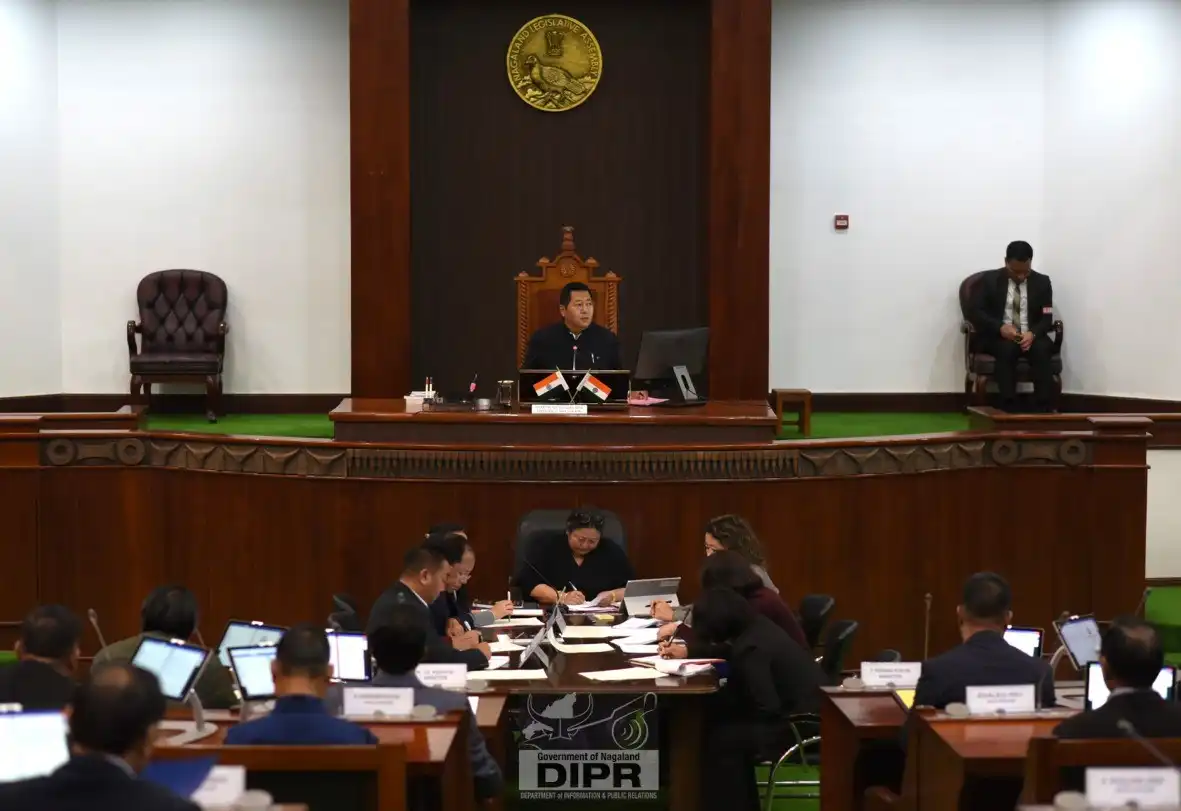
The sensitive and often volatile Disputed Area Belt (DAB) along Assam-Nagaland border which took center stage in the Nagaland Legislative Assembly on Thursday, as legislators voiced grave concerns over territorial integrity, the “one-sided” enforcement of decades-old agreements, and the systemic neglect of border residents.
The discussion, initiated by NPF legislator Achumbemo Kikon during question hour, highlighted alleged violations of the 1972 interim agreement between Nagaland and Assam, increased deployment of police outposts by Assam along the border, and difficulties faced by residents in the disputed belt. Various ministers responded to the concerns raised by the legislator.
Kikon also said that Nagaland had complied with the 1972 interim agreement by withdrawing all NAP outposts and police stations from the disputed belt, while Assam had instead increased its presence. He also alleged that neutral forces such as the Central Industrial Security Force (CISF) and Central Reserve Police Force (CRPF) were not maintaining neutrality and were protecting citizens from the Assam side while obstructing certain activities on the Nagaland side.
Among other issues, he also mentioned that after the last eviction drive, landowners in the area had held a meeting and decided to donate 10,000 acres of land to the state government, but no action had been taken by the government.
Responding to the queries, deputy chief minister in charge of Border Affairs and Home Y Patton said that prior to the 1972 agreement Nagaland had five police outposts along the border while Assam had thirteen.
He said Nagaland withdrew all its outposts after the agreement, but Assam did not withdraw any and had since established 63 permanent police outposts along the border areas adjoining Nagaland. Patton further informed that about 102 Naga villages are located along the border with Assam and that the government was examining proposals from various departments regarding the establishment of eight to nine police outposts in bordering areas.
Power supply to border villages: Raising the issue of power connectivity, Kikon said villagers from the Ralan area, along with organisations such as the Lotha Hoho and local women’s groups, had been collecting money to purchase fuel for generators used by the Indian Reserve Battalion (IRB) stationed at Tchunjanphen. He asked the government about the progress made in extending power supply to the area.
In his reply, power and parliamentary affairs minister K.G. Kenye said the disputed nature of the area had created difficulties in extending electricity supply to border villages. He said two attempts had been made by the department to extend power lines after he assumed office, including one last year, but the proposed alignment had to pass through disputed areas, which led to resistance and tensions.
Kenye said the department was exploring alternative routes and assured that efforts were being made to provide electricity connections to the affected villages within the year.
Forest patrolling and plantation: Minister for Environment, Forest and Climate Change C.L. John said plantation work in the eviction areas along the Assam–Nagaland border had not been carried out due to the dry season. He informed that a proposal had been submitted to undertake plantation work between May and July and added that neutral forces were currently present in the disputed belt. John said if patrolling became necessary in the future, the department would deploy personnel accordingly.
Development activities in disputed areas: Supplementing the discussion, PHE minister Jacob Zhimomi said several departments were implementing flagship programmes, including road projects under Central Road and Infrastructure Fund (CRIF).
He suggested that the government write to the appropriate authorities so that development projects were not hindered by forces stationed in the so-called neutral areas.
He also pointed out that departments often faced difficulties when certain locations were depicted as belonging to different states during planning processes with central ministries.
He suggested that the government write to Geological Survey of India (GSI) to clearly demarcate the areas reflecting the legitimate territory of Nagaland.
He asserted that from Nagaland’s perspective the areas were not disputed and that Nagas had been occupying them for over a hundred years.
Police recruitment fee: Kikon also raised concerns over the recent police recruitment process, particularly the Rs. 300 application fee. With around 32,000 applicants, he noted that nearly Rs. 96 lakh had been collected, and pointed out speculations that additional fees might be demanded from candidates selected for training.
Deputy CM, Y Patton clarified that the Rs 300 fee was collected in all recruitment processes and not only for the police department. However, he assured that no additional money would be collected from candidates who qualify and warned that any officer found collecting money illegally would face suspension.