Ancient bacteria, trapped in caves for millions of years, live in a miniature world of terror. Their only food source is each other. The survival tactics they develop make them resistant to almost all antibiotics. Now scientists hope to use their tricks to inspire new drugs and treatments.
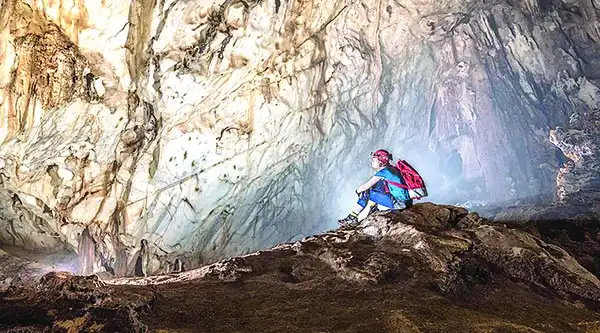
Deep underground, plunging 1604ft (489m) beneath the Chihuahuan Desert in southern New Mexico, lies the Lechuguilla Cave, a cavern which stretches on for 149 miles (240km). There is no light, and little to eat either. Any living thing must eke out an existence under conditions of near starvation.
“You can go in an entrance and travel for 16 hours in one direction before you get to the end of it,” says Hazel Barton, professor of geological sciences at the University of Alabama.
“So you’re a very, very, very long way from the entrance. You’re isolated, and there are places in that cave where more people have walked on the moon than have been in that area.”
Yet despite the darkness, there is a dazzling diversity of microbial life. Because the bacteria have been isolated for millions of years, they offer a unique window into the past. What’s more, each has evolved a different strategy to survive. Some extract energy from rocks and the atmosphere. Others are predators, feeding off other bacteria.
“Like in the rainforest, we see predators that just run in and grab, stab and kill other microbes,” says Barton. “But we also see other microbes that work together to get nutrients and energy out of a system that otherwise wouldn’t be able to yield enough energy to survive.”
The bacteria also have an even more surprising trick up their sleeve – they are resistant to most antibiotics, despite the fact that they have been trapped in a cave that formed six million years ago, most of which was completely sealed off from humans until 1986. Not only is this resistance a remarkable natural phenomenon, it is now helping guide researchers to drugs that can withstand the onslaught of antimicrobial resistance in modern medicine.
But let’s rewind slightly. Today, the emergence of antibiotic-resistant bacteria, often called “superbugs”, is a growing global health crisis. These pathogenic, disease-causing bacteria have developed resistance to multiple types of antibiotics, making infections harder to treat. Bacterial antimicrobial resistance (AMR) was found to be directly responsible for 1.14 million deaths in 2021, and an estimated 39 million people are expected to die due to AMR between 2025 and 2050. Already, it’s estimated that millions of children are dying each year from infections resistant to antibiotics.
The cause of the AMR crisis is usually attributed to the misuse and overuse of antimicrobials in humans, animals and plants. Yet this isn’t the whole picture. In 2006, for example, Gerard Wright, professor of biochemistry and biomedical studies at McMaster University in Ontario, discovered soil-living bacteria packed full of antibiotic resistance genes. The mud-loving microbes had the exact same resistance genes that are found in bacteria that cause disease in humans.
“These were not pathogenic bacteria. They weren’t causing disease. They were just sitting around minding their own business,” says Wright.
This suggested that antimicrobial resistance wasn’t new and was in fact hard-wired into many bacteria, a finding backed up by the fact that bacteria with resistance have also been found in glacial ice cores extracted from Antarctica, as well as the soils, seas and rocks of this isolated continent. AMR bacteria have also been discovered in ancient permafrost, as well in the gut bacteria of villagers from an isolated Amazonian jungle tribe.
Yet Wright’s finding by itself was not enough to convince the scientific community that AMR had emerged without human contact. After all, the overuse of antibiotics in agriculture is well documented. The soil bacteria could have come into contact with antibiotics this way.
“We’re living in the anthropogenic age, so there’s no place that is without evidence of human activity, whether you’re at the top of Mount Everest or at the bottom of the Mariana Trench,” says Wright.
What was needed was a pristine environment. One that had been cut off from humans for millennia. Enter the Lechuguilla Cave. This cave formed millions of years ago from rainwater trickling deep underground.
(BBC)