
A refresher course on livestock insurance, disease diagnostics and post mortem was held on March 25 at Hotel Japfü, Kohima, organised by the Department of Animal Husbandry and Veterinary Services.
Delivering the keynote address, secretary to the Government of Nagaland, Department of AH & Veterinary Services, Angelina Tajen, said livestock rearing in Nagaland is not merely an economic activity but a way of life, with nearly 70% of households engaged in it. She noted that pigs and poultry dominate the sector, particularly in rural backyard systems.
Highlighting production, she said that in 2024–25, the state recorded 24.42 metric tonnes of meat, 52.79 metric tonnes of milk, and 443.38 lakh eggs. Despite this, a gap between demand and supply persists, making interventions such as the National Livestock Mission (NLM) crucial.
She emphasised that livestock insurance is vital due to increasing risks. In 2023–24, over 45,000 poultry birds and 24,000 pigs were affected by diseases, resulting in significant mortality. For small farmers, even the loss of a single animal can severely impact income and food security, she said, adding that insurance serves as a critical safety net.
Tajen also pointed out challenges in implementation, including difficulties in conducting post mortems in remote areas due to terrain and poor connectivity, often leading to delays in claim processing. She further highlighted the issue of minimum flock size in poultry insurance, where insurers require 1,000 birds, while most farmers rear only 50–200, leaving many excluded from coverage.
She suggested solutions such as flexible claim verification through geo-tagged photos, certification by veterinary staff, cluster-based verification, and group insurance models through SHGs and FPOs. She also called for relaxing flock size norms and strengthening veterinary services at the grassroots level.
Entrepreneur Penyiisielie Suokhrie, in his address, underscored the importance of insurance in protecting farmers from financial losses due to animal deaths caused by disease, accidents, or natural disasters. He noted that India’s livestock sector contributes around 5% to Gross Value Added, yet insurance penetration remains low at less than 1%.
He attributed this to factors such as lack of awareness, high premiums, complex procedures, and difficulties in claim settlement. Sharing his experience as a dairy farmer, he said livestock insurance had helped him recover losses and sustain his business after accidental animal deaths.
Director of AH & Veterinary Services, Dr. Imomanen Tzudir, in his welcome address, said livestock plays a vital role in Nagaland’s rural economy, where the majority depend on farming. He noted that the state has significant livestock resources, but increasing risks from climate change, disasters, and diseases pose challenges, making insurance awareness essential.
The programme was chaired by additional director, Directorate of AH & Veterinary Services Dr. Kuokehebi Gwirie, with an invocation by joint director, Directorate of AH & Veterinary Services. Dr. Hiabe Zeliang, and concluded with a vote of thanks by Joint Director Dr. Chubasangla.
The programme was organised in collaboration with the College of Veterinary Sciences & Animal Husbandry, Central Agricultural University (Imphal), Jalukie, Peren, and sponsored by the Department of Animal Husbandry & Dairying, Ministry of Fisheries, Animal Husbandry & Dairying, Government of India.
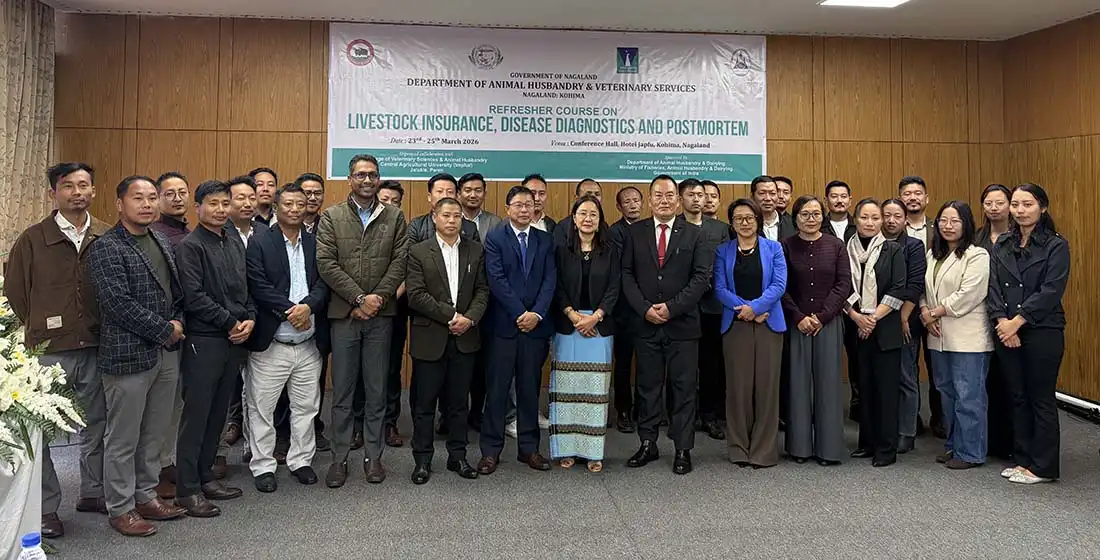
Refresher course on livestock insurance
CorrespondentKOHIMA, MAR 23(NPN):