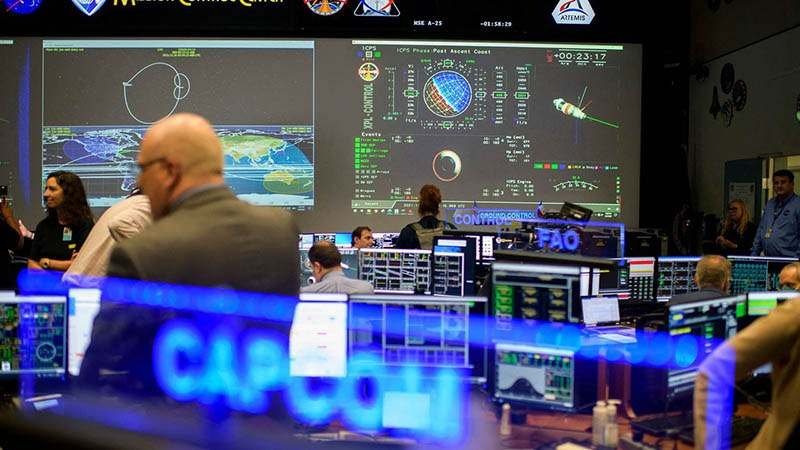
Just like the Apollo missions, Artemis II will be run from a mission control monitoring every instrument from here on Earth. How has it changed since the days of the space race?
The rocket scientists get the acclaim, the astronauts the glory but – when it comes to flying to the Moon – the real heart of the action can be found in a 1960s concrete office block in Texas.
Nasa’s Christopher C Kraft, Jr Mission Control Center on the outskirts of Houston is named after the man who came up with the concept at the dawn of the space age. Kraft’s idea was to bring together, in a single room and under the direction of a flight director, all the people responsible for the spacecraft.
The original mission control that oversaw the first Moon landing and brought us the phrase “failure is not an option,” after a section of the Apollo 13 spacecraft exploded on the way to the Moon, is now preserved as a US National Historic Landmark – ashtrays, coffee cups and all. (You can read more about the restoration here.)
But across the hall is the modern equivalent for 21st-Century lunar missions: Artemis mission control and the purpose is essentially the same.
“The structure that Chris Kraft put together as the first flight director has really stood the test of time,” says Fiona Antkowiak, one of nine flight directors assigned to Artemis II, Nasa’s first crewed Moon mission since 1972. Currently due for launch in April 2026 (the latest launch opportunities are here), Artemis II will take four astronauts in a loop beyond the Moon, further than humans have ever gone before. They will become the first people to blast into space on the giant new SLS rocket and fly in the Orion capsule. There is a lot at stake.
It will be up to the team in Houston to keep the mission on track and bring the crew safely back to Earth 10 days later. Working in three shifts, 24 hours a day, mission control will communicate with the astronauts, send commands and monitor everything from trajectory and propulsion systems to the astronauts’ heartbeats.
“The role of mission control is ultimately to keep the astronauts safe, keep the Orion spacecraft safe and to achieve the mission objectives,” Antkowiak says. “We structure our work to do those items in priority order.”
From the ‘80s-era Nasa ‘worm’ logo on the back wall, to the funky hexagonal LED lights suspended from the ceiling, today’s mission control is a blend of the old and new. The bespoke grey consoles with the chunky buttons and black and white monitors of the Apollo era have been replaced by keyboards and touchscreens. But the names of the desks date back to the earliest missions – life support, for example, is still overseen by Eecom (Emergency, Environmental, and Consumables Officer) – crucial for keeping the astronauts alive during the Apollo 13 rescue.
The air is also a lot cleaner than it used to be now smoking is banned and the china cups have been superseded by plastic travel mugs. But beyond the technology, probably the biggest change has been in the appearance of the mission controllers themselves.
Look at any picture of Apollo mission control and the controllers were all young white men, wearing white shirts, their pockets filled with pens and slide rules. When Poppy Northcutt joined as the first female engineer in the mid-1960s it was very much seen as a boys’ club. Today, not only is the attire much more informal but mission control is much more diverse – and frequently led by women. Every aspect of the flight will be overseen from this room. Mission controllers on the ground will work with the astronauts in space to keep Artemis II on track. To avoid confusion, all communication with the crew is through a capsule communicator or “capcom” (a name dating back to the earliest Mercury spaceflights) but it’s the flight director that ultimately calls the shots. “The key is that you have an on-console flight director and that person has ultimate authority to make any quick-turnaround decision,” says Antkowiak.
Although many of the systems on this complex spacecraft are automated, keeping across everything and dealing with any problems is more than a small group of people in one room can do alone. That is where another team in the building’s Orion Mission Evaluation Room (Mer) gets involved.
“The Mer has a unique and different perspective from the flight director and his or her operational team,” says Orion Mer Lead, Trey Perryman. “We’re not responsible for operating or the immediate response to issues, but for monitoring the spacecraft performance in significant detail and to lead resolution of problems – there’s a difference between responding to a problem and resolving the problem.” (BBC)