
A study led by Nagaland University has used advanced Geographic Information System (GIS) modelling and remote sensing techniques to map environmental degradation in Kohima district, revealing rapid land-use change, climate shifts and seismic vulnerability in the North East Hill (NEH) region.
The research, conducted in collaboration with PNG Government PG College Ramnagar, Nainital, highlights the fragile geo-ecological conditions of the region and aims to support improved environmental monitoring, climate resilience planning and sustainable development in the North East Hill region and the broader Indian Himalayan landscape.
According to the researchers, environmental degradation is being driven by rapid urbanisation, deforestation, shifting cultivation and climate change, contributing to increased risks such as landslides, floods, droughts and extreme weather events.
Nagaland University vice-chancellor Prof. Jagadish K. Patnaik said the study presents a comprehensive geospatial analysis highlighting rapid land-use changes, emerging climate trends and seismic vulnerability, providing valuable inputs for policymakers, planners and stakeholders.
The findings were published in December 2023 in Environmental Monitoring and Assessment, a peer-reviewed journal brought out by Springer Nature.
The study was co-authored by Dr. Khrieketouno Belho and Prof. M.S. Rawat of Nagaland University, along with Dr. Pradeep Kumar Rawat of Uttarakhand Open University Study Centre, and supported by Nagaland University and the Ministry of Tribal Affairs.
Prof. M.S. Rawat said the region is highly fragile due to continuous seismotectonic activities, landslides, slope failures, unstable geology and rugged topography, warning that high rates of land-use degradation are accelerating climate change impacts.
Using an integrated GIS database modelling system, the study analysed geodiversity, land use and climate through multiple parameters, including geological structures, vegetation cover, rainfall, temperature and ecological habitats.
The study found that natural landscapes such as forests, scrublands and water bodies declined from 93.93% to 81.86% over two decades, while built-up areas, agricultural land and wasteland increased.
It also recorded a rise in average temperatures at about 0.13°C per year, along with declining rainfall and fewer rainy days.
Further, analysis of earthquake data from 1982 to 2022 revealed over 1,100 seismic events in Kohima district, averaging around 27 micro-earthquakes annually, mostly linked to tectonic faults contributing to erosion and landslides.
The study identified geodiversity, ecological and climatic degradation as key concerns, and emphasised the need for evidence-based planning, geospatial technology and action-oriented management strategies to mitigate environmental risks and support sustainable development.
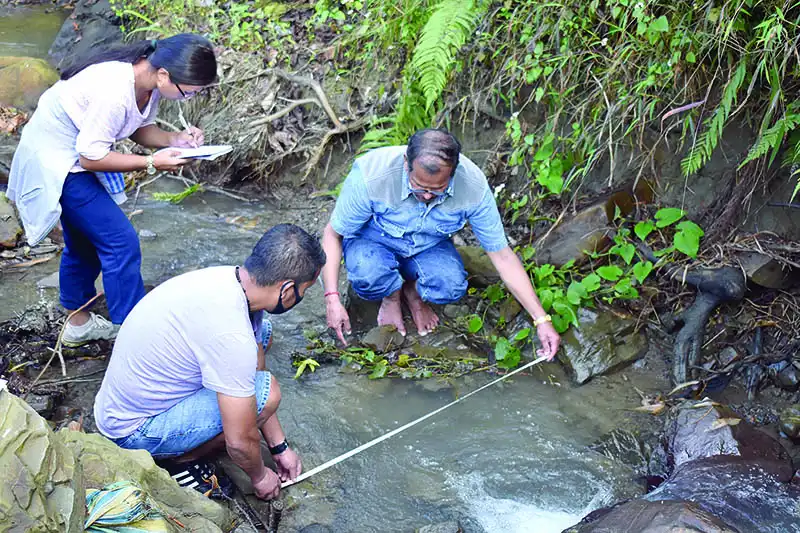
NU study maps alarming environmental degradation
DIMAPUR, APR 1 (NPN):