
Staff Reporter
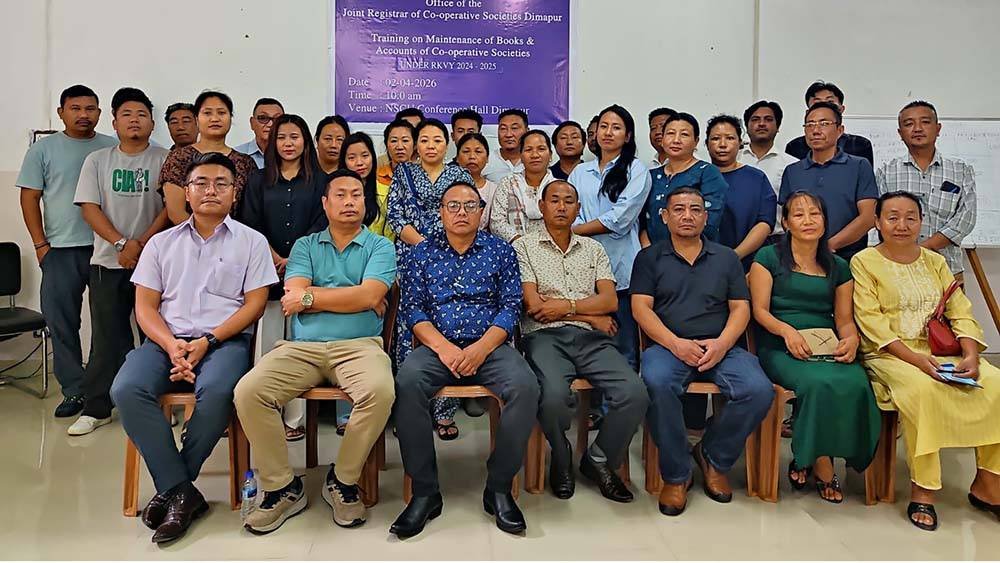
The office of the Joint Registrar of Cooperative Societies, Dimapur, organized a training session on the maintenance of books and accounts for cooperative societies under the Rashtriya Krishi Vikas Yojana (RKVY) 2024–2025. The program began with an inaugural ceremony at the Nagaland State Co-operative Union Conference Hall, Dimapur, and was attended by 50 participants from various cooperatives in Dimapur District.
In his welcome address, Joint Registrar of Cooperative Societies (Jt. RCS), Dimapur, Imnanukshi stated that the training had been organised to equip chairmen, secretaries, and other members responsible for maintaining records of their society’s activities. He emphasized that, business organisations, cooperatives required proper maintenance of books and accounts to function effectively.
He explained that accurate records helped provide necessary information when needed, enabled auditors to conduct audits without dispute, and allowed clear assessment of whether a society was progressing appropriately, making a profit, or incurring a loss. He further noted that, to ensure uniformity in accounting systems of all the functioning cooperatives in the department, the department had initiated the training despite financial constraints and expressed hope that the participants would gain significant knowledge from it.
The inaugural programme was chaired by Inspector of Cooperative Societies (ICS), Zuchamo Ngullie. Participants also introduced themselves during the session ,and a vote of thanks was delivered by ICS, Atoho Sema.
The training session began with a detailed session on, ‘Maintenance of Books & Accounts,’ led by Jt. RCS, Imnanukshi, and continued with a session on, ‘Review on the maintenance of day book by the cooperative societies,’ by ICS, Joshua Changkija. The event also included an interactive session.
The sessions highlighted the importance of keeping accurate and up-to-date records, as they are essential for efficient management, auditing, and assessing the performance of cooperative societies. Key records such as the day book, which records daily transactions, and the cash book, which tracks cash receipts and payments, were discussed in a simple and practical manner. Overall, the sessions helped participants understand how proper record-keeping supports better financial management and performance of cooperative societies.