
Correspondent
A 39-hour endurance trek across the Naga Hills concluded in Kohima on April 3 as part of the 82nd commemoration of the historic Battle of Kohima.
The trek retraced the arduous route taken by Naga soldiers and Allied forces during the fierce fighting of 1944 and was described as the first endurance walk of its kind in Northeast India. Participants traversed challenging terrain, echoing the movement of troops who had navigated the same hills under extreme wartime conditions.
The trail culminated at the Kohima War Cemetery, located at the site of the former Deputy Commissioner’s bungalow and tennis court, where some of the fiercest fighting had taken place. Upon completion, participants were received with a ceremonial welcome.
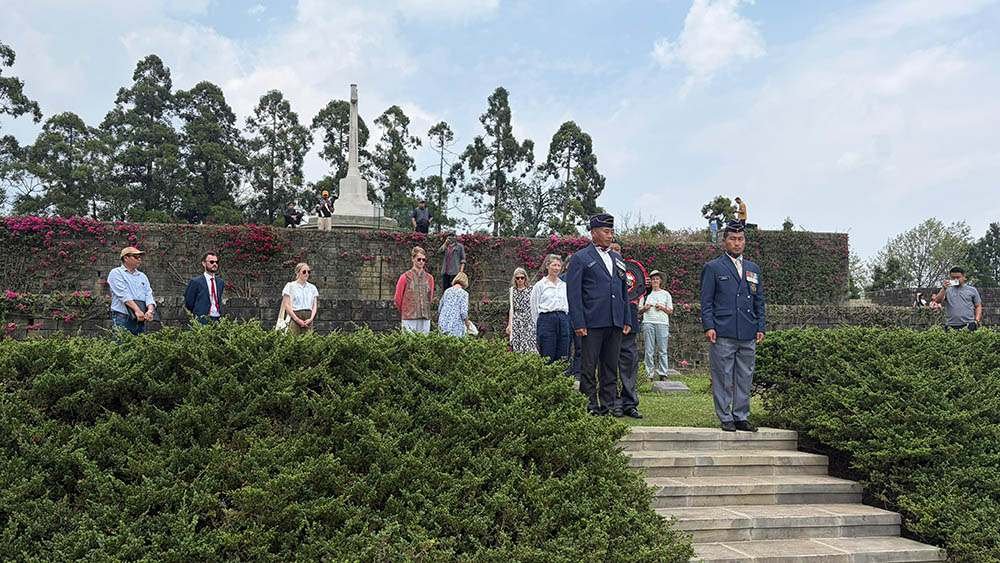
The commemoration programme, including a wreath-laying ceremony, was held on Saturday, marking the official start date of the Battle of Kohima in 1944. Dignitaries, historians, local leaders and community members gathered to pay tribute to those who fought and fell in what is regarded as one of the most decisive battles of the Burma Campaign during the Second World War.
Speaking at a brief programme held at the cemetery, Charlotte Carty, a Second World War enthusiast, Battle of Jessami expert and trustee of the Kohima Educational Trust, stated that despite its global significance, awareness of the Battle of Kohima remained limited in the United Kingdom and elsewhere.
She maintained that the battle played a crucial role in halting the Japanese advance into India and deserved wider recognition.
Carty acknowledged the vital support extended by the Naga people to the Allied forces, asserting that the course of the battle would have been entirely different without their assistance. She also expressed appreciation for the local community, describing them as generous and supportive.
She further called for remembrance of all those involved in the conflict, including Japanese soldiers, whom she described as brave and formidable, noting that their advance through the difficult terrain had been an extraordinary feat initially underestimated by military command.
Referring to the historical context, she stated that Japanese forces had advanced rapidly through the Naga Hills despite the terrain, and noted that initial defensive preparations at Kohima were limited due to uncertainty over whether Dimapur or Kohima should serve as the primary defensive position.
Carty stated that on April 4, 1944, around 1,500 Allied personnel in Kohima faced an estimated 15,000 troops of the Japanese 31st Division. Despite being outnumbered and fatigued, Allied forces held their position for over two weeks until reinforcements arrived.
She also recounted that troops of the Assam Regiment reached Kohima on April 3, 1944 and were immediately tasked with preparing defensive positions, highlighting the urgency of the situation.
Describing the Kohima War Cemetery as a deeply significant site, she noted that it stands on the former tennis court, which became a “no man’s land” between opposing forces and a crucial battleground in the wider Burma Theatre.
She further noted that Japanese forces occupied positions around the tennis court from April 10, leading to intense close-quarter fighting before the ground was retaken on May 13 with support from the Dorset Regiment and Royal Engineers.
Organisers informed that the programme combined endurance, history and remembrance. In addition to the trek, it included guided tours of the battles of Kohima and Jessami, treks to Mount Puliebadze and Jessami Peak, visits to the pheasant reserve in Jessami, and associated ceremonial and cultural engagements.
Wreaths were laid and a moment of silence was observed, underscoring the enduring significance of the Naga Hills as a place of sacrifice and historical importance.