
Former chief secretary Alemtemshi Jamir on Saturday called for introspection on the socio-political and economic condition of the Nagas, urging officers to take a more proactive and transformative role in addressing emerging challenges and shaping the future of the state.
Speaking as guest speaker at the third general conference of Dimapur Zone Ao Officers’ Telongjem (DZAOT) held at Hotel Saramati, Jamir posed a critical question, asking officers to reflect on “where Naga people are today—socially, politically and economically,” and highlighted concerns across all sectors.
On social issues, he observed that divisions and fragmentation had weakened collective unity, adding that even church institutions were not immune to corruption. He remarked that moral values among Nagas were at a “low point”, resulting in a deeply divided society.
On the economic front, Jamir said that while individuals have the capability to excel, the state as a whole continued to lag behind. He pointed to poor fiscal health, low Human Development Index (HDI), high unemployment and limited industrialisation.
He cautioned that the economy remained heavily dependent on the primary sector with minimal investment prospects, and noted that a large section of the population continued to rely on government employment.
Addressing political concerns, he said political understanding remained limited and was further complicated by the existence of “parallel systems” of governance involving overground and underground structures.
He also described the absence of a strong opposition as a “sad affair” in a democracy, stressing that constructive criticism was essential for progress.
He added that lack of clear political ideology had hindered growth, remarking that Nagas often take “one step forward and two steps back,” while other Northeastern states continued to advance.
Emphasising the role of officers, Jamir said that in the absence of a strong opposition, public expectations increasingly rested on the bureaucracy.
He cited statistics showing that out of 1,23,375 government servants, 21,005 (17%) were Aos, while among 5,515 Class-I gazetted officers and 4,192 Class-II officers, Aos accounted for 1,219 (22%) and 1,037 (24.7%) respectively. He urged officers to leverage their strengths, uphold cultural values and contribute meaningfully to the uplift of both the community and the wider Naga society.
Jamir also touched on emerging challenges such as artificial intelligence and climate change, calling for adaptability, innovation and forward-looking governance.
Commissioner of Income Tax, Jorhat, Imlimeren Jamir, in his address, underscored the responsibility of officers in mentoring youth and contributing to societal growth. He outlined three guiding principles for public servants—excellence in duty, uncompromising integrity and mutual support—and encouraged officers to embrace technological advancements while remaining open to change.
Also delivering a short address, former deputy commissioner of Niuland and secretary, Science & Technology, Sara S. Jamir, described officers as the “backbone of society” and urged them to act as agents of change. She challenged officers to move beyond blaming the system, asserting that “we are the system,” and called for greater political awareness and revival.
Highlighting the legacy of the Ao community as pioneers in education, religion and social transformation, she urged introspection on whether that leadership continued today. She stressed the importance of electoral integrity and called for elimination of malpractices such as proxy voting and the influence of money and muscle power. She further encouraged officers to engage with communities at the grassroots level to reshape mindsets ahead of elections and work towards a “political revival” rooted in free and fair practices.
Earlier, invocation was offered by associate pastor, DABA, Imsunungsang Pongen, while DZAOT president Imosong Imsong delivered the welcome address. The programme also featured a special number by Chubatsur Jamir, a message on the formation and vision of DZAOT by treasurer Anungba Sanglir, and vote of thanks by vice president R Atsung Tzudir.
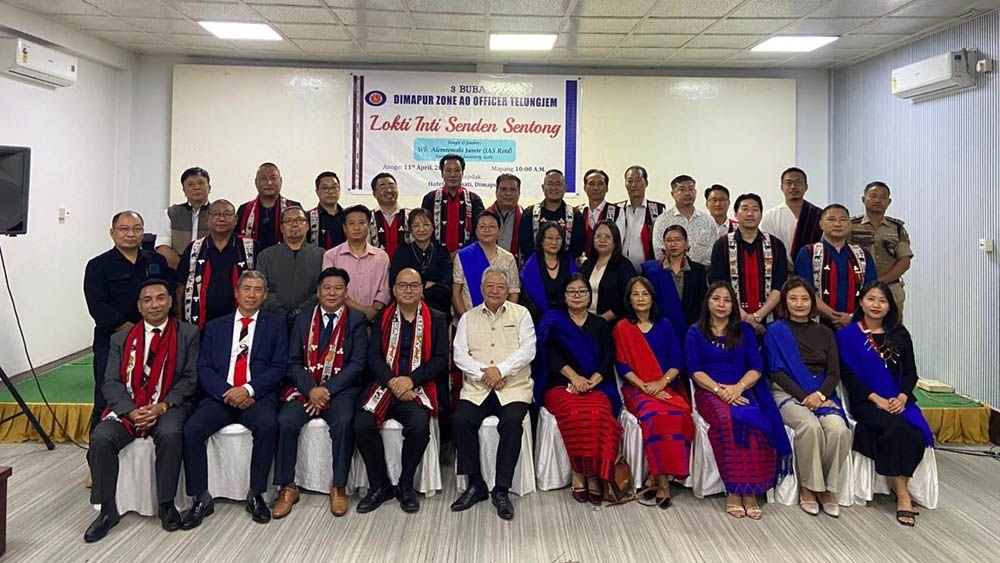
Former CS calls for urgent reforms, flags systemic issues
Staff Reporter