
A decade-long analysis of school performance across Nagaland has highlighted a pattern of consistency, emerging performers and persistent regional gaps, with Kohima retaining its position as the state’s top-performing district and Longleng recording a gradual surge in 2026.
The analysis, based on compiled district-wise HSLC and HSSLC results from 2017 to 2026, including Arts and Commerce streams, shows Kohima maintaining over 85% HSLC qualification rate in 2026 and close to 90% pass percentage in HSSLC (Arts), continuing its consistent performance over the years.
Mokokchung remained a strong contender with stable results, maintaining above 75% qualification rates and over 90% pass percentage in Arts.
A significant shift was observed in Longleng, which recorded over 92% pass percentage in Arts in 2026, marking a sharp rise from previous years. Zunheboto also showed improvement, crossing the 80% mark, while Dimapur, Phek and Wokha maintained steady performance in the 70-80% range.
However, disparities persist, with Kiphire and Tuensang continuing to record lower HSLC qualification rates between 50% and 65%, despite gradual improvement. Mon showed fluctuating trends but steady progress, while Noklak recovered to above 60% in 2026 after a dip in 2022.
The data further highlighted strong performance by female students, who outperformed boys across most districts. In Kohima, female students consistently outperformed males across districts, with similar trends seen in Dimapur, Niuland and Tuensang.
Though the data does not categorically differentiate between government and private institutions, urban districts with higher concentration of private schools– such as Kohima, Dimapur and Mokokchung– continued to perform better, while rural districts lagged, possibly due to limited access to institutions and resources.
The analysis also reflected the impact of policy changes. During the COVID-19 period (2020–2021), rationalised syllabi contributed to higher results, while the introduction of competency-based assessment and Higher Order Thinking Skills (HOTS) in 2024 led to a dip in performance and enrolment, followed by recovery by 2026.
In the Commerce stream, enrolment peaked at 1,347 in 2021, declined to 949 in 2024, and rose to 1,125 in 2026, with 919 students qualifying, indicating gradual stabilisation.
Overall, the decade-long data presents a dynamic picture of Nagaland’s education sector, marked by consistent leadership, emerging districts and ongoing challenges in bridging regional gaps.
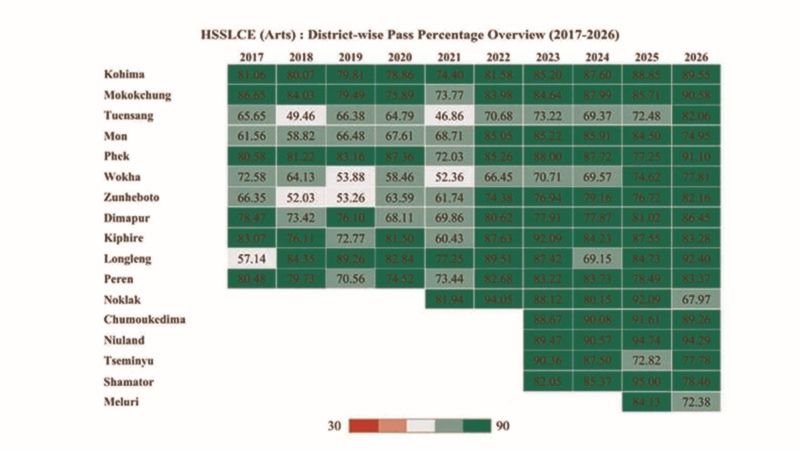
Decade of board results shows Kohima dominant, Longleng emerging
Nzano Humtsoe