
Correspondent
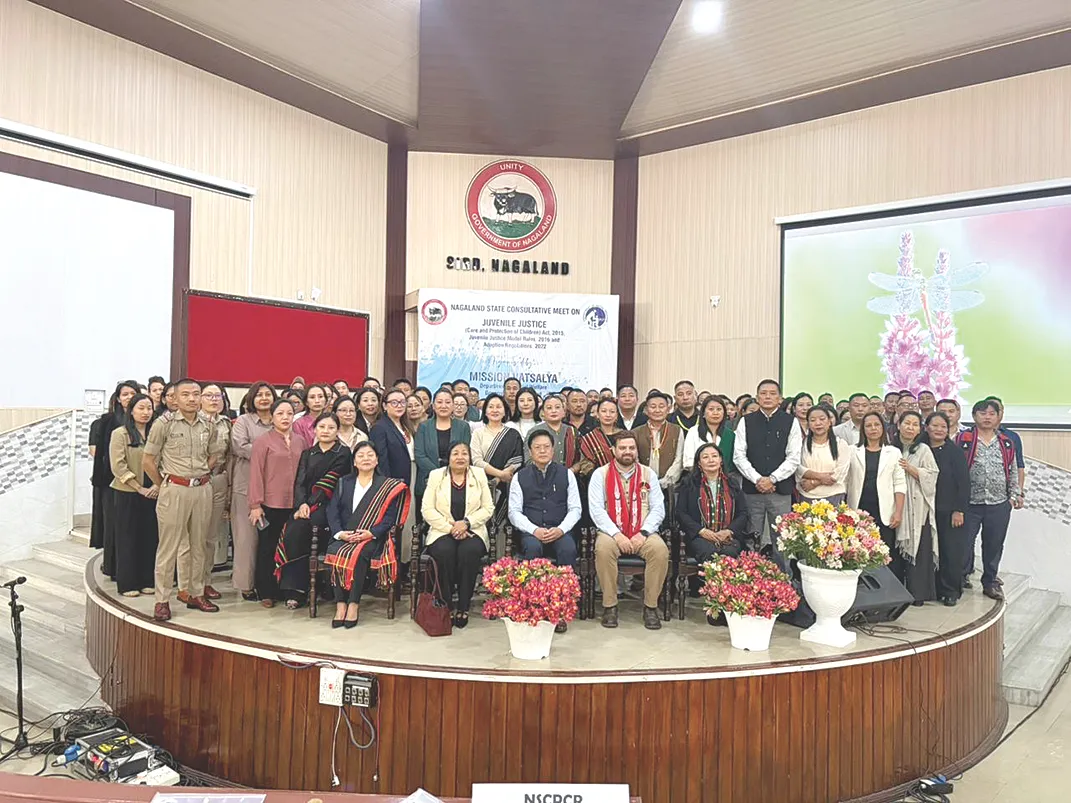
KOHIMA, MAY 19 (NPN): Nagaland on Monday stressed the need for a child protection system that balances legal safeguards with Naga customary practices during the State Consultative Meet on the Juvenile Justice (Care and Protection of Children) Act, 2015, Juvenile Justice Model Rules, 2016, and Adoption Regulations, 2022 held at the State Institute of Rural Development auditorium, Kohima.
The consultation, organised by Mission Vatsalya under Social Welfare department, brought together officials from the judiciary, police, child welfare institutions, NGOs and district administrations to discuss challenges and implementation of child protection laws.
Addressing the gathering, secretary, Social Welfare and Mission director, Mission Vatsalya, Limawabang Jamir, IAS, said the true measure of the Juvenile Justice Act and adoption regulations lay not merely in legal provisions on paper, but in how effectively they were implemented across Nagaland, including remote districts.
He observed that while the formal legal framework assumes seamless digital connectivity, standardized police handling and institutional care systems, Nagaland’s realities remained different due to geography, infrastructure gaps and customary social systems.
Limawabang Jamir said Nagaland’s unique identity under Article 371A safeguarded Naga customary laws and traditional institutions, adding that customary forms of adoption rooted in clan and village traditions often left children legally vulnerable in matters of identity, inheritance, education and welfare entitlements.
Stressing that Nagaland should neither erase its culture nor ignore legal safeguards, he said the State already possessed strong community-based systems of care through families, clans, village councils, churches and tribal institutions.
“The task before stakeholders is not to dilute the law or disregard Naga customs, but to implement the provisions in a manner that is practical, culturally sensitive and responsive to the realities of Nagaland,” he said.
He urged stakeholders to move beyond general discussions and provide structural, localized and actionable recommendations to bridge the gap between statutory mandates and local realities. He emphasized the need for coordinated efforts among the Social Welfare department, judiciary, police, medical fraternity, district administrations and traditional institutions.
Quoting a phrase often used by State Adoption Resource Agency (SARA) officials, he said, “Adoption is an act of love, but the process must come from law.”
Senior consultant, Ministry of Women and Child Development, Government of India, Junaid Ul Islam, said the Centre was now preparing comprehensive amendments to the Juvenile Justice Act, Rules and Adoption Regulations.
He informed that India currently had around 40,000 prospective adoptive parents waiting, while only around 2,000 to 3,000 children were available for adoption.
Islam also revealed that after integration of the CARINGS portal with the Mission Vatsalya portal, the country crossed 5,000 adoptions this year for the first time.
He said Nagaland was the first State to initiate consultations on proposed amendments and encouraged stakeholders to provide practical field-based suggestions.
In her introductory address, director Social Welfare and member secretary, Mission Vatsalya, Tosheli Zhimomi, said the consultation aimed at assessing implementation mechanisms, identifying gaps and strengthening coordination among stakeholders.
She informed that the Juvenile Justice Act, 2015 was notified in Nagaland on March 22, 2018, while the Nagaland Juvenile Justice Rules, 2024 were notified on December 2, 2025.
The programme was chaired by Raitale Zeliang, programme manager (SCPS), while vote of thanks was delivered by Imkongzenla, joint director, department of Social Welfare and nodal officer, Mission Vatsalya.
The programme was attended by Child Welfare Committees, Juvenile Justice Boards, Child Care Institutions, officials from various departments and Nagaland State Commission for Protection of Child Rights.