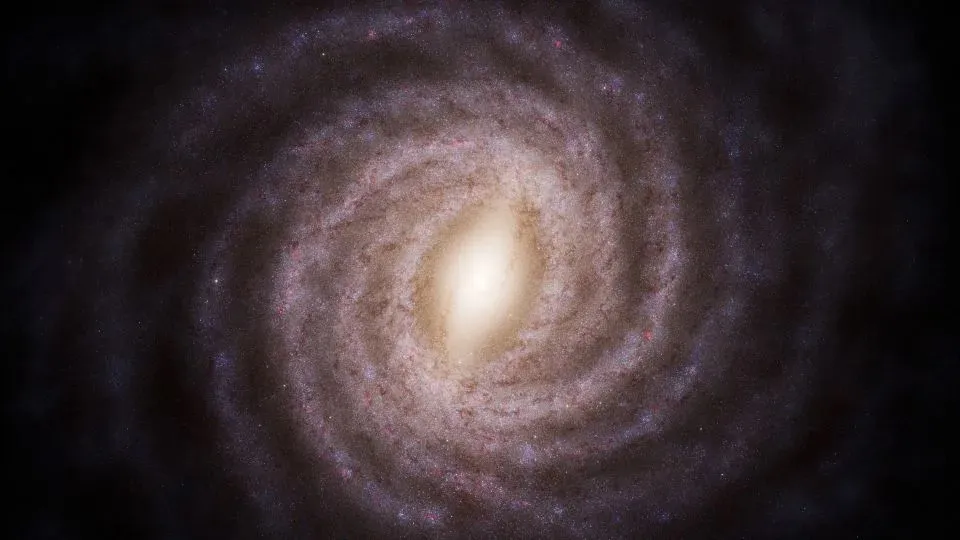
An unusual collection of stars may represent the remnants of a dwarf galaxy that the Milky Way devoured about 10 billion years ago. Astronomers have dubbed the ancient galaxy Loki, after the Norse god of mischief. The finding could change the current understanding of how the Milky Way evolved in the distant past.
The vast Milky Way spans about 100,000 light-years and contains anywhere between 100 billion and 400 billion stars, according to NASA. A light-year is the distance light travels in one year, which is 5.88 trillion miles (9.46 trillion kilometers).
Our home galaxy wasn’t always such a cosmic giant. It grew over time starting about 12 billion years ago by merging with a multitude of dwarf galaxies. But the original size and mass of the Milky Way remain an open question — driving scientists to search for evidence of the galaxies it consumed to determine its history and evolution.
To identify those missing puzzle pieces, astronomers have now zeroed in on a cluster of metal-lacking stars detected oddly close to the galactic disk, according to a study published in May in the journal Monthly Notices of the Royal Astronomical Society.
The astronomers are interested in these stars near the disk — a massive rotating pancake-like region containing much of the Milky Way’s stars — because the first stars in the universe were comprised of hydrogen and helium, which fused heavier elements together in their cores before exploding and unleashing the heavy elements that enriched future generations of stars.
Metal-poor stars are often associated with ancient dwarf galaxies, which the Milky Way might have consumed over time to grow to its current massive state — and remnants of these cosmic meals might be hiding deep within the galaxy.
The metal-poor composition of such ancient stars close to the galactic disk suggests that the Milky Way once made a rather large meal of another galaxy early in its history — and it could represent a critical, previously overlooked building block of our galaxy.
Astronomers are like the detectives of the universe, searching the cosmos for clues of its origins, and very-metal-poor, or VMP, stars are a powerful tool in that quest, said Dr. Cara Battersby, associate professor of physics at the University of Connecticut, who did not participate in the study.
“VMP stars have been around for billions of years, holding within them clues to the formation of the Universe’s earliest generations of stars,” Battersby wrote in an email. Studying the metal-poor stars’ composition and motion can unlock details about the conditions and dynamics of the early universe, she added.
The search for metal-poor stars in the Milky Way has largely centered on the plentiful range of old stars in the galaxy’s stellar halo, so named because it’s a large, round diffuse cloud that surrounds the galactic disk.
Some astronomers believe evidence of more ancient mergers could be found deeper inside the Milky Way, such as in its disk.
An abundance of young, metal-rich stars, as well as a plethora of dust, crowded within the galactic disk has made it hard to spot metal-poor stars there, said lead study author Dr. Federico Sestito, a postdoctoral fellow at the University of Hertfordshire’s Centre for Astrophysics Research in England.
Sestito and his colleagues identified 20 metal-poor stars in surprising proximity to the disk using observations from the European Space Agency’s Gaia telescope. The space observatory mapped the motions and compositions of 2 billion stars across the Milky Way between July 2014 and January 2025. Then, Sestito and his team used the high-resolution spectrograph instrument on the Canada-France-Hawaii Telescope near the summit of Maunakea, Hawaii, to observe the stars.
The exact age of the stars is hard to pin down, but their chemical composition suggests they are older than 10 billion years, Sestito said, and all of them are located roughly 7,000 light-years from our solar system. The stars also have similar chemical compositions, suggesting they all came from the same metal-poor dwarf galaxy, according to the study.
(Yahoo News)