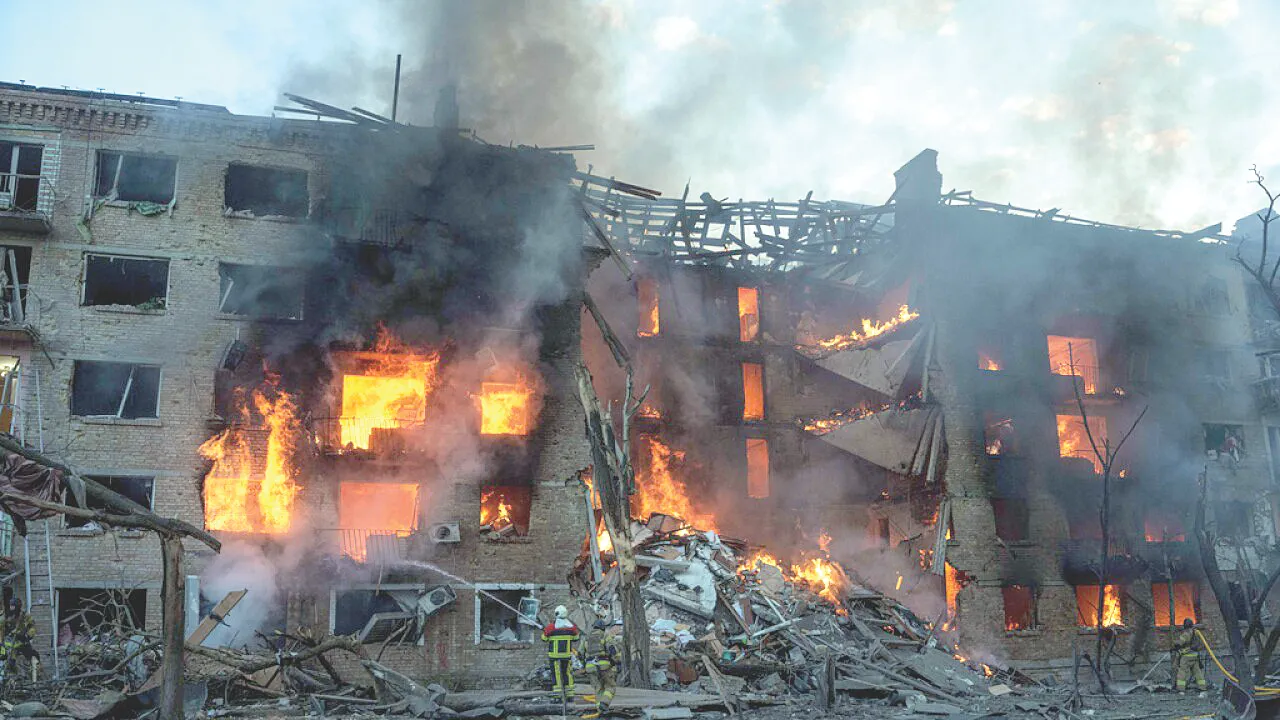
Kyiv, May 24 (AP): Ukrainian President Volodymyr Zelenskyy said Sunday that Russia used the powerful hypersonic Oreshnik ballistic missile during a mass drone and missile attack on Kyiv on Sunday that killed at least two people, marking the third time the weapon has been used in the four-year war.
The intense aerial assault damaged buildings across the Ukrainian capital, including near government offices, residential buildings, schools, and a market, Ukrainian authorities said. At least 83 people were wounded in the attack.
The Oreshnik, which is capable of carrying nuclear or conventional warheads, struck the city of Bila Tserkva in the Kyiv region, Zelenskyy said in a post on Telegram. The target was not immediately clear.
Russia’s Defence Ministry on Sunday confirmed it used the Oreshnik, as well as other missile types, to strike Ukrainian “military command and control facilities,” air bases and military industrial enterprises. It did not specify where the targets were. Ministry officials later told Russian media that no civilian sites were targeted in the overnight strike, the Tass state agency reported on Sunday. In a statement on social media, the ministry said the attack was retaliation for Ukrainian attacks on “civilian facilities on Russian territory,” without immediately giving details.
Russian President Vladimir Putin on Friday denounced a drone strike on a college dormitory in Russian-occupied eastern Ukraine, which Moscow blames on Kyiv, and ordered the Russian military to submit its proposals for retaliation. He said there were no military or law enforcement facilities near the college.
The death toll from the strike in Starobilsk had risen to 21 as search-and-rescue operations closed, the press service of Russia’s Ministry of Emergency Situations said late on Saturday. It said 42 other people had been wounded in the attack the previous night. The Kremlin-installed authorities of the Luhansk region announced two days of mourning on Sunday and Monday to honour the victims.
At a UN Security Council emergency meeting on the strike, held at the request of Russia, Ukrainian Ambassador Andrii Melnyk denied his Russian counterpart’s accusations of war crimes, calling them a “pure propaganda show” and asserting that the May 22 operations “exclusively targeted the Russian war machine.” Ukraine and its allies have accused Russia of routinely targeting civilians and key civilian infrastructure since the early days of the war. The Kremlin denies this. Russia says the Oreshnik is immune to any missile defence system
Russia first used the multiple-warhead Oreshnik on the Ukrainian city of Dnipro in November 2024. It was used a second time in January in the western Lviv region. The latest combined attack included 600 strike drones and 90 air, sea and ground-launched missiles, according to Ukraine’s Air Force. Ukrainian air defences destroyed and jammed 549 drones and 55 missiles. Around 19 missiles failed to reach targets, the Air Force said.
Earlier, Zelenskyy warned that Russia was planning to use the Oreshnik, citing intelligence from the US and Western partners.
Kyiv’s European allies condemned the Russian strikes and use of the Oreshnik.
“Russia hit a dead-end on the battlefield, so it terrorises Ukraine with deliberate strikes on city centres. These are abhorrent acts of terror meant to kill as many civilians as possible,” Kaja Kallas, the European Union’s foreign policy chief, posted on X.
She added that top diplomats from EU states will meet within days to “discuss how to dial up the international pressure on Russia.”
President Vladimir Putin earlier said the Oreshnik, which means “hazelnut tree” in Russian, streaks at 10 times the speed of sound, or Mach 10, and is capable of destroying underground bunkers “three, four or more floors down.”
The weapon travels “like a meteorite” and is immune to any missile defence system, Putin said, adding that several such missiles, even fitted with conventional warheads, could be as devastating as a nuclear strike.
Air raid sirens blared through the night as smoke billowed across the city from strikes. Associated Press reporters heard powerful explosions near the city centre and close to government buildings.