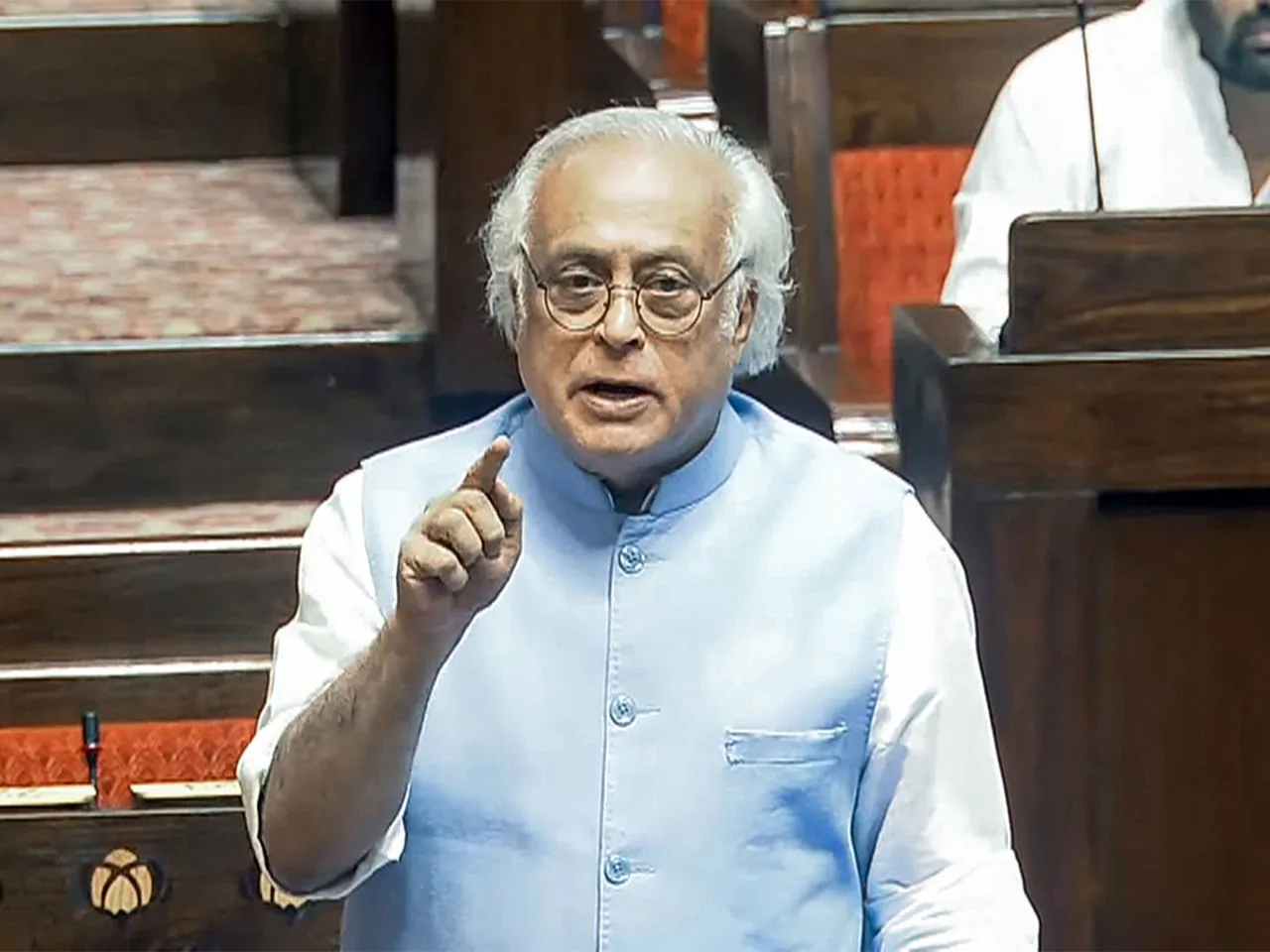
KOZHIKODE (KERALA), MAY 28 (PTI): Senior Congress leader Jairam Ramesh on Thursday said SIR—sustainable, inclusive and rapid development—would be the dominant theme of policymaking in the coming years, irrespective of which party is in power.
Delivering the M P Veerendrakumar Memorial Lecture here, Ramesh said the country would face three major challenges over the next 10 to 15 years, which he termed as SIR, with ‘S’ standing for sustainable development, ‘I’ for inclusive development and ‘R’ for rapid development. He said all three were important, as the country needed economic growth that was environmentally sustainable, inclusive in ensuring benefits reached all sections of society rather than a select few, and rapid enough to create jobs for the seven to eight million Indians entering the labour market every year.
The senior Congress leader said that irrespective of which party was in power at the Centre or in the states, the priority in the coming years would be integrating the environment with development.
“Secondly, we have to create wealth, but ensure that inequalities do not widen. Thirdly, we have to expand the economy to create more and more jobs,” he said.
The AICC general secretary in charge of communications also spoke about his close association with Veerendrakumar and recalled the latter’s contributions.
Ramesh said he first met Veerendrakumar nearly 30 years ago after the latter was sworn in as Union Minister of State for Finance.
At the time, Ramesh was serving as an adviser to then Finance Minister P Chidambaram. “Over the years, till his death, we maintained a very close and cordial relationship,” he said.
Ramesh said that when he and Veerendrakumar became Rajya Sabha MPs, the latter had joked: “You may be Jairam Ramesh MP, but I am M P Veerendrakumar MP. So, I am a double MP, unlike you. That was the kind of person he was,” he recalled.
The Rajya Sabha MP said three aspects stood out in Veerendrakumar’s life, one of them being the socialist tradition to which he dedicated his life.
He said the socialist tradition in India dated back nearly a century and included leaders such as Jayaprakash Narayan, Ram Manohar Lohia and Kamaladevi Chattopadhyay.
“It is said of the socialists that they could not live together for six months and could not live apart for six months.
“So the socialists went through various avatars — the Congress Socialist Party, Socialist Party of India, Praja Socialist Party and others — till George Fernandes formed the Samata Party, which later became the JD, then JD(S) and JD(U). So all the alphabets of the English language were covered by the socialists,” Ramesh said.
However, he said the socialist tradition stood for values rather than power.
“They were invested in people’s struggles. Veerendrakumar represented and exemplified the grand socialist tradition, which is gradually withering away,” he said.
Ramesh said the other two notable aspects of Veerendrakumar’s life were that he represented and celebrated India’s diversity of culture, religion and languages.
He also said this diversity was currently under threat, adding that there was no other country in the world as extraordinarily multi-religious, multilingual, multicultural and multi-ethnic as India.
Referring to nations such as the Soviet Union and Yugoslavia, which no longer exist despite their diversity, Ramesh said India continued to survive because its Constitution not only respected, tolerated and accommodated diversity, but also celebrated it.
“That is also the message of Veerendrakumar’s life,” he added.
A socialist leader, Kumar was a member of the Lok Sabha, the Rajya Sabha, and the Kerala Legislative Assembly. He had also served as Union Minister of State for Finance, Minister of State, Urban Affairs & Employment, as well as a minister in Kerala.