
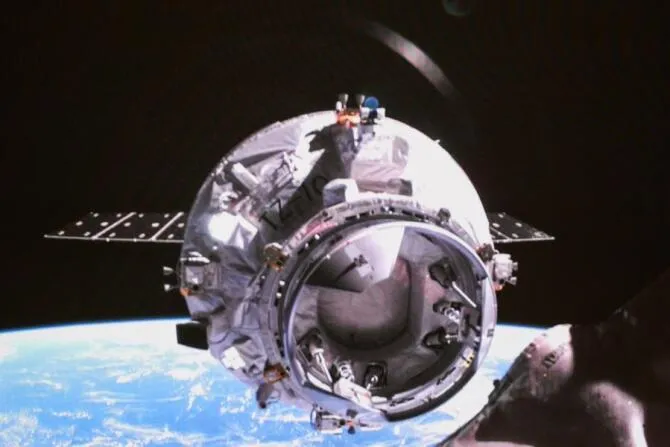
The Chinese Academy of Sciences has announced an amazing and potentially controversial new project to test the development of “artificial human embryos” in space.
What is an artificial human embryo? Well, it’s a collection of human cells arranged to closely mimic an early-stage human embryo, but without the ability to develop into an actual human fetus.
It’s a critical distinction, and one that limits the medical insights they can provide, but it makes them important to research that can be slowed by ethical concerns about experimenting on human cells. These multicellular complexes contain “most” of the cell types found in an embryo at the earliest stages. There are actually two different types of artificial embryos, one representing about two weeks of development, the other about three weeks.
After five days of growth, each of these samples will be frozen and analyzed, both onboard the station and back on Earth. The Chinese Academy of Sciences hasn’t specified when this will occur, meaning it could already have happened. The goal of the experiment is to see how the development of these human analogs compares to that of those grown similarly on Earth. It’s not currently known whether embryonic cells can develop without the directional force of gravity.
Yu Leqian, a professor at the Chinese Academy of Sciences’ Institute of Zoology and head of the project, says that the artificial embryos “were brought to space to explore whether life, which has evolved under gravity for hundreds of millions of years, is affected by its sudden absence.”
The impacts could be minimal or extreme, negative or perhaps positive; in some science fiction, it’s even been predicted that some people will choose to develop or go through certain stages of life in a weightless environment.
Early fetal development could easily be affected by zero-g, which is a concern even for accidental pregnancy in space. While NASA has never confirmed any instances of sex in orbit, there have been multiple married couples that have gone to space, and copious rumors of Soviet “sexperiments” in the early days of the Russian space program. (Yahoo News)
Recent work doesn’t look too optimistic, however, and it’s worth remembering that weightlessness is just one aspect of space that could impact development. One recent study reviewed the data and concluded that space (in particular, its tendency to be highly radioactive) is “inherently hostile” to human life.
Another study found that microgravity caused real problems with sperm motility and fertilization, which could greatly impact the possibility of conception in space.
If it turns out that space does pose significant problems, there could be ways around them. Fetal development could take place in spinning portions of a station, or even in more modest, low-speed centrifuges, while shielding could help to keep them safe from errant cosmic rays.
With private space missions carrying more and more civilians to space every year, however, it seems inevitable that some jet-setting millionaire couple will find a way to test this hypothesis the old-fashioned way. (Yahoo News)