
Staff Reporter
DIMAPUR, JUN 5 (NPN): Dimapur Municipal Council (DMC) has launched a cleanliness programme on the occasion of World Environment Day, which aims to promote scientific waste segregation and management practices beginning at the household level.
Speaking at the launch, DMC Chairperson Hukheto Yepthomi said Ward 3 and Ward 15 were initiated as pilot areas, calling it an important first step towards a cleaner city. He said the success of the project would depend on active support from the public.
He said the response from GBs and residents was encouraging and added that any shortcomings would be corrected together.
Yepthomi said the two wards were selected after discussions with the Dimapur Chamber of Commerce, Traders Federation, GBs, Women Hoho, Student Union, churches and civil society groups.
He reminded citizens that keeping the city clean is not only the government’s duty but everyone’s responsibility. He also expressed concern over blocked drains caused by encroachment and careless waste disposal.
Yepthomi urged people to support youth-led beautification efforts and work together to make Dimapur cleaner and more beautiful in the coming days.
Speaking at the event, recently posted DMC chief executive officer Dr. Kuzonyi Wideo said waste segregation should have started much earlier in Dimapur, but called the present initiative a very good step.
He said Dimapur is not among the cleanest cities and urged everyone to take responsibility for changing this. Wideo said cleanliness is not only the duty of the government but also a personal and social responsibility.
He appealed to auto drivers, traders and citizens to stop littering and expressed hope that Lhomithi Colony would become a model colony.
Sentinuklu Jamir, co-convenor of DMC Sanitation branch, said the new sanitation programme aims to cover all 23 wards and over 97 colonies under the municipality.
In her welcome address, she said waste management begins from every kitchen and household. The programme has started with Ward 15 and Ward 3 as pilot areas and will later be expanded to all colonies.
Jamir urged residents to support the initiative and said small efforts can bring big changes to society.
Atoho L. Yepthomi, GB of Lhomithi Colony ‘B’, assured full support from residents for the DMC sanitation project. He said the colony was happy to be selected and would work to become a model ward by educating people on civic sense and proper waste disposal. The technical session on waste segregation was conducted by Adrian Mahung, waste management consultant, DMC. He explained that waste should not be seen only as something to throw away, but as a resource that can be reused. Mahung said waste segregation has become mandatory from April 1, 2026, under the Solid Waste Management Rules 2026, and violators may face penalties. He explained four waste types: wet, dry, sanitary and hazardous waste. He urged households to separate kitchen waste from plastics. DMC plans to collect wet waste regularly from pilot colonies and support recycling efforts.
He said DMC was introducing an end-to-end waste management model with technical support from NGOs and active public participation. In this regard, Adrian Mahung said DMC wants Lhomithi Colony to become a model colony for others. He said the project also has economic benefits. DMC expects to process about 350 kilograms of wet waste every day, which could produce compost worth around Rs. 5,000 daily.
Mahung informed that waste segregation in Dimapur began in February 2024 in Ward 11, covering Riverbelt Colony and Duncan Colony. He said Riverbelt Colony reached almost 100 percent segregation within two months because residents cooperated well. However, progress was slower in larger colonies. He said DMC plans to use two vehicles for Ward 15 and upcoming projects in Ward 3, including Burma Camp, Mao Colony and Housing Complex. DMC already has 12 compost beds at the municipal dump site, each able to handle 25 tonnes of wet waste. A shredder machine has also been ordered locally through NTTC to speed up compost production.
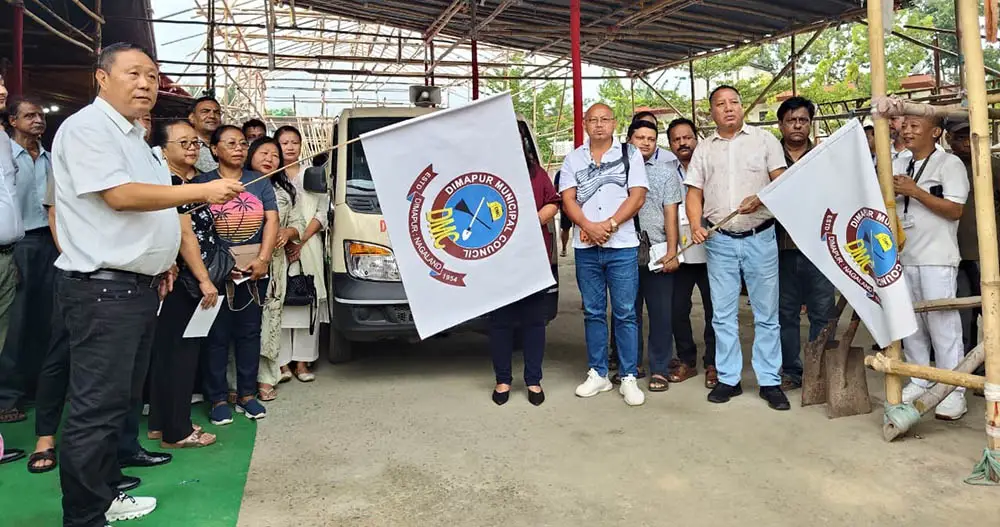
Mahung said public support is the main key to expanding the programme across Dimapur’s 97 colonies and more than 35,000 households. He added that the target is to reduce waste going to dump sites by nearly 80 percent. The programme concluded with the formal flagging off of the Dimapur Waste Segregation & Management initiative by DMC chairperson Hukheto Yepthomi.